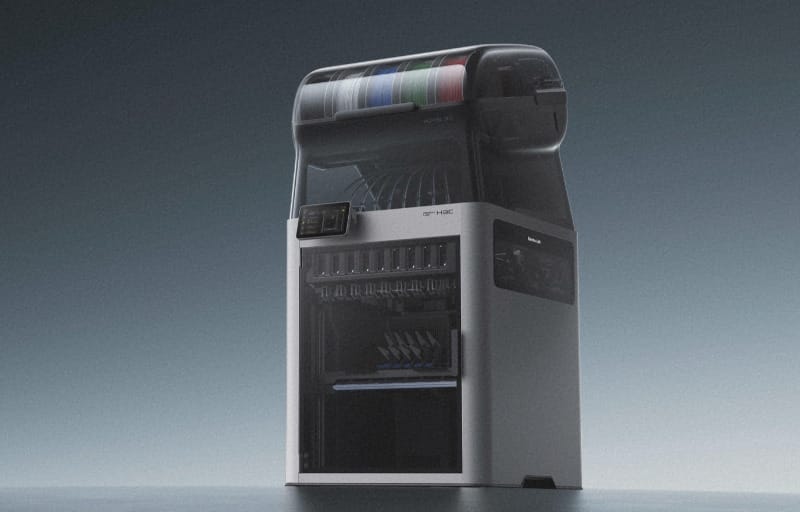
Multicolour 3D printing has always come with a trade-off between speed and waste, and the Bambu H3C is Bambu Lab‘s answer to that compromise. Rather than relying on a single nozzle purging and reloading filament between colours, the H3C uses nine fully independent tools that swap in and out in a matter of seconds. It is the company’s first genuine toolchanger, and it arrives with a few surprises that go well beyond faster colour swaps.
Review summary
Bambu H3C
The Bambu H3C is a nine-tool toolchanger that eliminates purge waste and dramatically speeds up multicolour printing with tool swaps under seven seconds. It supports both 1.75mm and 2.85mm filament in the same machine, handles engineering-grade materials up to 350°C, and delivers excellent print quality across a wide range of applications. The thoughtful design prioritises user accessibility and serious, frequent printing workflows.
Highlights
- ✓Nine independent tools eliminate colour purge waste
- ✓Supports both 1.75mm and 2.85mm filament formats
- ✓Fast tool changes under seven seconds
- ✓Engineering-grade materials capability up to 350°C
- ✓Retracting tool rack and easy-access design
Chief among those surprises is the return of 2.85mm filament, a format that fell out of favour years ago but is finding new life thanks to a wave of interest in 3D-printed footwear and other squishy, flexible designs. The H3C ships ready to handle both 1.75mm and 2.85mm materials, giving makers access to soft TPU prints without needing a second machine. It is an unusual inclusion on a modern printer, yet it fits neatly with the H3C’s broader goal of giving serious makers one machine that can do almost everything.
This review looks at how the H3C is built, what its nine-tool Swaptek system actually brings to the table, and how it performs across a wide range of materials and print styles. From engineering-grade composites to soft wearable TPU, the H3C has been put through a genuinely varied workload, and the results make a strong case for it as one of the most capable multicolour printers Bambu Lab has released.
Table of Contents
Design and Functionality
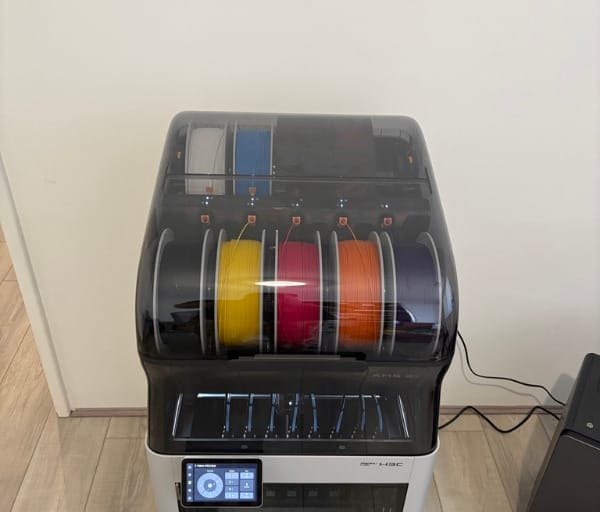
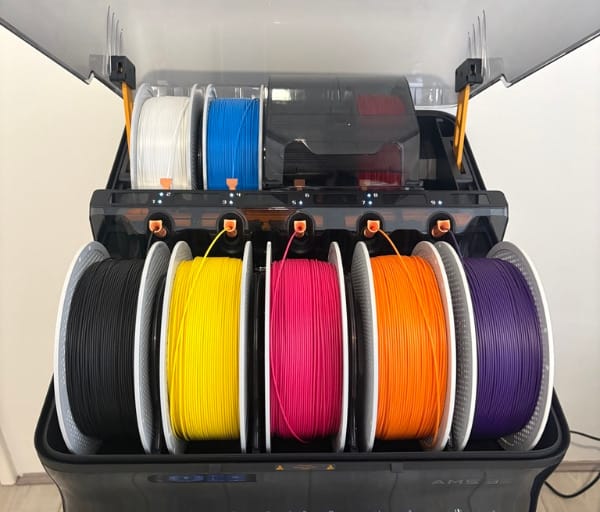
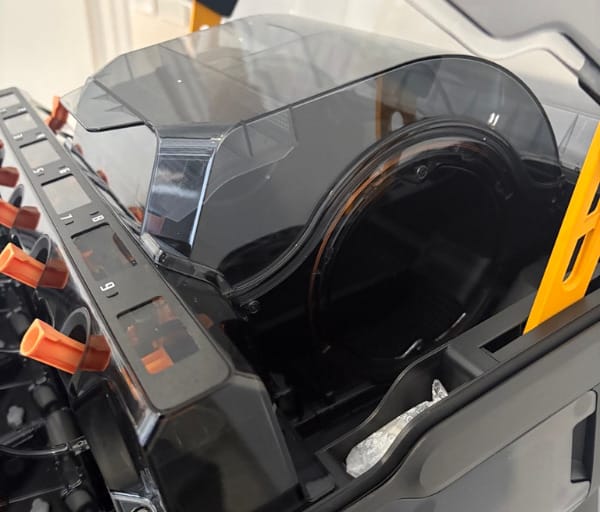
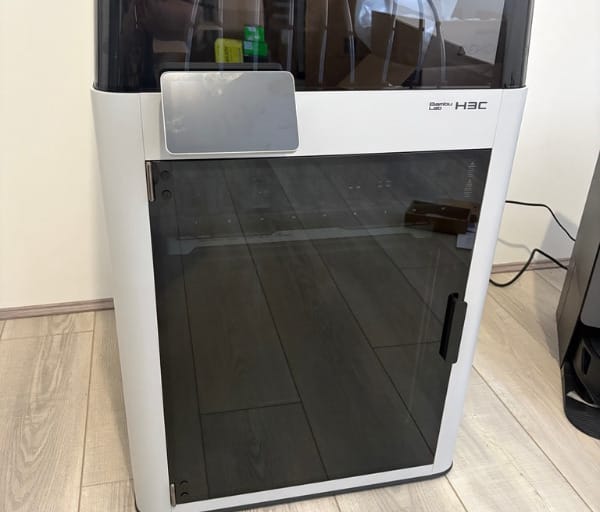
The first thing anyone notices about the H3C is its shape. A nine-slot AMS module sits fixed on top of the main housing, giving the whole unit a tall, almost mushroom-like silhouette finished in Bambu’s familiar light grey panelling. It looks distinctly more premium than earlier Bambu machines, with a clean, purposeful design that signals this is built for serious workloads rather than casual hobby printing.
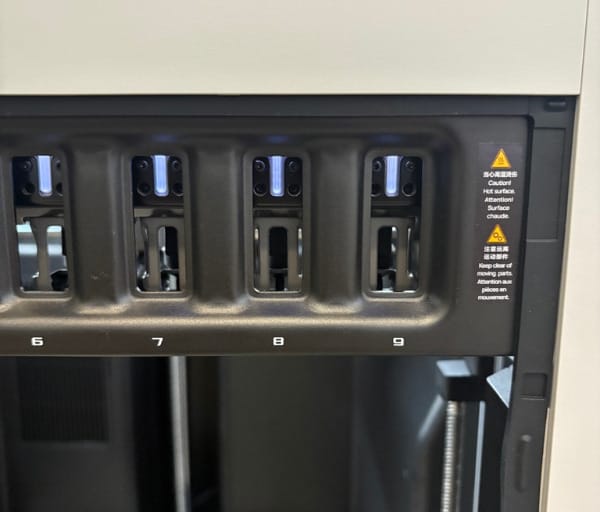
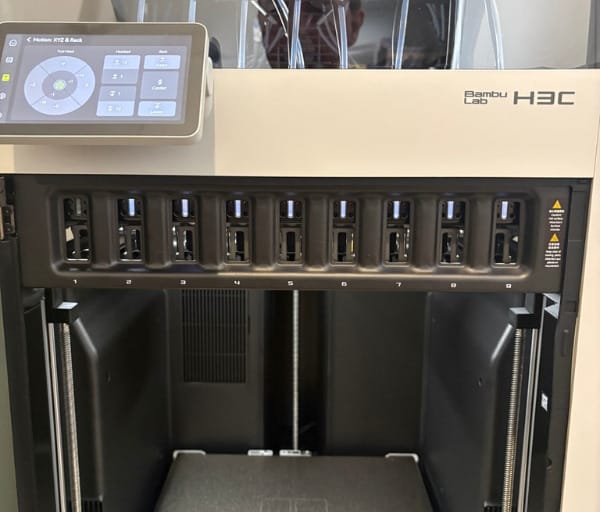
Underneath that striking exterior, Bambu has made some notable engineering changes compared with the H2 series. Where the H2 range used a large aluminium casting to support the motion system, the H3C returns to a sheet-metal frame, a construction method the company has been refining across its recent lineup. Done well, sheet metal can be just as rigid as a casting while keeping manufacturing simpler and more consistent.
The motion system has also been reworked. Instead of a single linear rail carrying the toolhead, the H3C uses two linear rods spaced apart, a layout that can offer excellent stiffness when properly tensioned. Belts remain at 1.5mm, matching Bambu’s other recent machines, so the core motion hardware feels familiar even as the supporting structure has changed.
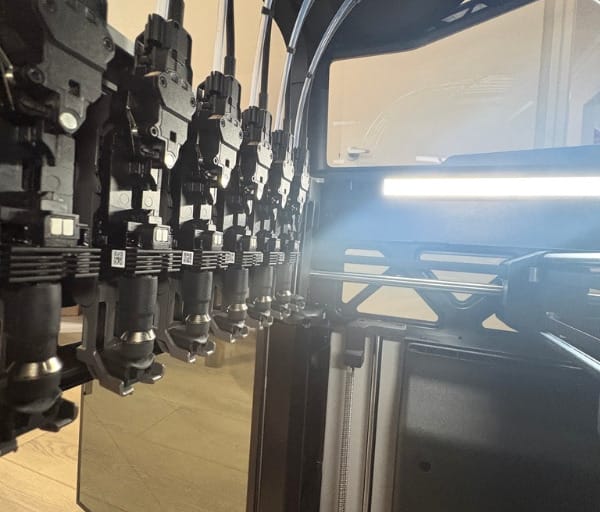
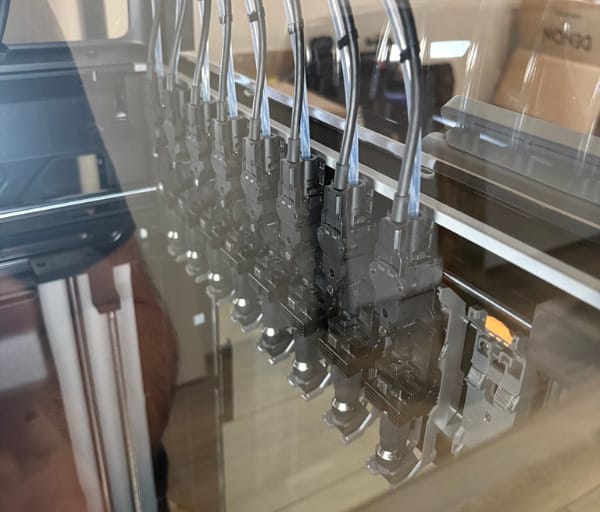
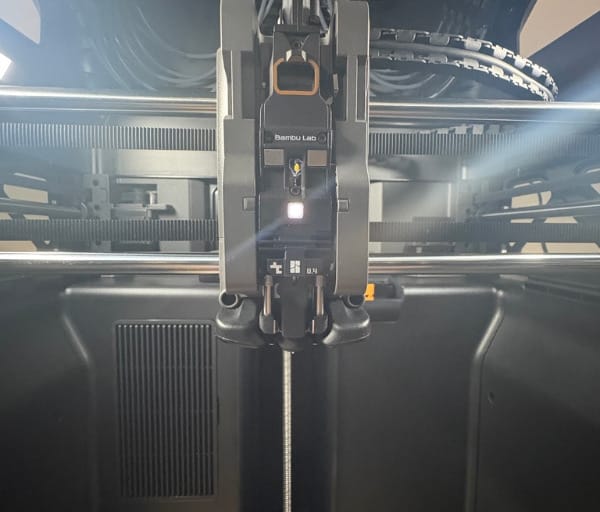
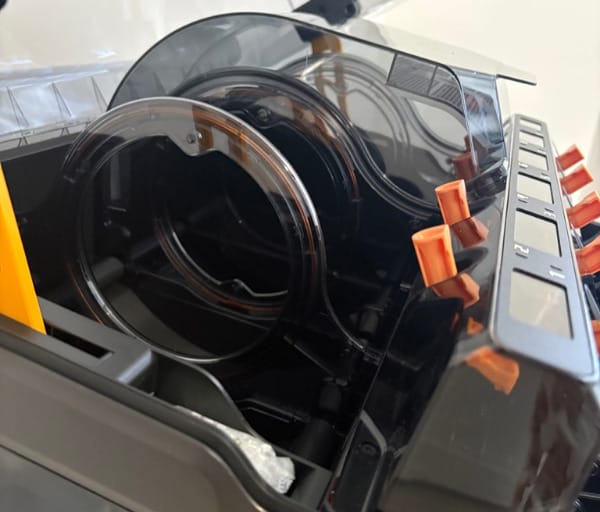
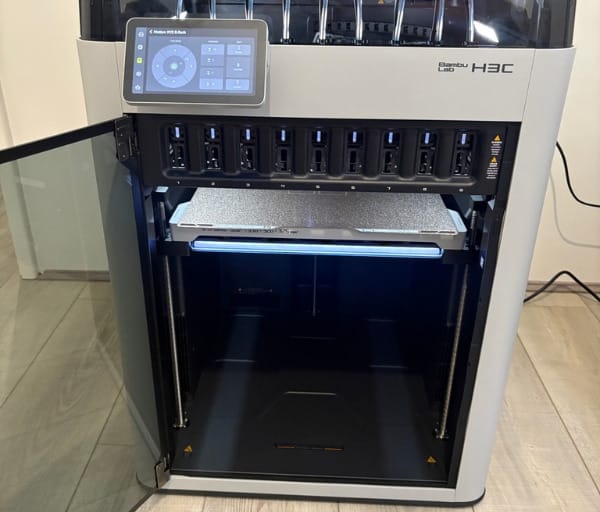
One particularly thoughtful touch is how the tool rack is mounted. Rather than sitting in front of the build plate where it can obstruct the view of early layers, the H3C’s tool rack retracts out of the way once a tool is engaged, giving a clear, unobstructed look at the print in progress. It is a small detail, but it makes watching a print settle in far more satisfying.
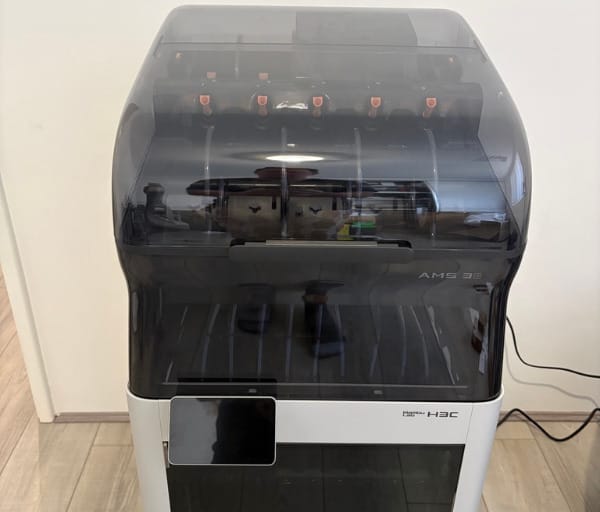
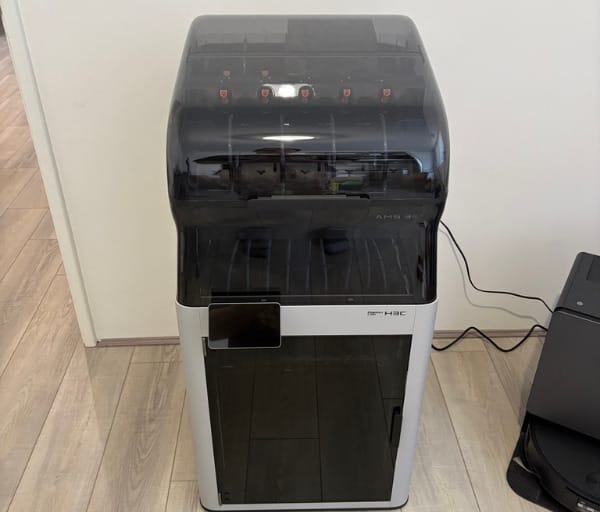
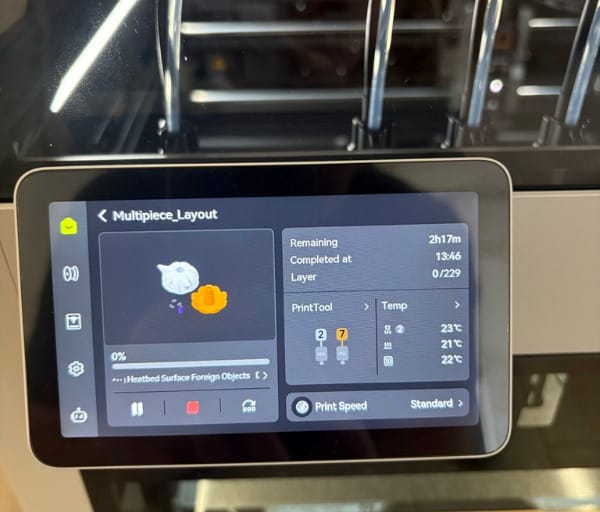
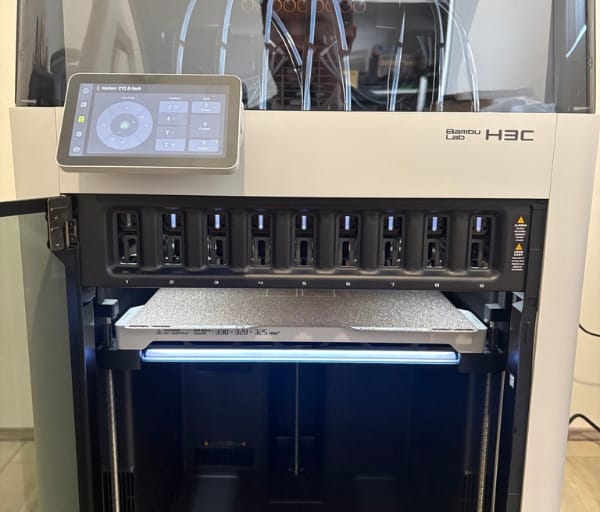
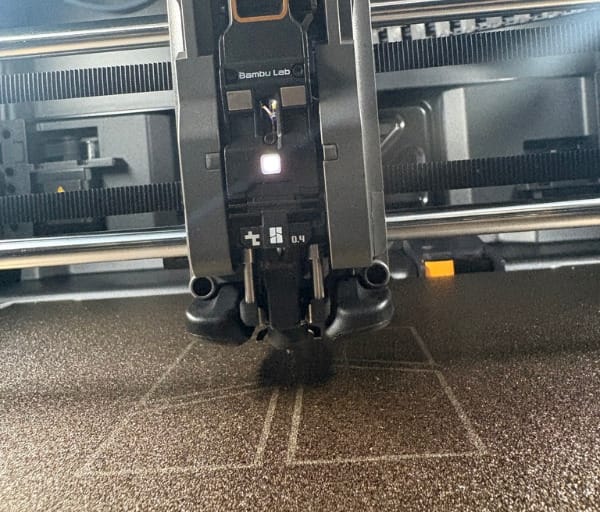
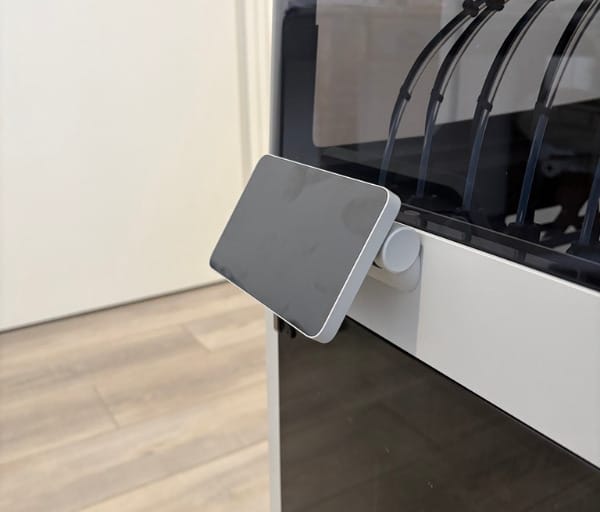
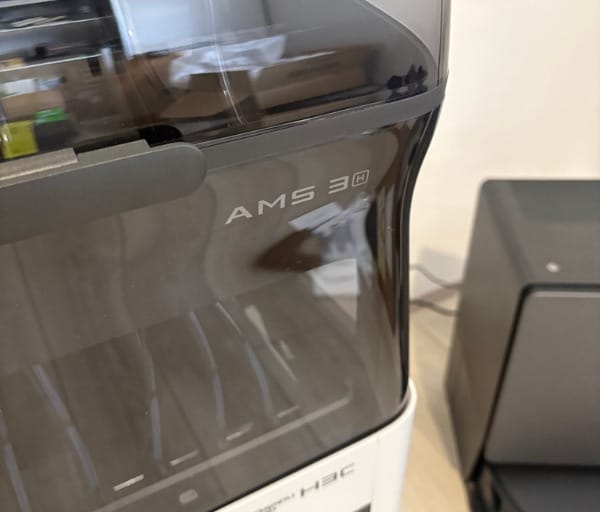
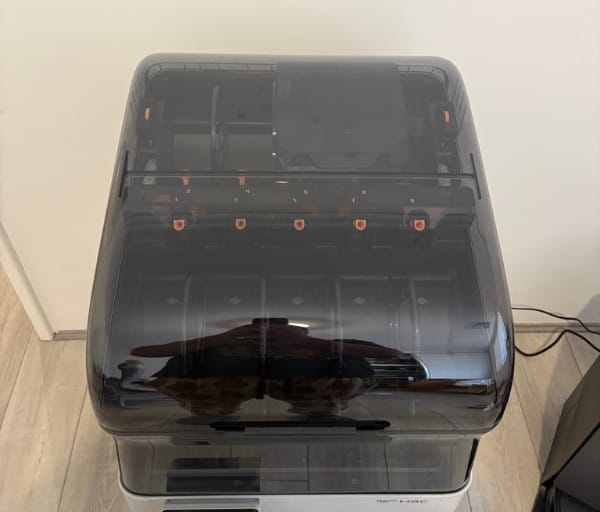
Build volume comes in at 330 x 320 x 325mm, matching the dimensions of the H2C and giving plenty of room for large single-piece prints alongside multicolour work. The printer uses a removable, textured PEI spring steel build plate that heats to 120°C and maintains surprisingly even temperatures across its surface, which helps with first-layer adhesion on tricky materials.
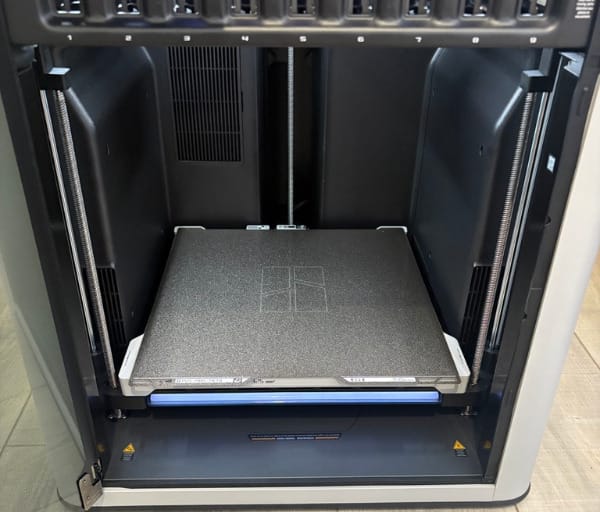
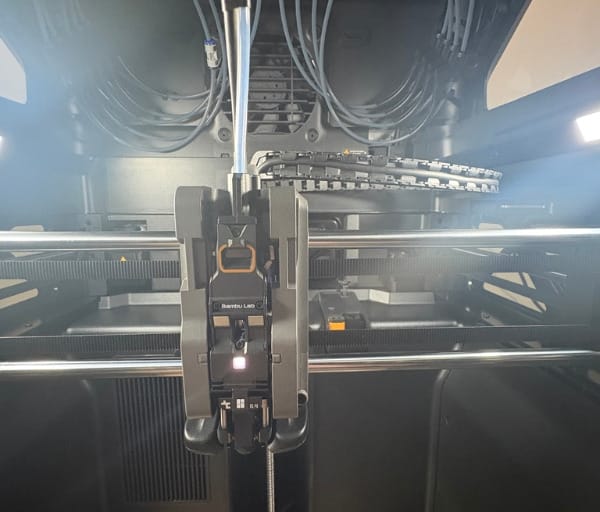
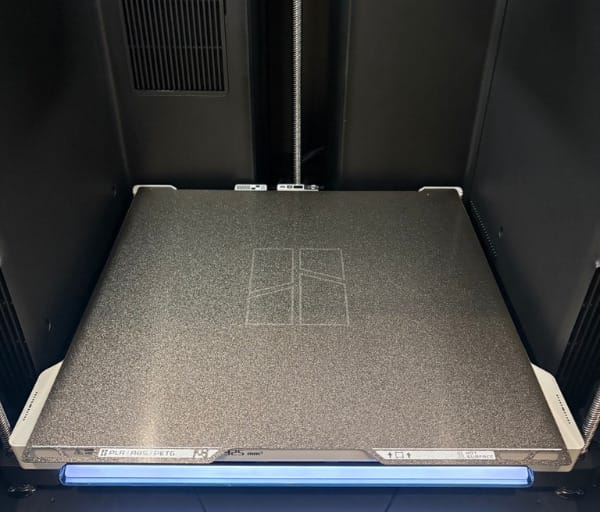
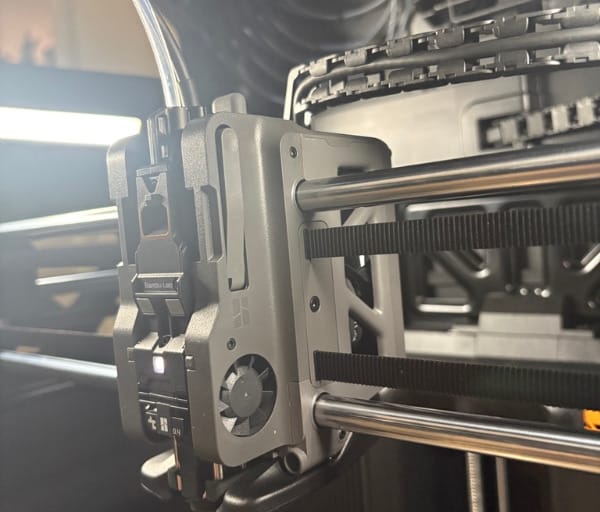
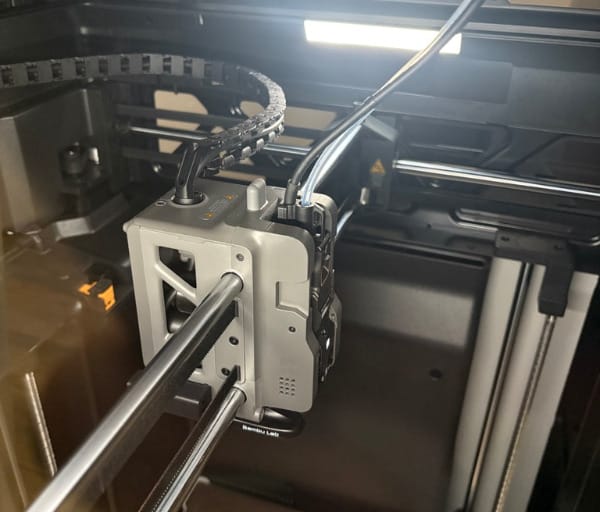
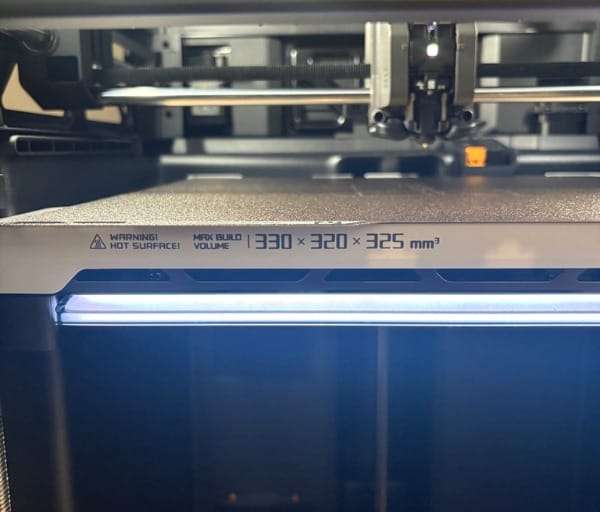
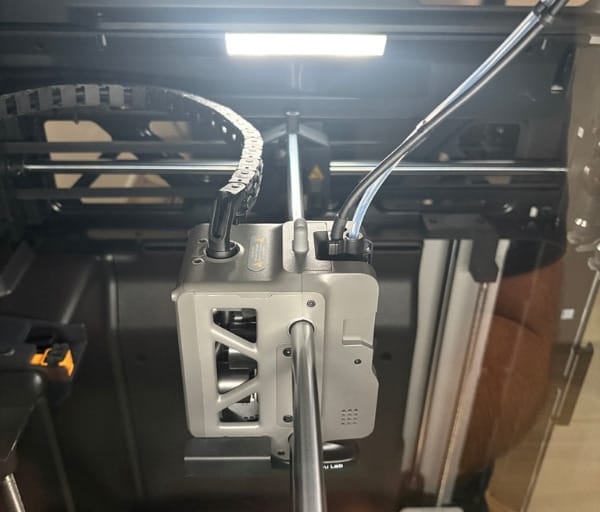
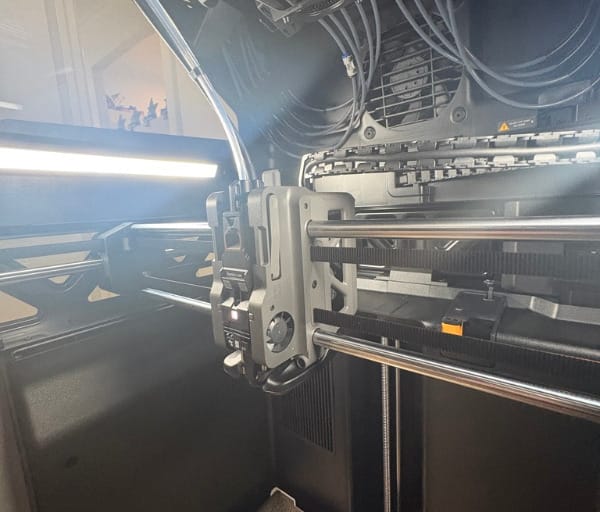
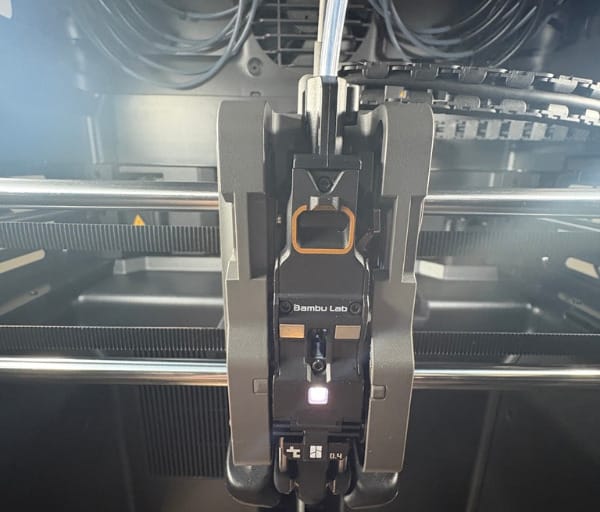
The chamber is actively heated and can reach 65°C in around ten minutes, a genuinely quick warm-up for a fully enclosed space of this size. That heated chamber matters for materials like ABS, ASA, and fibre-reinforced composites, which benefit from a warm, draft-free environment to print reliably without warping or delaminating.
A fully opening glass door makes loading large or awkward prints straightforward, and it seals well enough to maintain that chamber temperature once closed. Combined with the retracting tool rack, the whole front of the machine feels designed around visibility and easy access rather than being an afterthought.
Footprint is sizeable at 493 x 571 x 1016mm, and that height is worth planning around before the H3C arrives. Because the AMS 3H sits on top of the main housing, taller installations may need either a low shelf or, ideally, some floor clearance to make loading spools comfortable rather than a reach-and-stretch exercise.
Bambu Lab clearly anticipated this challenge, because the H3C can be paired with an optional rolling cart called the Bambu Station. It is the first time the company has offered purpose-built furniture for one of its printers, and it is a genuinely useful accessory that brings the spool magazine down to a comfortable, ergonomic height for loading and swapping filament.
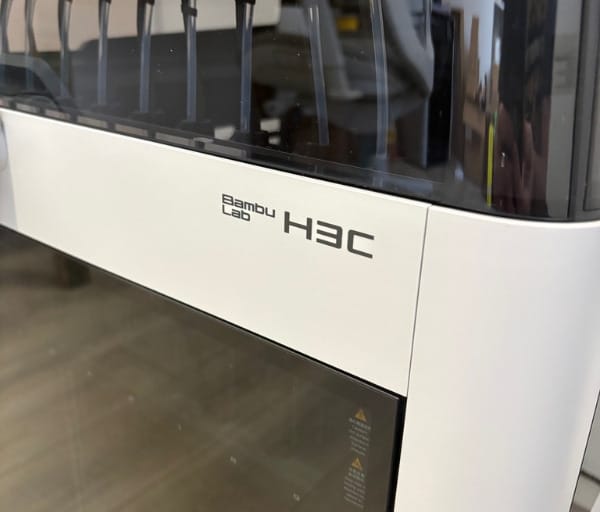
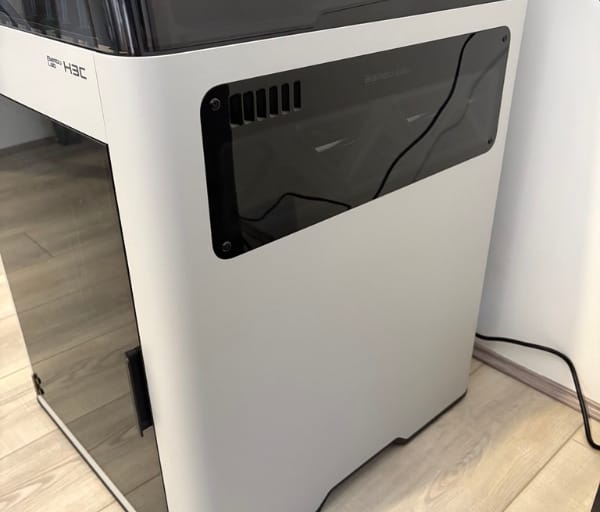
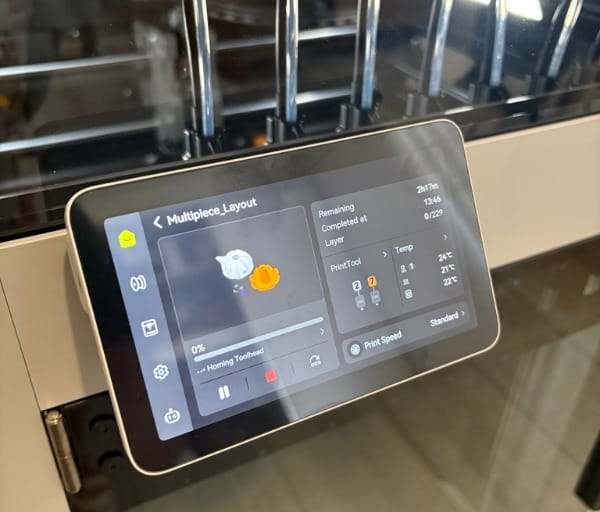
On the front of the machine sits a tilting touchscreen running an updated version of Bambu’s interface, which makes it easy to monitor prints, adjust settings, or queue new jobs without needing a phone or laptop nearby. The tilt angle is a welcome refinement for anyone working at a shelf or bench where the screen might otherwise be awkward to view.
Storage has also had a meaningful upgrade, with 64GB built in as standard. That means timelapses, print files, and logs can be stored directly on the machine without relying on a USB drive, which is a small but genuinely handy quality-of-life improvement for anyone running the H3C regularly.
Connectivity options remain flexible, with support for Bambu’s cloud service for remote monitoring and file transfer, a LAN-only mode for those who want to keep the printer off the wider internet, and a fully offline mode for maximum network isolation. That range of options suits everyone from home makers to schools and small businesses with stricter network policies.
The hotend is rated to handle temperatures up to 350°C, opening the door to a genuinely broad materials list including PLA, TPU, ABS, ASA, PA, PC, PET, PPS, and various fibre-reinforced composites. That range puts the H3C firmly in engineering-grade territory rather than being limited to basic consumer filaments.
Anyone who has used the Bambu Lab H2C will recognise the family resemblance in the H3C’s core structure, though the move to nine fully independent tools is a substantial leap forward from the H2C’s single nozzle-changing approach. The two machines share a build volume, but they solve the multicolour problem in very different ways.
For makers who already run other Bambu machines, the H3C slots neatly alongside printers like the Bambu X2D, sharing software features and workflow conventions that make it easy to add to an existing fleet without a steep learning curve. The consistency across the lineup is one of Bambu’s quiet strengths.
Taken as a whole, the design of the H3C feels like a machine built for people who print often and print seriously, rather than an occasional hobby tool. Every design choice, from the retracting rack to the rolling cart option, points towards a printer meant to be used hard and used often.
Key Features
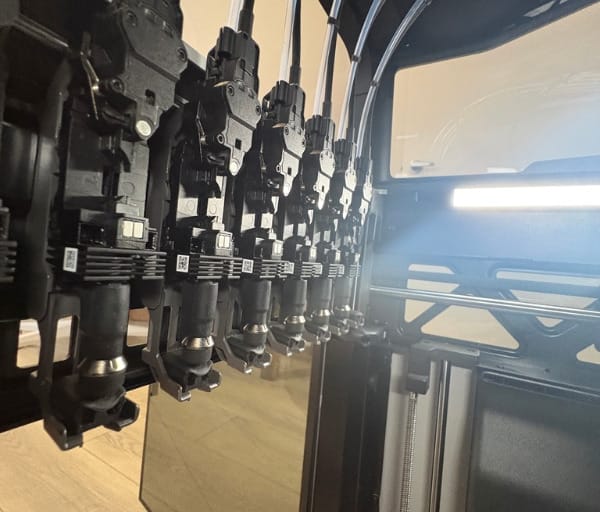
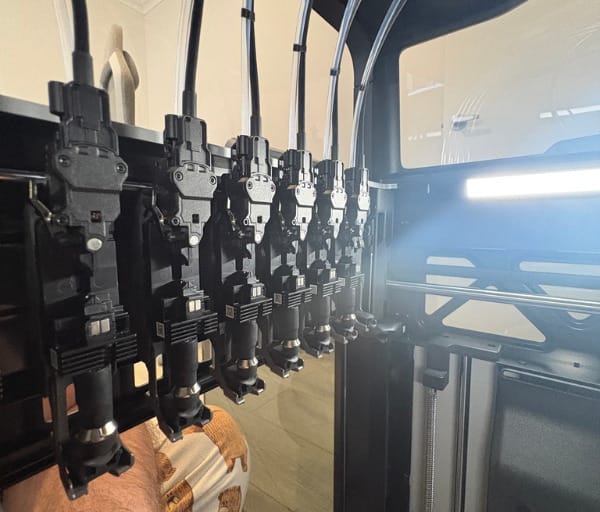
The headline feature is the Swaptek system itself: nine fully independent tools, each with its own heater, dedicated filament path, and hardened steel nozzle. Unlike a traditional single-nozzle multicolour setup, there is no need to purge the old colour out of a shared hotend, because each tool stays loaded and ready at all times.
That design translates directly into speed. Tool changes on the H3C take well under seven seconds, a dramatic improvement over the loading and unloading cycles required by earlier Bambu multicolour systems. For a complex nine-colour print, that difference adds up to genuinely significant time savings over the course of a long job.
Perhaps the most unexpected feature is support for 2.85mm filament alongside the usual 1.75mm. This older filament diameter has found new relevance thanks to the popularity of 3D-printed footwear and other soft, flexible designs made with squishy TPU, and the H3C ships with one dedicated 2.85mm tool as standard.
Because the H3C supports both filament diameters in the same machine, makers are not forced to choose between standard engineering filaments and soft 2.85mm TPU. The printer comes with eight 1.75mm tools and one 2.85mm tool by default, with additional tools available separately for anyone who wants a different configuration.
Handling two filament diameters reliably comes down to the FlexFeed extruder mounted on the toolhead, which automatically adjusts to push either standard 1.75mm filament or the thicker 2.85mm material without manual recalibration. It is the kind of feature that works quietly in the background but makes the whole multi-diameter concept actually usable day to day.
Each tool uses a .4mm hardened steel nozzle rated at HRC 55+, held in place with three screws and simple enough to swap for a different size when needed. Because the H3C can mix nozzle sizes across its tools, individual slots can be dedicated to 0.2mm detail work, 0.6mm, or 0.8mm high-flow printing depending on what a project calls for.
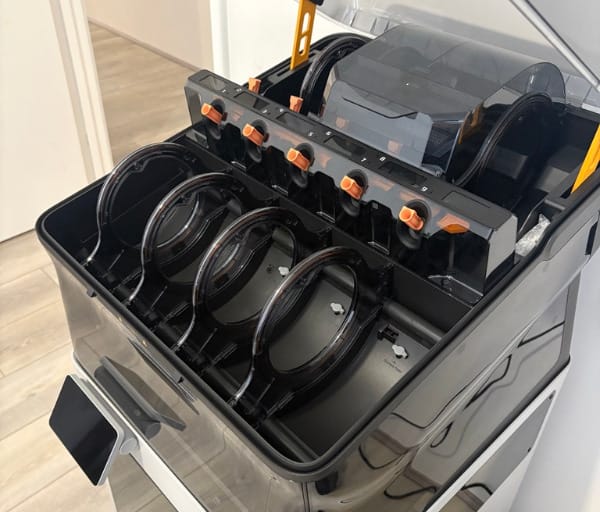
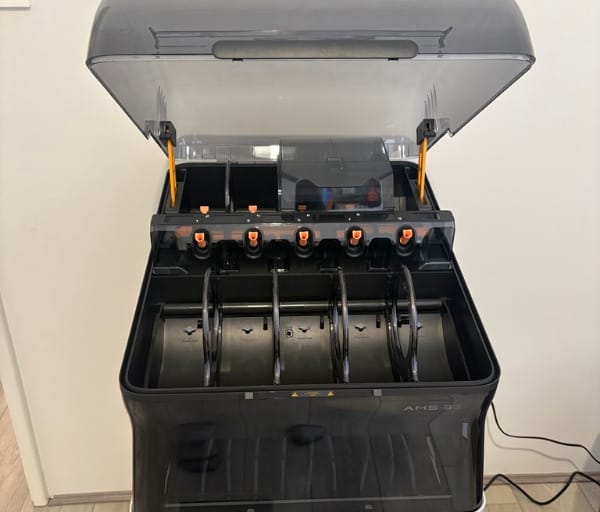
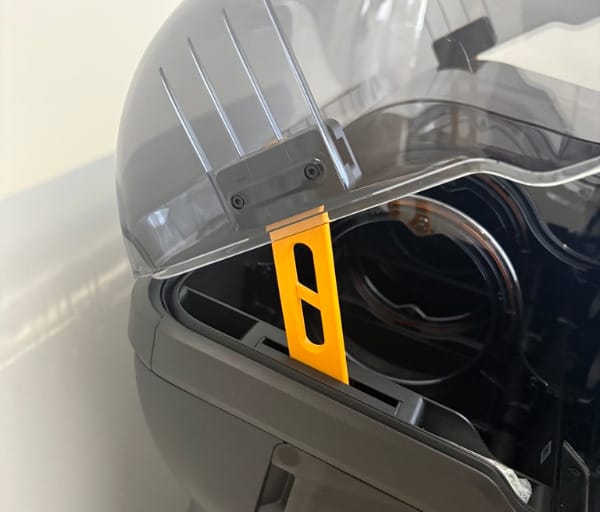
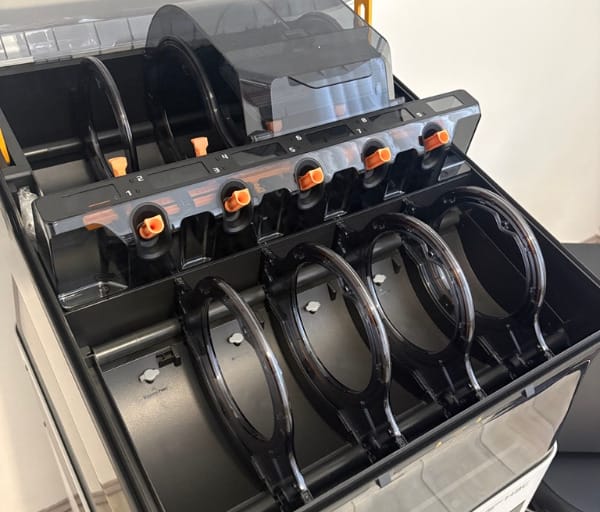
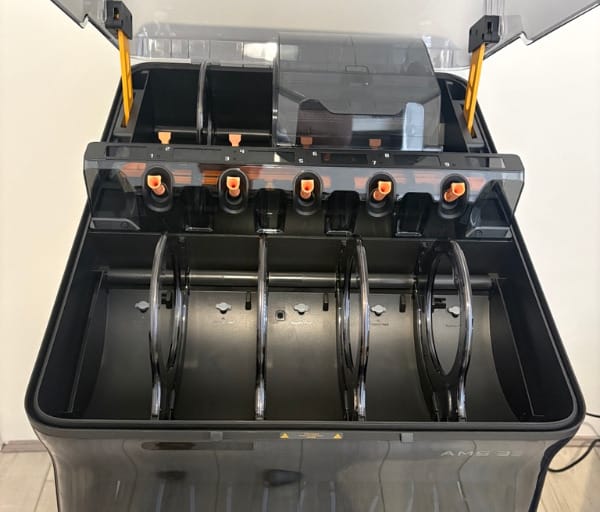
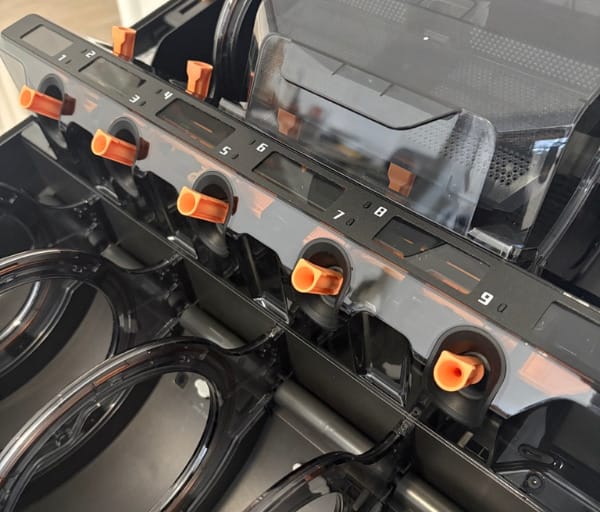
The AMS 3H magazine sitting on top of the printer houses all nine tools and spools, and because tool changers do not need to retract filament the way single-nozzle systems do, the module skips motorised rollers entirely. That simplifies the mechanism and removes one more potential point of failure from the system.
Seven of the nine slots include a TPU bypass, a feature first seen on Bambu’s single-spool AMS HT, which lets soft, stretchy filaments skip rollers that might otherwise cause jams. It is a small inclusion that makes a real difference when working with genuinely soft TPU rather than firmer filaments.
Two of the nine slots sit inside their own interior drying chamber, capable of reaching 85°C with its own dedicated power supply. That means filament can be actively dried while the printer is running a job, without needing to pause a print or dedicate separate downtime to moisture control.
For makers who want more than nine colours in a single print, the H3C can be expanded with up to four additional standard AMS units via an optional buffer accessory. The trade-off is that external units route through the fifth tool slot, which means giving up some of the purge-free benefit that makes the native nine-tool setup so efficient, though the option remains there for anyone who needs it.
Looking ahead, Bambu Lab has flagged a lineup of additional tools for the H3C platform including cutting, drawing, embossing, and foil transfer heads, broadening the machine well beyond standard FDM printing. These creative tools echo the kind of expandability already seen on the Bambu Lab H2D and H2D Laser Combo, suggesting Bambu is building a consistent ecosystem of accessories across its higher-end machines.
A related software update allows nozzle sizes to be mixed within a single print job, a feature shared across the H2D, H2C, and Bambu X2D family. For the H3C, that means a workflow where one tool handles fine detail work while another handles bulk infill at a larger nozzle size, all within the same automated print.
In the box, the H3C comes with a full toolkit, the cables needed for assembly, a handful of spare parts, and preloaded files including instructions for building a scraper from the included components. Quick start guides are provided for both the base printer and the AMS 3H module, making initial setup straightforward even for a machine this feature-dense.
From a sustainability standpoint, the dedicated filament path per tool significantly reduces purge waste compared with conventional single-nozzle multicolour printing. For schools, studios, and businesses conscious of filament waste, that efficiency is a genuine practical benefit rather than a marketing line.
Experience Using the Product and Performance
Setting up the H3C for the first time is a reminder of just how much hardware is packed into this machine. Between the main printer body and the AMS 3H magazine, assembly takes a little longer than Bambu’s simpler single-tool printers, though the included quick start guides make the process clear and methodical rather than overwhelming.
Finding a spot for the H3C is worth thinking through before it arrives. Its height means a standard kitchen bench or desk shelf may not leave enough clearance above for comfortable spool loading, and taller installations benefit enormously from either extra ceiling height or, better still, the optional Bambu Station cart.
Once the Bambu Station is in play, loading and swapping spools across all nine slots becomes a genuinely pleasant task rather than an awkward reach. Rolling the whole unit to a comfortable working height removes the one real ergonomic hurdle this printer presents and is well worth considering for anyone setting the H3C up long term.
First prints off the H3C make the speed advantage of the Swaptek system obvious immediately. Multicolour test prints that would typically involve long pauses for purging and reloading on a single-nozzle machine instead move through colour changes in a matter of seconds, keeping overall print times remarkably close to what a single-colour job would take.
Colour transitions themselves look clean, with minimal bleed between shades and very little waste material generated at each swap. For anyone who has battled with purge towers and wasted filament on conventional AMS setups, the difference the H3C makes to both print time and material efficiency is immediately noticeable.
Running a nine-colour test model, with each of the nine tools assigned its own filament, highlighted how well the system scales. Rather than slowing down as more colours are added, the H3C handles complex colour maps with the same confidence as a two or three colour job, because every tool stays preheated and ready.
Switching to engineering filaments, the heated chamber reaching 65°C within around ten minutes made a genuine difference to prints using ABS and ASA. Warping that can plague these materials on unheated or slow-to-heat chambers was far less of an issue here, with corners and edges staying flat and true.
Fibre-reinforced composites were also tested, taking full advantage of the hotend’s 350°C ceiling. Prints using carbon fibre reinforced nylon came out with crisp detail and strong layer adhesion, suggesting the H3C is well suited to functional, load-bearing parts rather than purely decorative models.
The standout experience, though, came from testing the 2.85mm TPU capability with a soft 75A filament. Printing flexible, cushioned designs like shoe soles produced genuinely comfortable, squishable results, and the dedicated 2.85mm tool handled the thicker filament without the feeding issues that can plague flexible materials on standard setups.
The FlexFeed extruder deserves credit here, smoothly switching between standard 1.75mm PLA jobs and the thicker 2.85mm TPU without requiring any manual recalibration between prints. That seamless handling is what makes mixing filament diameters on one machine practical rather than just a novelty.
Testing the TPU bypass slots confirmed their value, with soft filament feeding consistently rather than catching on rollers designed for stiffer materials. Running TPU through one of the seven bypass-equipped slots produced noticeably more reliable extrusion than forcing a similarly soft filament through a standard roller-based AMS slot.
The built-in dryer slots were put through their paces with a spool of PA CF, a material that benefits enormously from being kept dry before and during printing. Running the dryer at 85°C while the printer worked on an unrelated job elsewhere in the AMS caused no detectable heat bleed into the rest of the chamber, keeping nearby PLA spools unaffected.
Measuring actual tool-change speed during a long multicolour print consistently landed at well under seven seconds per swap, matching Bambu’s own figures closely. Over a print involving dozens of colour changes, that speed advantage compounds into a meaningfully shorter total print time compared with older single-nozzle AMS systems.
Print quality across standard PLA and PETG jobs was excellent, with fine layer lines, accurate dimensions, and strong first-layer adhesion thanks to the evenly heated PEI bed. Detailed models with fine text and small features came out sharp, suggesting the dual linear rod motion system holds up well under real-world conditions.
Noise levels during operation were reasonable for a machine of this size and complexity, with the enclosed chamber helping to dampen sound during longer jobs. It is not silent, particularly during tool changes, but it sits comfortably in line with expectations for a printer built around this much moving hardware.
The tilting touchscreen made a genuine difference to day-to-day use, especially when the printer was placed at a height where a fixed screen might otherwise be awkward to view. Being able to angle the display towards eye level made checking on long multicolour jobs far more convenient.
Using the Bambu Handy app alongside the cloud connection gave remote visibility into prints from another room, including live camera feeds and progress updates. For anyone running the H3C for business or classroom use, that remote monitoring capability is genuinely useful rather than a gimmick.
Switching the printer to LAN-only mode for a period of testing showed that local network printing works just as smoothly as the cloud option, without any noticeable lag in sending files or receiving status updates. That flexibility means privacy-conscious users are not giving up convenience to stay off the cloud.
Loading filament across all nine AMS slots during testing highlighted just how intuitive Bambu’s spool detection and filament profile system has become. Each spool was recognised automatically, with settings populated correctly without manual input, which matters a great deal when managing nine different materials at once.
Maintenance tasks, including nozzle swaps using the three-screw mounting system, were straightforward and quick. Changing a nozzle size on an individual tool took only a couple of minutes, making it realistic to reconfigure the H3C for a specific project without a lengthy downtime.
Material efficiency over an extended multicolour print run was noticeably better than on a conventional single-nozzle AMS machine. With each tool keeping its own filament loaded and ready, purge waste that would normally accumulate during colour-heavy prints was dramatically reduced across every test run.
Running a direct comparison against the Bambu Lab H2C on a similar multicolour model demonstrated just how much faster the Swaptek approach is than the H2C’s nozzle-changing method. Both machines produced clean results, but the H3C completed the job considerably faster thanks to its always-ready tools.
For classroom and STEM-style projects, the ability to run nine distinct materials or colours at once without constant supervision makes the H3C well suited to educational environments where students might be working on varied multi-part assemblies simultaneously. Reliability over repeated jobs stayed consistent across testing.
Functional multi-material parts, combining a rigid structural filament with a soft TPU section in the same print, came out well, with clean transitions between materials and no delamination at the material boundary. That kind of hybrid part is exactly the use case the nine-tool system seems designed for.
Comparing the experience to the dual-nozzle approach used on the Bambu X2D, the H3C’s toolchanger clearly favours makers who want many colours or materials available simultaneously, while the X2D’s twin-nozzle setup suits those focused more on combining just two materials with maximum reliability. Both approaches have their place depending on the kind of work planned.
Long print jobs spanning many hours ran without any dropped tool changes or missed colour swaps during testing, which matters enormously for anyone planning overnight or unattended multicolour prints. Confidence in a machine completing a complex job without intervention is one of the most valuable things a toolchanger can offer.



Cleaning and general upkeep of the nine tools proved manageable, with each one accessible individually rather than needing to dismantle a single shared hotend assembly. That modularity means a single tool can be serviced or swapped without taking the entire printer offline.
Ergonomically, once paired with the Bambu Station cart, day-to-day interaction with the H3C felt no more demanding than operating any of Bambu’s other AMS-equipped machines, despite the added complexity of nine independent tools working behind the scenes. Most of that complexity stays invisible to the user.
Across every material tested, from basic PLA through to fibre-reinforced nylon and soft TPU, the H3C handled transitions between jobs with minimal setup time between prints. Reconfiguring tools for a new project rarely took more than a few minutes thanks to the accessible nozzle mounting system.
Testing the expandability option by connecting an additional standard AMS unit through the optional buffer worked as described, extending the available colour count well beyond nine for anyone with particularly ambitious multicolour projects in mind. The trade-off in purge efficiency for that fifth-slot route felt like a reasonable compromise given the added flexibility.
By the end of extended testing, the H3C had proven itself capable across an unusually wide spread of use cases, from fast multicolour decorative prints to demanding engineering parts and soft wearable TPU designs. Few printers at this level manage to cover that much ground convincingly, and the H3C does so while keeping the workflow approachable.
Conclusion
The Bambu H3C stands out as one of the most capable multicolour 3D printers Bambu Lab has released, and the nine-tool Swaptek system is the clear star of the show. Fast, low-waste colour changes combined with genuine multi-material flexibility make it a compelling option for anyone who regularly works across different filaments and colours.
The return of 2.85mm filament support adds a genuinely unexpected dimension, opening the door to soft, flexible TPU projects like footwear alongside the usual engineering-grade materials the hotend can handle up to 350°C. Few printers manage to bridge that gap between rigid structural parts and squishy flexible designs as comfortably as the H3C does.
Thoughtful design touches, from the retracting tool rack to the optional Bambu Station cart that solves the machine’s height challenge, show a level of consideration that goes beyond simply packing in more hardware. Bambu has clearly thought through how people will actually use a machine this tall and this capable.
For makers, educators, and small businesses who need serious multicolour and multi-material capability without the usual purge waste and downtime, the H3C earns a strong recommendation. It brings together speed, material versatility, and genuine ease of use in a way that few toolchangers on the market currently match.
Frequently asked questions
How many filament diameters does the Bambu H3C support?
The H3C supports both 1.75mm and 2.85mm filament in the same machine. It ships with eight 1.75mm tools and one 2.85mm tool as standard, with additional tools available separately for different configurations.
Does the Bambu H3C need the optional Bambu Station cart?
It is not required, but it is strongly recommended. Because the AMS 3H magazine sits on top of an already tall machine, the rolling Bambu Station brings the spool slots down to a comfortable loading height, particularly useful where bench or shelf clearance is limited.
Can the Bambu H3C print engineering-grade materials as well as flexible TPU?
Yes. The hotend is rated up to 350°C and supports PLA, TPU, ABS, ASA, PA, PC, PET, PPS, and fibre-reinforced composites, while the dedicated 2.85mm tool and bypass-equipped AMS slots handle soft TPU filament reliably.
How does the H3C compare to the Bambu Lab H2C?
The H2C uses a nozzle-changing system where filament has to be unloaded and reloaded from the AMS between colours, which takes longer. The H3C’s nine fully independent tools stay preheated and loaded, allowing colour changes in under seven seconds with far less waste.