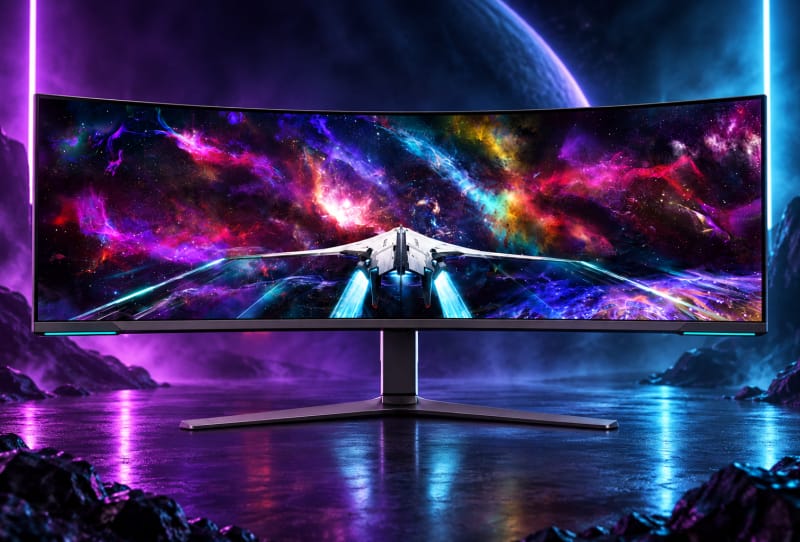
The Samsung Odyssey G9 monitor remains one of the most distinctive ultrawide gaming displays on the market, pairing a 49-inch curved QD-OLED panel with Dual QHD resolution and a 240Hz refresh rate. Years after its debut, the G93SC model still holds its own against newer rivals, thanks to a combination of screen size, panel technology, and smart features that few competitors match in one package.
Key takeaways
- ✓The Samsung Odyssey G9 G93SC uses a 49-inch curved QD-OLED panel with 1000R curvature.
- ✓It runs at Dual QHD resolution (5120×1440) with a 240Hz refresh rate and 0.03ms response time.
- ✓The panel carries DisplayHDR True Black 400 certification for deep contrast in dark scenes.
- ✓It includes a matte anti-glare coating, height-adjustable stand, and built-in smart TV features.
- ✓The monitor competes with newer OLED ultrawides from AOC, Gigabyte, and Acer in the same category.
Samsung built the Odyssey G9 around a single curved panel instead of multiple monitors stitched together, which gives players an uninterrupted field of view stretching across a 32:9 aspect ratio. At 5120×1440 pixels, it offers the same vertical resolution as a standard QHD monitor but roughly double the horizontal width, effectively replicating a dual-monitor setup on one seamless screen.
Table of Contents
What makes the Samsung Odyssey G9 monitor stand out
The headline feature is the QD-OLED panel itself. Unlike traditional LCD panels that rely on backlighting, OLED pixels emit their own light, which allows for near-instant pixel response times and genuinely deep blacks. Samsung rates the Odyssey G9 at 0.03ms response time, a figure that virtually eliminates visible motion blur during fast-paced gaming.
Curvature is another defining trait. The panel uses a tight 1000R curve, meaning it matches the curvature of a circle with a 1000mm radius. That is aggressive even by curved-monitor standards, and it is designed to keep every part of the screen roughly equidistant from the viewer’s eyes, which reduces distortion at the edges of such a wide display.
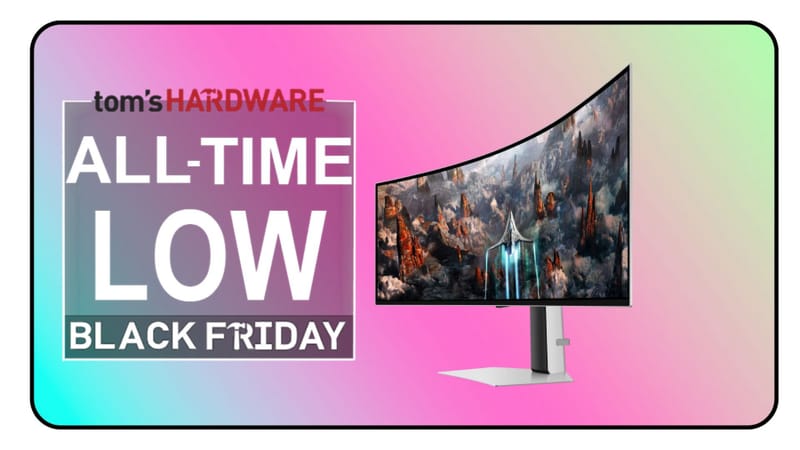
Samsung also added a matte coating to cut down on glare, a sensible decision given how reflective glossy OLED panels can be under bright room lighting. Combined with a height-adjustable stand and built-in speakers, the Odyssey G9 is pitched as a complete desktop solution rather than just a screen that needs a separate stand or soundbar.
Key specifications of the Odyssey G9 G93SC
The table below summarises the core specifications that define this monitor’s place in the ultrawide OLED category.
| Specification | Detail |
|---|---|
| Panel type | 49-inch curved QD-OLED |
| Resolution | 5120 x 1440 (Dual QHD) |
| Refresh rate | 240Hz |
| Response time | 0.03ms (GtG) |
| Curvature | 1000R |
| HDR certification | DisplayHDR True Black 400 |
| Aspect ratio | 32:9 |
| Connectivity | USB-C (90W), HDMI, DisplayPort |
That DisplayHDR True Black 400 certification matters because it is specifically designed for OLED and other self-emissive panels, with strict black-level requirements that LCD-based HDR tiers do not need to meet. In practice, that translates to genuinely inky shadows in dark game scenes rather than the washed-out greys common on lower-tier HDR monitors.
How it compares with rivals in the OLED gaming space
Samsung was an early mover in bringing QD-OLED technology to gaming monitors, but the field has grown considerably more competitive since the Odyssey G9 first launched. Acer, AOC, and Gigabyte have all released their own large-format OLED gaming displays, some pushing refresh rates and panel technology even further.
Acer’s own QD-OLED gaming monitor targets a similar 240Hz WQHD experience in a more conventional flat format, while AOC’s own flagship OLED gaming monitor has pushed brightness higher on its panel generation. Meanwhile, Gigabyte’s five-layer OLED panel technology demonstrates how quickly refresh rates are climbing across the category, with some newer panels reaching 320Hz.
Where the Odyssey G9 still holds a clear edge is sheer immersion. None of the single-panel rivals mentioned match its 49-inch, 32:9 footprint, which remains a genuinely different proposition to a 27 or 34-inch ultrawide. For simulation racing, flight sims, and open-world titles that benefit from peripheral vision, that width is hard to replicate with a smaller screen.
Who the Odyssey G9 suits, and what to weigh up
Buyers considering a 49-inch curved OLED monitor should think carefully about desk space and viewing distance, since a panel this wide needs enough depth to sit comfortably in a user’s field of view. It also demands a graphics card capable of pushing 5120×1440 pixels at high frame rates, meaning a mid-range GPU will struggle to exploit the full 240Hz ceiling in demanding titles.
For competitive shooters, a narrower, faster panel might still suit some players better, and the earlier guide on choosing the best gaming monitor for competitive play covers that trade-off in more depth. For single-player, simulation, and creative multitasking use, though, the Odyssey G9’s scale and OLED contrast remain difficult to beat, which explains why it continues to show up in discussions about the best ultrawide gaming monitors well after its original release.
Samsung’s continued support for the Odyssey gaming monitor lineup suggests the G9 series will keep evolving, even as rivals close the gap on refresh rate and brightness. For now, the original Dual QHD Odyssey G9 remains a benchmark for what a single ultrawide OLED panel can deliver.
Frequently asked questions
What resolution does the Samsung Odyssey G9 monitor support?
The Odyssey G9 G93SC runs at 5120 x 1440, known as Dual QHD, giving it the vertical height of a standard QHD monitor stretched across a 32:9 ultrawide canvas.
Is the Samsung Odyssey G9 monitor good for competitive gaming?
Its 240Hz refresh rate and 0.03ms response time suit fast-paced games well, though its 49-inch curved format is generally better suited to immersive single-player and simulation titles than tightly competitive esports play, where smaller flat panels are often preferred.
Does the Odyssey G9 use the same panel as other OLED monitors on the market?
It uses a QD-OLED panel, a technology also found in rival monitors from brands such as Acer and AOC, though Samsung’s curvature and 49-inch size remain distinct from most single-panel competitors.
What graphics card is needed to get the most out of the Odyssey G9?
Reaching the monitor’s full 240Hz refresh rate at its native 5120×1440 resolution typically requires a high-end graphics card, since the pixel count is substantially higher than a standard 1440p display.