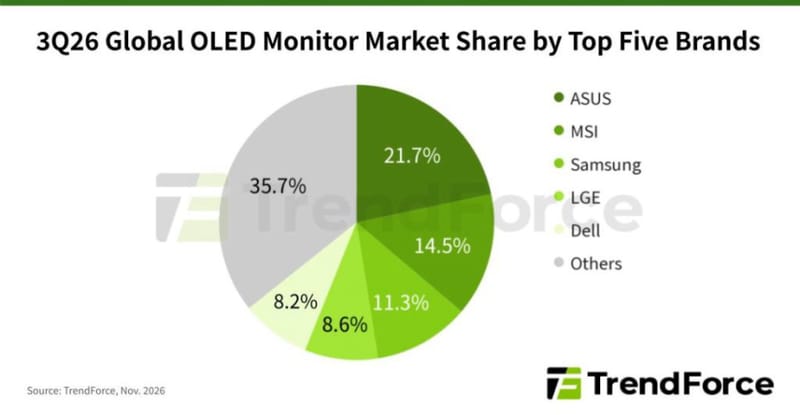
Global OLED monitor shipments doubled year-on-year in the third quarter of 2026, and MSI used that growth to leapfrog Samsung into second place behind market leader Asus, according to new figures from TrendForce. It marks the first time MSI has outranked Samsung in the category, and it comes as shipments across the whole sector rose 13% quarter-on-quarter.
Key takeaways
- ✓Global OLED monitor shipments doubled year-on-year and grew 13% quarter-on-quarter in Q3 2026
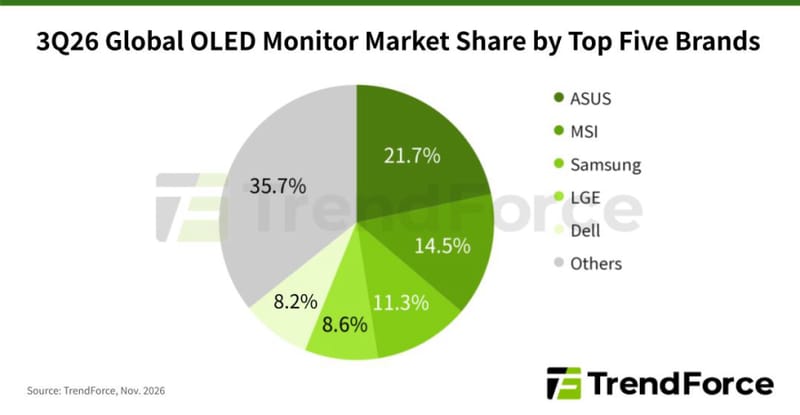
- ✓Asus held the top spot with a 21.7% market share, up 6% quarter-on-quarter
- ✓MSI rose 1.7 percentage points to 14.5% share, pushing Samsung into third place
- ✓Samsung's share sat at 11.3% despite steady shipments, with a Q4 push expected
- ✓LG and Dell rounded out the top five with 8.6% and 8.2% shares respectively
The numbers paint a picture of a market that is still expanding fast, but also one where the gap between the smaller players is closing. Asus remains comfortably in front, yet the fight for second and third place has become genuinely competitive for the first time since OLED monitors became mainstream.
Table of Contents
Asus keeps the top spot as OLED monitor shipments climb
Asus finished Q3 2026 with a 21.7% share of the global OLED monitor market, growing its shipments by 6% compared with the previous quarter. TrendForce credits that gain to improving supply of its own 27-inch QHD 540Hz OLED monitors, which had previously been constrained by panel availability.
Asus also benefited from a run of new products released to mark the company’s 20th anniversary, giving it fresh models to push through retail channels just as demand for high refresh-rate screens kept climbing. Holding onto the top spot while shipments across the market doubled is no small feat, and it shows Asus has kept pace with a segment that is growing far faster than monitors as a whole.
MSI’s rise pushes Samsung into third
MSI added 1.7 percentage points to reach a 14.5% share, enough to overtake Samsung for the first time. TrendForce notes that MSI’s cumulative shipments across the first three quarters of 2026 are now running roughly level with Samsung’s, which suggests the gap could widen further before the year is out rather than close again.
Samsung ended the quarter with an 11.3% share. Its shipment volumes stayed fairly steady through the year, but steady was not enough while its own high-refresh Odyssey OLED lineup faced sharper competition from rivals launching new panels at a faster clip. TrendForce expects Samsung to push harder in the fourth quarter, particularly across Europe and North America, as it tries to claw back second place during the holiday shopping period.
| Rank | Brand | Q3 2026 market share | Quarterly change |
|---|---|---|---|
| 1 | Asus | 21.7% | +6% shipments QoQ |
| 2 | MSI | 14.5% | +1.7 points share |
| 3 | Samsung | 11.3% | Stable shipments |
| 4 | LG | 8.6% | Climbed from lower rank |
| 5 | Dell | 8.2% | Entered top five |
LG and Dell round out a tighter top five
LG climbed to fourth place with an 8.6% share, aided by promotions on its 27-inch QHD 240Hz OLED monitors. That is a notable result for a brand that also supplies panels to several of its rivals through LG Display, giving it leverage on both the manufacturing and retail sides of the business.
Dell moved into fifth with an 8.2% share, driven by strong sales of mainstream 27-inch QHD 240Hz displays alongside a 39-inch ultrawide model it launched earlier in the year. Together, LG and Dell’s results show that OLED monitor shipments are no longer just a story about gaming brands chasing the highest refresh rate. Mainstream and productivity-leaning buyers are now a meaningful part of the growth too, with competitors such as brighter OLED panels from rivals like AOC adding further pressure further down the rankings.
Why the OLED monitor market is growing so quickly
TrendForce attributes the overall surge largely to improved panel availability. Supply constraints that limited OLED monitor shipments in earlier years have eased, letting smaller vendors expand output and letting established brands fill in cheaper tiers they previously could not reach.
That broader availability is also encouraging diversification beyond OLED itself. Asus and others continue to chase higher refresh rates on OLED panels, but Mini LED backlighting remains a serious alternative for buyers who want brightness and resolution over raw speed. KTC, for instance, is reportedly preparing the M32P2 ahead of CES 2027, a 31.5-inch monitor pairing a 6K IPS panel with a 2,304-zone Mini LED backlight aimed squarely at content creators and productivity users rather than gamers chasing refresh rate records.
That kind of product shows the wider display market splitting into clearer lanes. OLED increasingly owns the high-refresh gaming conversation, while Mini LED IPS panels are carving out space among buyers who care more about colour accuracy and screen real estate than motion clarity.
What the shake-up means for monitor buyers
For shoppers, a more competitive OLED monitor market tends to mean faster model refreshes and more aggressive pricing, since brands fighting for the same shelf space rarely stand still for long. MSI’s rise and Samsung’s expected Q4 response both point to a segment where no single challenger brand can afford to coast.
It also suggests that OLED monitor shipments will keep climbing into 2027, with more brands entering at more price points rather than the category staying a premium niche. Buyers weighing an OLED upgrade now have a genuinely wider field to choose from than they did even a year ago, and that competition is likely to keep benefiting anyone shopping for a new screen over the next few quarters.
Frequently asked questions
Why did MSI overtake Samsung in OLED monitor shipments?
TrendForce points to improved OLED panel availability during Q3 2026, which let MSI expand shipments faster than Samsung, whose volumes stayed relatively flat over the same period.
Will Samsung regain second place in OLED monitors?
TrendForce expects Samsung to push shipments more aggressively in the fourth quarter, particularly in Europe and North America, as it tries to win back the position MSI took in Q3.
Which brand leads the global OLED monitor market?
Asus remains the market leader with a 21.7% share in Q3 2026, helped by its 27-inch QHD 540Hz OLED monitors and a run of 20th anniversary product launches.
Are Mini LED monitors replacing OLED?
Not directly. Mini LED panels, such as the upcoming KTC M32P2 shown ahead of CES 2027, are aimed more at content creators and productivity users, while OLED continues to lead the high-refresh gaming segment.