T-Mobile has started selling a 5Gbps home fiber plan for $90 a month in the United States, a price it says undercuts several rivals offering similar multi-gigabit speeds. The new tier, which went on sale from November 3, also comes with a 10-year price guarantee, meaning customers who sign up now should not see that monthly rate rise for a decade.
Key takeaways
- ✓T-Mobile's 5 Gig fiber plan costs $90 a month and went on sale from November 3
- ✓The plan comes with a 10-year price guarantee locking in that rate
- ✓It arrives about a year after T-Mobile officially launched its fiber business
- ✓T-Mobile says the price undercuts some rival multi-gigabit fiber offers
- ✓The service is US-only, but reflects a wider global push toward multi-gig home fiber
The launch arrives roughly a year after T-Mobile officially entered the fiber broadband market, a notable shift for a company best known as a mobile carrier. The T-Mobile’s official fiber internet page lists the 5 Gig plan alongside its existing slower tiers, positioning the new option as the fastest residential internet product the company currently sells.
Table of Contents
What the T-Mobile 5 Gig fiber plan actually offers
At its core, the T-Mobile 5 Gig fiber plan promises download and upload speeds of up to 5,000Mbps, delivered over a fiber-optic connection rather than the fixed wireless technology T-Mobile is better known for in its home internet business. That distinction matters because fiber connections generally offer more consistent speeds and lower latency than wireless alternatives, particularly for households running multiple high-bandwidth devices at once.
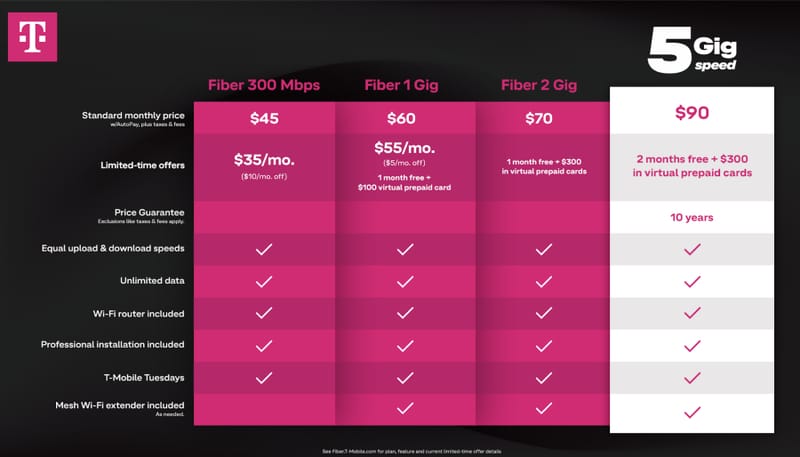
The 10-year price guarantee is arguably the more interesting part of the announcement. Broadband providers have a well-documented habit of hiking prices after an introductory period ends, so a decade-long lock is a significant commitment if T-Mobile honours it as described. It also fits the company’s broader “price guarantee” marketing approach, which it has leaned on across its mobile plans for years.
The table below summarises the key details of the new plan as announced.
| Detail | T-Mobile 5 Gig fiber plan |
|---|---|
| Download/upload speed | Up to 5,000Mbps |
| Monthly price | $90 (USD) |
| Price guarantee | 10 years |
| On-sale date | November 3 |
| Fiber business launched | Approximately one year earlier |
Why T-Mobile is pushing hard into fiber
T-Mobile’s move into fiber broadband is a deliberate diversification play. Cable and traditional telco providers have dominated US home internet for decades, and T-Mobile has spent recent years chipping away at that market first with fixed wireless home internet, which uses its mobile network rather than physical cables. Fiber lets it compete more directly in dense urban and suburban markets where wireless capacity can be constrained.
Pricing the 5 Gig tier below some competing multi-gigabit offers is a classic disruption tactic, one T-Mobile has used repeatedly in its mobile business under its self-styled “Un-carrier” banner. By pairing an aggressive price with a long-term guarantee, the company is clearly trying to pull customers away from cable incumbents that have historically relied on promotional pricing followed by steep increases.
It is worth remembering that fiber availability still depends heavily on physical infrastructure being built out street by street, so even an attractive plan like this one will only be accessible in the specific neighbourhoods T-Mobile’s fiber network, built in part through partnerships with regional fiber providers, actually reaches.
What it means for Australian readers
T-Mobile’s fiber service is a US-only product, so this particular plan has no direct equivalent on offer locally. Australian households shopping for fast home internet remain tied to the National Broadband Network, where the fastest widely available residential tiers typically top out well below 5Gbps for most providers, though some NBN retailers have begun trialling higher-speed fibre tiers in select areas.
Even so, the announcement is a useful signal of where the broader broadband market is heading. As multi-gigabit fiber becomes cheaper and more common overseas, pressure tends to build on local providers to eventually match those speeds and price points. Readers researching home networking upgrades, including 10-Gig WAN mesh routers already arriving in Australia, will notice that hardware capable of handling multi-gigabit speeds is already on local shelves, even if the matching internet plans are not yet widely available.
For anyone juggling fixed-line and mobile connectivity, it is also a reminder that carriers increasingly see broadband as a bundle rather than a single product. Devices such as mobile hotspots built for faster, more flexible connectivity show how the line between mobile and fixed internet keeps blurring, a trend T-Mobile’s fiber push only reinforces. The same logic applies to households and small businesses focused on keeping home and business networks reliably online, since faster upstream speeds make tasks like cloud backups and remote access noticeably quicker.
Frequently asked questions
Is the T-Mobile 5 Gig fiber plan available in Australia?
No. T-Mobile’s fiber service, including this 5 Gig plan, is only available to customers in select areas of the United States where its fiber network has been built out.
What does the 10-year price guarantee actually cover?
It means T-Mobile has committed to keeping the monthly price for the 5 Gig plan at $90 for customers who sign up, for a full decade, rather than raising it after an introductory period.
How fast is a 5Gbps internet connection in practice?
A 5,000Mbps connection is far beyond what most households need day to day, but it offers significant headroom for multiple simultaneous 4K streams, large file transfers, and fast cloud backups without congestion.
Does Australia have anything similar to T-Mobile’s fiber plans?
Australian home internet runs through the National Broadband Network rather than a telco-built fiber network like T-Mobile’s, and most widely available residential plans currently offer lower maximum speeds than this new US tier.