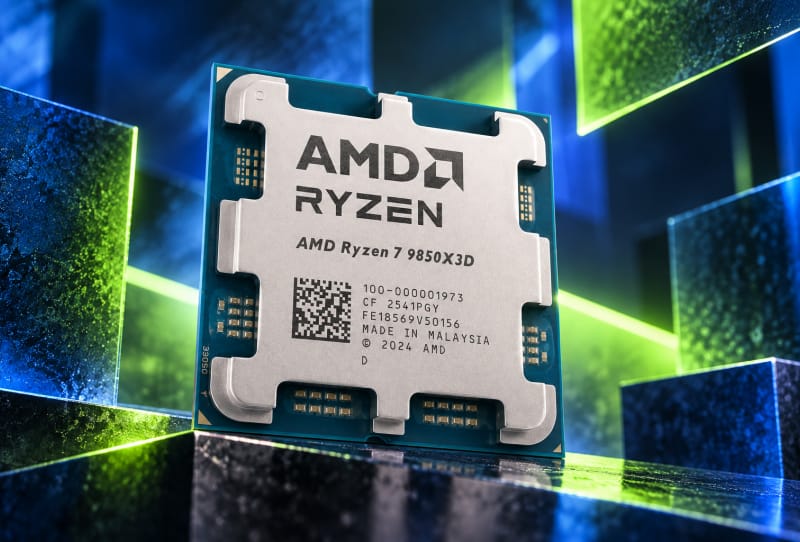
The AMD Ryzen 9850X3D has settled in as a direct companion to the Ryzen 7 9800X3D, giving PC builders two near-identical routes to AMD’s fastest gaming processor design. Both chips lean on the same 3D V-Cache technology that has made AMD’s X3D family the benchmark for gaming performance since it first appeared in 2022, and AMD now effectively treats the pair as equally strong picks for anyone assembling a gaming rig on the AM5 platform.
Key takeaways
- ✓The AMD Ryzen 9850X3D now stands alongside the Ryzen 7 9800X3D as one of AMD's top gaming processors.
- ✓Both chips use AMD's 3D V-Cache design, stacking extra cache directly onto the CPU die to boost gaming frame rates.
- ✓The Ryzen 7 9800X3D pairs 8 cores and 16 threads with 96MB of total cache on the AM5 platform.
- ✓AMD's X3D lineup also includes the 12-core Ryzen 9 9900X3D and 16-core Ryzen 9 9950X3D for heavier workloads.
- ✓The two chips give builders flexibility without forcing a compromise on gaming performance.
That matters because the Ryzen 7 9800X3D has spent more than a year as the chip reviewers reach for when gaming frame rates are the only thing that counts. Having the Ryzen 9850X3D sitting at the same tier removes any reason to hesitate between the two, whether a shopper finds one or the other in stock at a given retailer.
Table of Contents
Why the AMD Ryzen 9850X3D matters for gamers
Most CPUs chase higher clock speeds or more cores to win benchmarks. AMD’s X3D chips take a different route, stacking extra cache directly on top of the processor die so the core can pull data from nearby memory far faster than it could from system RAM. That extra cache, known as 3D V-Cache, is especially valuable in games, where frame rates often hinge on how quickly the CPU can feed data to the graphics card rather than on raw clock speed.
The Ryzen 7 9800X3D already demonstrated how effective this approach can be, consistently topping gaming charts against rivals with higher core counts or clock speeds. The Ryzen 9850X3D carries the same fundamental idea into a second SKU, reinforcing that AMD sees 3D V-Cache, not raw specifications on a spec sheet, as the deciding factor for gaming performance.
How the Ryzen 7 9800X3D stacks up against the rest of AMD’s X3D family
AMD’s current X3D lineup spans several tiers, from the 8-core gaming specialist up to 16-core chips aimed at creators who also want strong gaming results. The table below lays out where the Ryzen 7 9800X3D sits relative to its bigger siblings.
| Processor | Cores / Threads | Total Cache | Primary Use Case |
|---|---|---|---|
| Ryzen 7 9800X3D | 8 / 16 | 96MB | Dedicated gaming performance |
| Ryzen 9 9900X3D | 12 / 24 | 140MB | Gaming plus heavier multitasking |
| Ryzen 9 9950X3D | 16 / 32 | 144MB | Gaming plus content creation |
The Ryzen 7 9800X3D remains the sweet spot for players who have no interest in rendering video or compiling code between matches. Its 96MB of total cache and AM5 socket support mean it slots into the same motherboards as AMD’s higher-tier chips, so builders are not locked into a particular platform depending on which X3D model they choose.
What the two-chip approach means for builders and buyers
Having the Ryzen 9850X3D positioned alongside the Ryzen 7 9800X3D gives system builders more breathing room. Prebuilt vendors already lean on the 9800X3D in flagship gaming machines, including prebuilt systems pairing a Ryzen 7 9800X3D with an RTX 5080, and a second equally capable SKU means supply constraints on one chip no longer force a compromise on the other.
It also arrives at a moment when AMD is fighting to hold ground in the desktop CPU market. Recent figures point to AMD’s broader desktop CPU standing against Intel slipping slightly, which makes a strong, clearly communicated gaming flagship more important than ever. A buyer who understands that both the 9800X3D and 9850X3D deliver the same class of gaming performance is less likely to shop elsewhere out of confusion over which model to pick.
For existing AM5 owners, the news sits alongside other platform momentum from AMD, including AMD’s recent push for official Ryzen overclocking on Linux and continued chatter about AMD’s rumoured next-generation Siren Halo silicon. Together, these signal a company still actively supporting and expanding the AM5 ecosystem rather than rushing everyone toward a new socket.
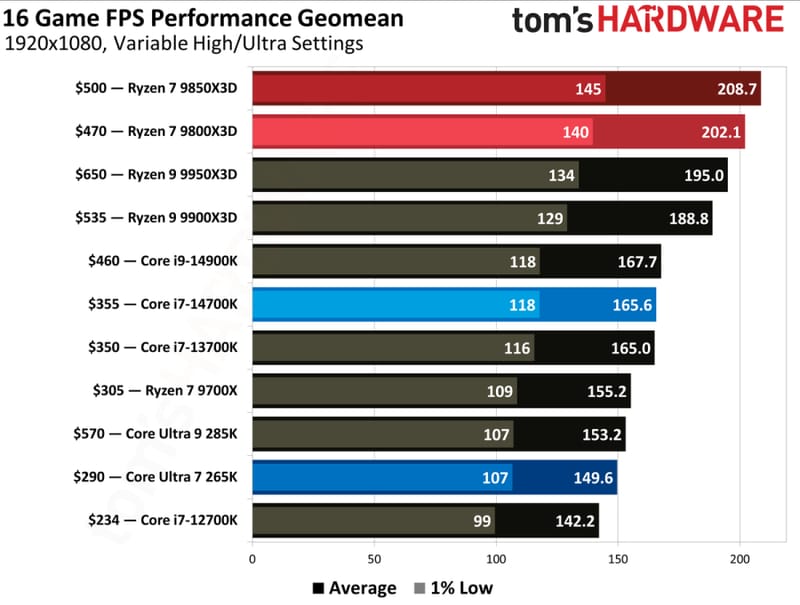
None of this changes the fundamentals of what makes a gaming CPU worth buying. Frame rates, latency, and smooth 1% lows still come down to how efficiently the chip’s cache keeps the graphics card fed, and AMD’s 3D V-Cache design, detailed on AMD’s 3D V-Cache technology pages, remains the clearest explanation for why these chips keep topping gaming benchmarks. Shoppers checking AMD’s own product pages will find both the 9800X3D and 9850X3D listed as current-generation gaming options, rather than one being positioned as a clear successor to the other.
Frequently asked questions
What is the difference between the Ryzen 7 9800X3D and the Ryzen 9850X3D?
Both chips use AMD’s 3D V-Cache design on the AM5 platform and are marketed as top-tier gaming processors, giving builders two comparable options rather than one being a clear upgrade over the other.
Is the Ryzen 7 9800X3D still a good gaming CPU in 2026?
Yes. Its 8-core, 16-thread layout and 96MB of cache continue to deliver class-leading gaming frame rates, and it remains the chip many prebuilt vendors pair with high-end graphics cards.
Do these X3D chips need a new motherboard?
No. The Ryzen 7 9800X3D, Ryzen 9850X3D, and the wider X3D lineup all use AMD’s existing AM5 socket, so current AM5 motherboard owners can upgrade without replacing the platform.
Why does AMD’s 3D V-Cache matter for gaming?
Games often depend more on how fast the CPU can access nearby data than on raw clock speed. Stacking extra cache directly on the die, as AMD does with 3D V-Cache, cuts that latency and lifts gaming frame rates noticeably.