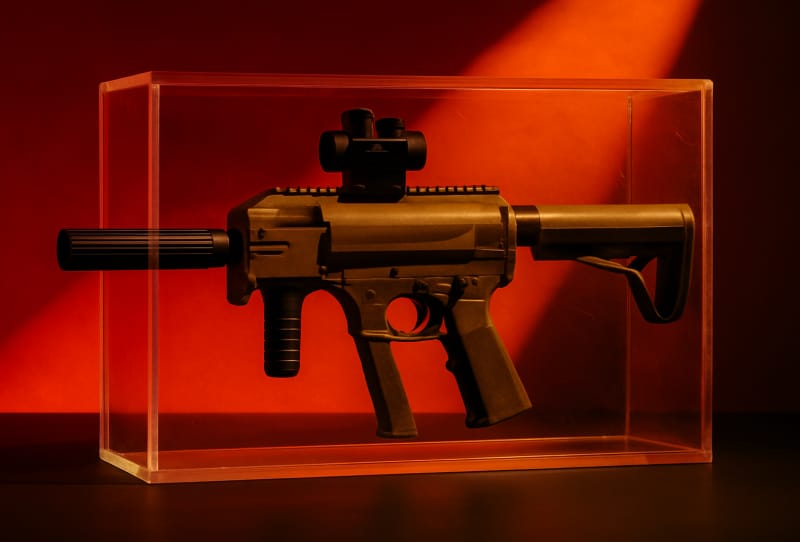
New York’s freshly minted 3D-printed gun detection software mandate has already run into its first serious challenge, and it comes from the man who started the entire ghost gun debate. Cody Wilson, the Texas-based creator of the world’s first fully 3D-printed firearm back in 2013, says he has built a tool that can quietly defeat the hash-matching systems states are trying to force onto new printers. He calls it “Hochulization”, a pointed reference to New York Governor Kathy Hochul, who signed the country’s first law requiring gun-blocking software on 3D printers earlier this year.
It is an early skirmish in what looks set to become a long-running contest between regulators trying to choke off illegal firearm production and hobbyists determined to keep printing whatever they like. Wilson frames his project as self-defence against what he calls invasive digital surveillance of open-source design work. Regulators frame it as a necessary patch for a legal loophole that lets prohibited people build working guns at home.
Table of Contents
How the Hochulization Tool Is Meant to Work
Wilson’s company, Defense Distributed, operates DEFCAD, the file repository Wilson runs, which he says now hosts more than 200,000 gun-related files, including complete firearm designs, components and suppressors. Most proposed 3D-printed gun detection software relies on hashing: running a file through an algorithm to generate a unique numerical fingerprint, then checking that fingerprint against a known database before a print job is allowed to start.
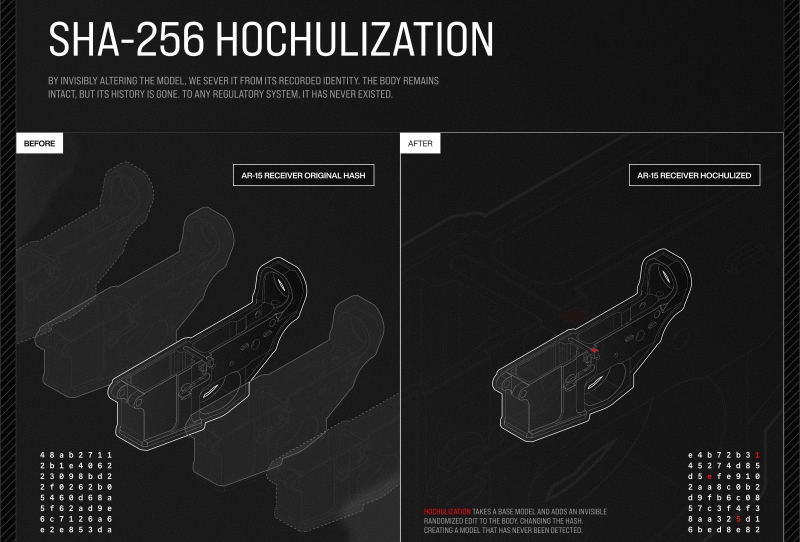
Hochulization is designed to break that approach at its root. It quietly adds extra bytes to a file, altering its hash without changing how the printed object actually functions. A scrambled suppressor still muffles a shot, and a scrambled gun frame still holds together, but the file no longer matches anything in a detection database. Wilson says he intends to apply the technique to every file on DEFCAD by default and eventually release it as an open-source tool anyone could run on their own designs.
“Hochulization is a de minimis policy to change the hash of every file that gets created and downloaded,” Wilson told The Verge, adding that the goal is to make sure there is “never going to be a complete library of hashes” for regulators to check against. Whether that claim holds up against more sophisticated detection systems is still an open question, but it exposes a real weakness in any approach that relies purely on matching known files.
New York and California Take Different Paths
New York’s law, tucked into the state’s FY 2027 budget, was the first in the country to require new 3D printers sold or manufactured in the state to include file-blocking software. California is close behind with AB 2047, a bill from Assemblymember Rebecca Bauer-Kahan that has advanced to a Senate floor vote. Neither bill spells out exactly how the detection software should work, leaving that detail to expert working groups drawn from manufacturing, artificial intelligence and firearms policy backgrounds.
| Detail | New York | California (AB 2047) |
|---|---|---|
| Status | Signed into law via FY 2027 budget | Advancing to Senate floor vote |
| Requirement | Print-blocking software on new printers | Print-blocking software on new printers |
| Enforcement mechanism | Not yet publicly detailed | State DOJ roster of compliant models |
| Effective date for non-compliant sales ban | Not specified | December 2029 |
Neither Hochul’s office nor a spokesperson for Bauer-Kahan responded to requests for comment about Wilson’s workaround, according to reporting on the tool. That silence leaves an obvious question hanging over both bills: if a simple byte-level trick can already defeat hash matching, is that the right technical foundation for a state-mandated system at all?
Ghost Guns Are Still a Small but Growing Problem
3D-printed firearms remain a small fraction of guns seized in the United States, but the trend line is moving quickly. The New York Police Department confiscated just one 3D-printed gun in 2021; by 2024 that figure had jumped to 109. Gun policy group Everytown has recorded similar increases across twenty other cities over the same period.
The designs themselves have also grown far more capable since Wilson’s original single-shot Liberator pistol. The FGC-9, for example, can fire multiple high-velocity rounds without failing and has turned up in the hands of neo-Nazi groups in Europe and rebel fighters battling Myanmar’s military government. Printed accessories such as switches that convert semi-automatic weapons into fully automatic ones, or suppressors that require special licences to buy legally, are arguably a bigger concern than the guns themselves, since a printer offers an easy route around licensing checks altogether.
That risk became a national talking point after Luigi Mangione, awaiting sentencing for the killing of UnitedHealthcare CEO Brian Thompson, allegedly used a partly 3D-printed Glock-style frame and a printed suppressor. Cases like that are exactly what lawmakers point to when arguing that current firearms law has a gap only 3D-printed gun detection software can close.
What This Means for Printer Owners and the Wider Industry
For everyday hobbyists running consumer machines like the Bambu Lab A2L, this fight is unlikely to change anything overnight. Neither New York’s law nor California’s bill targets existing printers already in homes and workshops; both apply only to new units sold after the rules take effect. But the direction of travel matters. If states start publishing approved-model rosters, manufacturers of everything from multi-material printers such as the Creality K2 Combo to larger-format printers like the QIDI Max4 will need to decide whether compliance is worth the engineering effort for every state they sell into.
Wilson’s tool also forces a harder technical choice onto the working groups drafting these rules. A pure hash-matching system is cheap to build and rarely flags an innocent file by mistake, but as Hochulization demonstrates, it is trivially easy to sidestep. The alternative, using AI to analyse a file’s actual geometry and guess whether it resembles a firearm, would likely catch more genuine attempts but risks blocking legitimate parts by accident, frustrating makers, educators and small businesses who rely on the same printers for entirely unrelated work.
That tension is unlikely to resolve quickly, especially as the consumer 3D printing market keeps expanding. Newer releases like the Bambu Lab P2S show how fast the hardware side of this industry is moving, often faster than the regulatory frameworks trying to keep pace with it. Whatever detection standard eventually gets written into law, Wilson’s early workaround has already made one thing clear: the software side of this fight will be just as contested as the hardware itself.