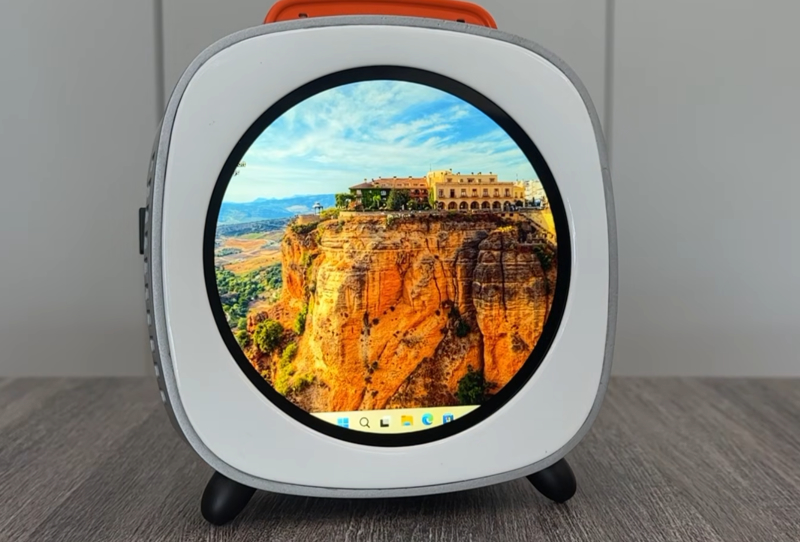
The Piston V mini PC has officially launched on Kickstarter, revealing full specifications and pricing for a device that spent weeks generating curiosity online before its creators were ready to talk details. Pitched as a hybrid between a mini PC and a games console, the Piston V pairs a dual-boot Bazzite and Windows setup with a 4-inch touchscreen bolted to the front, aiming squarely at buyers who want a compact machine that can double as a living room gaming box or a desktop workhorse.
Early backers can currently pledge from around $590, a jump from the initial super early bird tier of $559. Once the campaign wraps and the device reaches general retail, the creators expect the Piston V to carry a manufacturer’s suggested price of roughly $799. As with any crowdfunded hardware, those figures and the eventual shipping timeline remain promises rather than guarantees, and prospective backers should treat the campaign as a pre-order with the usual risks that come with funding a product before it exists at scale.
Table of Contents
What the Piston V mini PC actually offers
Underneath the touchscreen and console-style shell, the Piston V is built around AMD’s Ryzen AI 9 365 APU, a chip that pairs capable CPU cores with the integrated Radeon 880M graphics engine. It is not a chip designed to chase triple-A titles at high settings, but it has proven itself in other compact gaming hardware as a reasonable performer for esports titles, indie games, and older AAA releases at modest resolutions.
Every configuration available through the campaign ships with 16 GB of DDR5-5600 memory and a 500 GB PCIe Gen 4×4 M.2 SSD as the baseline. Backers who need more headroom can step up to 24 GB, 32 GB, 48 GB, or a full 64 GB of memory, alongside storage options that scale as high as 4 TB. That range gives buyers a genuine choice between a lean, budget-focused build and a machine kitted out closer to a small workstation.
One detail that did not surface during the earlier hands-on preview from YouTube channel ETA Prime is the inclusion of an OCuLink port. That connector allows the Piston V to be paired with an external GPU enclosure, which is a meaningful addition for a device this size. It means owners are not permanently locked into the performance ceiling of the Radeon 880M if they later want to add serious graphics grunt for demanding games.
Dual-boot design and the touchscreen angle
The standout software feature is the dual-boot arrangement between Bazzite, a Linux-based gaming distribution built on SteamOS-style principles, and Windows. Bazzite has built a following among handheld and mini PC enthusiasts for its console-like interface and lower overhead compared with a full Windows install, while Windows remains available for anyone who needs broader software and driver compatibility.
Letting owners switch between the two operating systems gives the Piston V unusual flexibility for its size. A user could boot into Bazzite for a controller-first, big-screen gaming session, then switch to Windows for general computing, productivity software, or games that lack proper Linux support. The 4-inch touchscreen on the front reinforces the console framing, offering quick access to system status, media controls, or a simplified interface without needing a monitor connected.
How it stacks up against other mini PCs
The mini PC category has grown crowded, with everything from budget office boxes to compact gaming rigs built around similar Ryzen AI silicon. Machines such as compact mini PCs like the Minix Neo P1 Mini compete on portability and efficiency rather than raw gaming grunt, while other small form factor builds prioritise airflow and thermal headroom over a console-style design.
Where the Piston V tries to differentiate itself is in blending that mini PC efficiency with genuine console-adjacent features, namely the touchscreen, the dual-boot software, and the OCuLink expansion path. It sits in an unusual middle ground compared with small form factor gaming builds that lean on discrete graphics cards for performance, or larger enthusiast cases designed around expandability rather than a compact footprint.
For anyone comparing this against a traditional desktop tower, it is worth remembering that the Piston V trades raw upgrade flexibility, the kind found in full-size PC cases built for airflow, for portability and a living room-friendly form factor. That is a reasonable trade for buyers who value desk space or want something that can sit under a television.
What buyers should weigh before backing
Kickstarter campaigns live and die on delivery, and hardware projects carry particular risk around manufacturing delays, component shortages, and final quality control. The jump from a $559 super early bird price to an expected $799 retail figure is a substantial increase, so early backers are effectively being rewarded for taking on that uncertainty.
Anyone drawn to the Piston V mini PC for its dual-boot flexibility and touchscreen novelty should read the campaign’s fulfilment timeline carefully, check the creators’ track record, and treat the pledge as support for a project still working toward mass production rather than a confirmed, ready-to-ship purchase. The core hardware, built around a proven APU and expandable memory and storage, gives the concept a solid foundation, but the usual crowdfunding caveats apply until units start reaching backers.