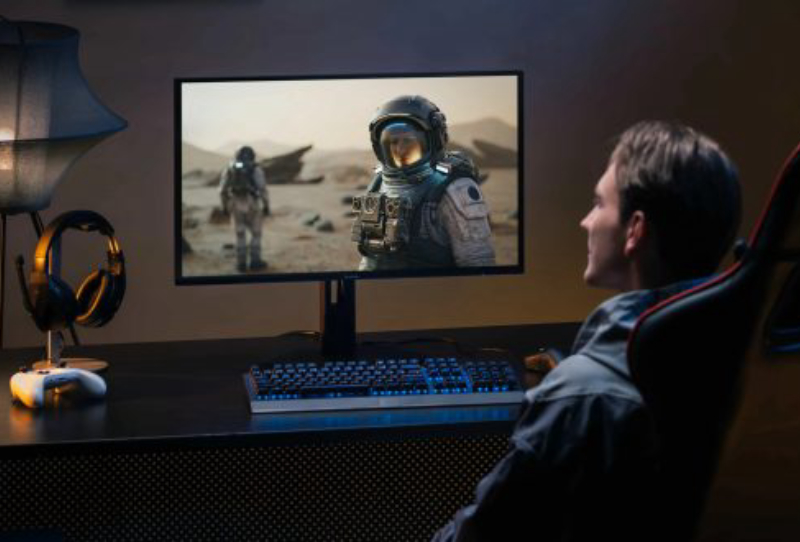
The ViewSonic XG2738-2K-OLED monitor brings a 27-inch QHD panel to the company’s OLED gaming lineup, aimed at players who want fast response times without stepping up to 4K. Rather than chasing the sharper but more demanding 3840×2160 resolution, ViewSonic has stuck with 2560×1440 and used that lower pixel count to push refresh rates and response times about as far as current QD-OLED technology allows.
It is a deliberate trade-off. A 4K panel looks sharper on paper, but driving it at high frame rates asks a lot of a graphics card. By staying at QHD, the ViewSonic XG2738-2K-OLED monitor can hit 240Hz while still being realistic to drive on mid-range hardware, which is likely to appeal to competitive players who care more about smoothness than pixel density.
Table of Contents
What the ViewSonic XG2738-2K-OLED Monitor Offers
The headline numbers are a 240Hz refresh rate and a 0.03ms grey-to-grey response time, both made possible by the self-emissive nature of QD-OLED panels. Unlike traditional LCD screens, each pixel lights up and switches off independently, which is why OLED monitors consistently post faster response figures than even the best LCD alternatives.
Colour performance looks solid too. ViewSonic quotes 10-bit colour depth and 98 percent coverage of the DCI-P3 colour space, figures that should satisfy gamers and casual content creators alike. Typical brightness sits at 200 nits, which is modest by LCD standards but fairly normal for an OLED panel running in a sustained, everyday brightness mode rather than a peak HDR spike.
Adaptive sync support covers both major camps, with Nvidia G-Sync and AMD FreeSync compatibility built in to keep screen tearing away regardless of which graphics card sits inside the PC. That kind of dual support has become close to standard on serious gaming monitors, but it is still worth confirming before buying, since not every panel handles both equally well.

Key Specifications
| Feature | Detail |
|---|---|
| Screen size | 27 inches |
| Resolution | 2560 x 1440 (QHD) |
| Panel type | QD-OLED |
| Refresh rate | 240Hz |
| Response time | 0.03ms (GtG) |
| Colour | 10-bit, 98% DCI-P3 |
| Brightness (typical) | 200 nits |
| Adaptive sync | G-Sync and FreeSync |
| Connectivity | HDMI 2.1, DisplayPort, audio-out |
Esports Mode and Burn-In Protection
One of the more practical additions is the Esports Mode, which lets players shrink the active display area down to an effective 24.5 inches, or switch between 4:3, 5:4, 16:9 and 16:10 aspect ratios. Many competitive gamers still prefer a smaller field of view for tracking movement in shooters, and having that flexibility built into the monitor itself removes the need to fiddle with in-game settings on every title.
Burn-in remains the main concern shoppers raise around OLED monitors, and ViewSonic has answered it with a suite it calls OLED Care. That includes Screen Movement, which subtly shifts the image to avoid static wear, Average Picture Level management, and Static Icon Detection to spot elements like HUDs or taskbars that sit in the same spot for long stretches. A manual Image Cleaning function is also included for users who want to run a refresh cycle themselves.
These are largely the same defensive tools other OLED monitor makers use, and they reflect how far the technology has matured since early OLED TVs earned a reputation for ghosting images into the panel. Modern QD-OLED monitors are far more resilient, though sensible habits like varying content and using auto-hide taskbars still help.
How It Stacks Up Against Rivals
The QHD OLED space has become genuinely competitive over the past couple of years. Gigabyte’s own AORUS OLED gaming monitors have targeted similar buyers with fast panels and strong colour accuracy, while ASUS ROG‘s 720Hz PG259QWS esports OLED monitor shows just how far refresh rates can climb when resolution drops even further, in that case to Full HD. The ViewSonic XG2738-2K-OLED monitor sits in a middle ground, keeping resolution at QHD while still delivering a refresh rate well beyond what most eyes or even most displays can distinguish from lower numbers.

For a closer size comparison, the Gigabyte AORUS FO27Q3 review covers a similarly proportioned 27-inch OLED gaming monitor, giving a useful reference point for how ViewSonic’s brightness and colour figures measure up against an established rival. Meanwhile, the broader march toward extreme refresh rates, illustrated by LG’s 1000Hz gaming monitor launch, shows the direction the market is heading, even if most games and graphics cards are nowhere near ready to exploit numbers that high.
Why the QHD OLED Choice Matters
Choosing QHD over 4K is not a step backward so much as an acknowledgment of what most gaming PCs can realistically push. Hitting 240 frames per second at 4K still demands a high-end graphics card, whereas the same target at QHD is achievable on considerably more modest hardware. That makes the ViewSonic XG2738-2K-OLED monitor a practical option for gamers upgrading from an LCD panel who want the contrast and response benefits of OLED without needing to also upgrade their graphics card.
ViewSonic has not detailed pricing or availability for the Australian market, and buyers here should treat US retail listings as a rough guide only until local stock and pricing are confirmed. What is clear is that competitive QHD OLED options are multiplying quickly, giving gamers more genuine choice between resolution, refresh rate and price than existed even a year ago.