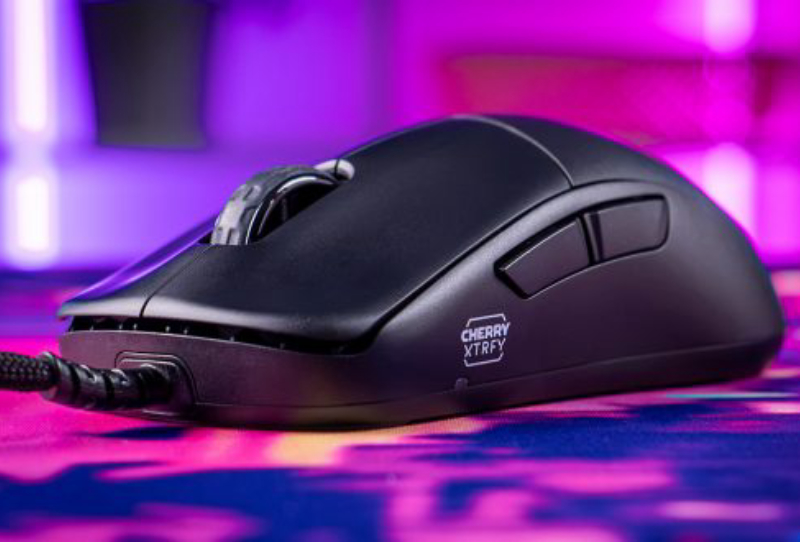
The Xtrfy M42V2 landed at Gamescom this week as the first mouse in a refreshed lineup from Cherry Xtrfy, and it arrives with a genuinely clever twist on the ultralight formula. At 45 grams, it sits among the lightest solid-shell mice on the market, but the real story is a rear shell that snaps on and off without a single tool.
That modular design lets buyers choose between two included shell shapes: one with a more pronounced hump for palm-heavy grips, and a flatter option better suited to claw or fingertip styles. Swapping between them takes seconds, and neither requires a screwdriver or any disassembly. It is a small mechanical idea, but one that solves a genuine problem for players who are never quite sure which shape suits them until they have used a mouse for a few weeks.
Table of Contents
What the Xtrfy M42V2 changes from the original
The M42V2 keeps the symmetrical shape that made the original M42 a popular pick among ambidextrous players, but the shell itself has been rebuilt from the ground up. Rather than bonding the top shell permanently to the chassis, Cherry Xtrfy engineered a snap-fit system that lets the rear section come free cleanly.
This is a departure from how most manufacturers approach modularity. Many rivals rely on magnetic covers or screw-in plates, which can add weight or introduce squeak over time. Xtrfy’s tool-free approach avoids both issues while still keeping the shell feeling solid rather than loose or rattly, according to the company’s own product materials.
Notably, the M42V2 sticks with a solid shell rather than following the perforated, honeycomb look that so many ultralight mice have adopted to shed grams. Instead, weight savings come from internal engineering and material choices, paired with a matte UV-coated finish that should resist the shine and grime that plagues cheaper coatings over months of use.
Sensor and feet: sensible rather than flashy
Under the shell, the M42V2 runs a PixArt 3327 sensor with CPI adjustable from 400 up to 6200, alongside a 1000Hz polling rate. Those numbers won’t turn heads next to flagship sensors from Logitech or Razer, but they cover what the vast majority of players actually need, whether that’s competitive shooters or everyday desktop use.
The trade-off is a familiar one in this segment of the market. Cherry Xtrfy has clearly prioritised keeping the price accessible over chasing headline specifications, which makes sense given the M42V2 is pitched as an entry point into the brand’s ultralight range rather than a halo product. Gliding is handled by UHMW-PE feet, a material widely regarded as the gold standard for smooth, low-friction mouse skates.
| Spec | Xtrfy M42V2 |
|---|---|
| Weight | 45g |
| Shell design | Solid, tool-free swappable rear shell (two included) |
| Sensor | PixArt 3327 |
| CPI range | 400 to 6200 |
| Polling rate | 1000Hz |
| Feet material | UHMW-PE |
How it fits against the rest of Xtrfy’s range
Cherry Xtrfy has built a reputation on offering lighter, simpler alternatives to the big-name gaming mice, and the M42V2 continues that pattern. Compared with Xtrfy’s wireless M4, the M42V2 trades wireless convenience for a lower weight and, presumably, a friendlier price, positioning it as the practical choice for players who prioritise raw lightness over cutting the cord entirely.
It also signals where the brand’s ultralight lineup is heading next. Describing the M42V2 as the first entry in a refreshed series suggests further models will follow, likely applying the same tool-free shell concept to other shapes or sizes in the catalogue. That would mirror how Xtrfy has steadily expanded its keyboard and headset ranges alongside its mice.
What it means for buyers
For players hunting an ultralight mouse without committing to a perforated shell, the Xtrfy M42V2 offers a rare middle ground: low weight, a solid enclosure, and the flexibility to try two grip shapes before settling on one. That kind of choice usually costs considerably more when it appears on premium mice from bigger brands.
Xtrfy has already built a presence in the local market following Xtrfy’s arrival in Australia and New Zealand, so local buyers should see the M42V2 stocked through the same channels as the rest of the lineup once it ships. Anyone curious about the brand’s design philosophy can also check Xtrfy’s official site or explore the wider portfolio from parent company Cherry, which has been steadily folding Xtrfy’s peripheral expertise into its own catalogue since the acquisition.
Whether the tool-free shell swap becomes a lasting feature across Xtrfy’s range remains to be seen, but it is a practical upgrade that solves a real annoyance rather than chasing a marketing checkbox. For a segment of the market often obsessed with shaving grams at any cost, that focus on usability is a welcome change of pace.