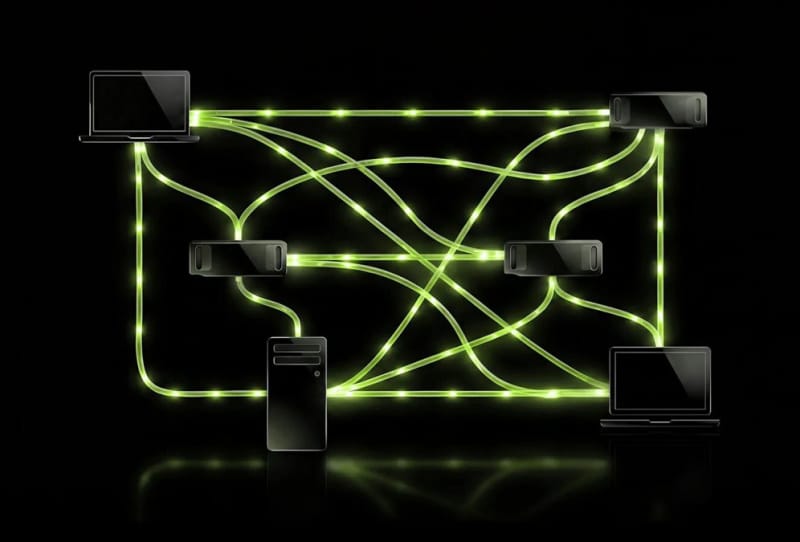
Nvidia PAIR is a new, free tool that quietly turns a house full of idle laptops and desktops into a coordinated AI cluster. Announced at IFA 2026 in Berlin as part of Nvidia’s own announcement, PAIR stands for Personal AI Router, and it shares processing power across every compatible machine already sitting on a home network. There is no subscription fee, no cloud upload, and no server rack required. Just the computer on the desk, the laptop in a drawer, and whatever else happens to be switched on.
The problem Nvidia is trying to solve is a practical one. Running AI locally, rather than through a cloud service, is compute-hungry. Historically that has meant either one very powerful machine chewing through tasks one at a time, or a cluster of machines working in parallel with complicated setup involved. As AI agents move from a novelty into something people actually rely on for daily tasks, that bottleneck becomes a real limitation for ordinary households, not just data centres.
Table of Contents
How Nvidia PAIR Actually Works
PAIR functions as an intelligent traffic controller for AI workloads. It takes a single job, whether that is sorting through files, drafting code, or organising a schedule, and splits it into smaller sub-tasks. Those pieces are then handed off to sub-agents running on whichever machines have spare capacity on the network. Rather than queuing everything through one device, the workload runs in parallel across several, which can noticeably speed up complex requests.
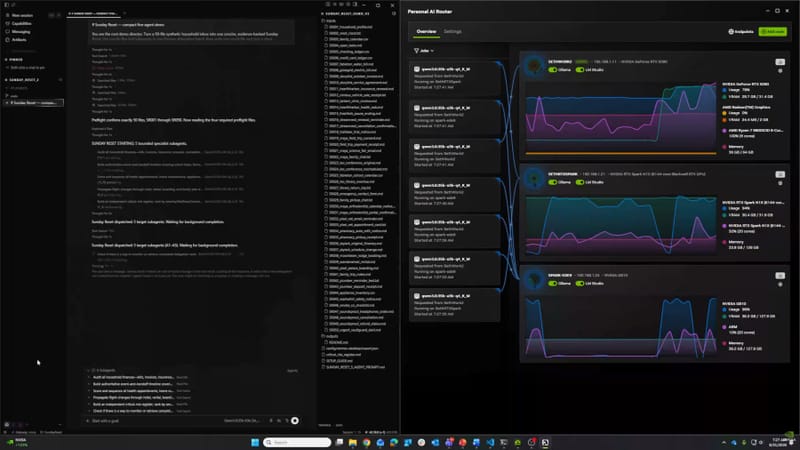
It is worth being clear about what Nvidia PAIR is not doing. It does not pool video memory or split a single AI model across multiple systems, the way clustering two Nvidia DGX Spark units would. Instead, each machine handles a complete, self-contained sub-task, and PAIR manages the orchestration behind the scenes so the user only sees one finished job come back.
Which Devices Qualify for Nvidia PAIR
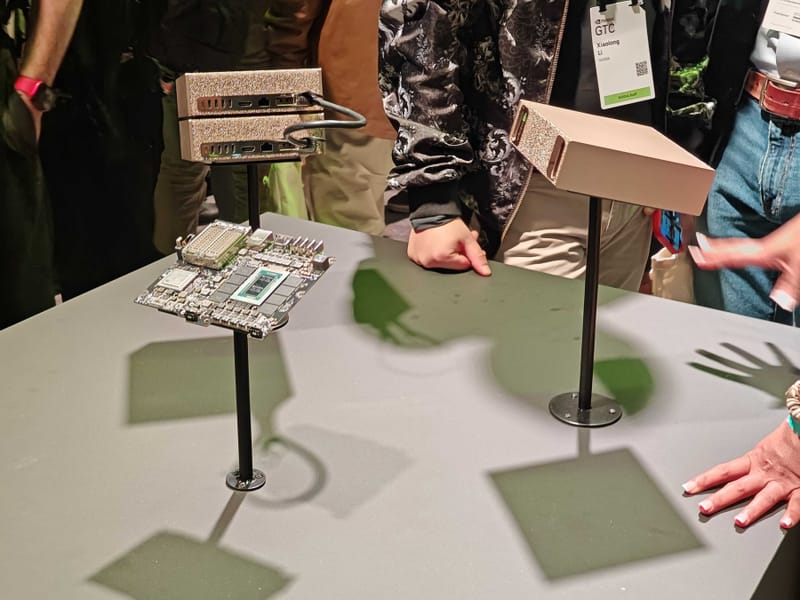
One of the more surprising details is how broadly Nvidia PAIR is built to work. Rather than restricting support to its own DGX Spark hardware, the tool also runs on GeForce graphics cards under Windows and on Apple silicon Macs, putting three very different platforms on the same home network.
| Requirement | Detail |
|---|---|
| Minimum memory | 8GB RAM |
| Minimum storage | 20GB free disk space |
| Supported GPUs | GeForce RTX 20 Series and newer, Nvidia RTX PRO workstation GPUs, Nvidia DGX Spark / GB10 |
| Supported Apple hardware | M4 silicon or newer |
| Operating systems | Windows 11, macOS Tahoe, Ubuntu, DGX OS |
PAIR dynamically discovers compatible machines as they join or leave the network, so nothing needs to be manually configured each time a laptop is turned on. There are no special cables or racks involved, just whatever devices happen to be connected, which makes getting a home network set up properly more relevant than ever. Once the required models are downloaded, PAIR can run with zero internet connection, keeping every prompt, file, and piece of agent context on the local network rather than sending it anywhere else.
Why Running AI at Home Actually Matters
The privacy argument behind Nvidia PAIR is straightforward. As AI agents start handling household tasks, they inevitably touch personal files, schedules, and sensitive context that most people would rather not hand over to a cloud provider. Keeping that processing local removes the risk of data leaks or misuse tied to third-party servers, while also sidestepping the growing fatigue around monthly AI subscription fees.

This isn’t the only project chasing that idea. Devices like other local AI and home storage hubs have already tried to combine local compute with home storage, but Nvidia’s approach is notable because it doesn’t require buying new dedicated hardware. It works with machines people already own, provided they meet the modest GPU and memory requirements.
What Nvidia PAIR Means for Nvidia’s Bigger AI Push
Nvidia PAIR arrives just as a new wave of hardware built for this exact use case is about to land. The upcoming RTX Spark laptops are due later this year, alongside desktop options such as Acer’s compact RTX Spark desktop, both aimed squarely at local AI workloads rather than gaming alone. A free tool that makes existing GeForce and Apple hardware useful for the same job gives Nvidia an easy way to build interest in local AI before that hardware even ships.
There is also a broader strategic angle here. By positioning itself as the company that makes home-based AI compute simple, Nvidia is offering an alternative to cloud subscription services while nudging more buyers toward its own GPUs. It is a bet that the shift from manually operated apps to autonomous, agentic computing will happen increasingly at the edge, inside people’s homes, rather than in a distant data centre. Whether households actually adopt clustered local AI at scale remains to be seen, but Nvidia has made the barrier to trying it unusually low.