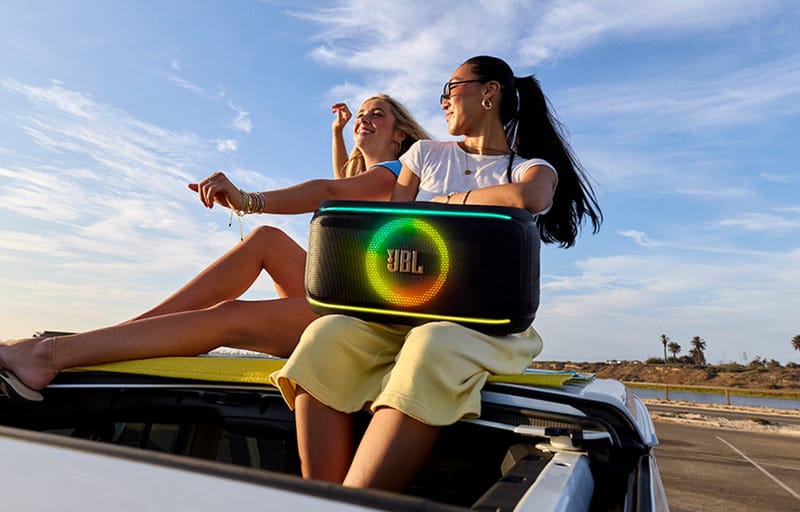
Portable party speakers have become a crowded category, but JBL keeps finding ways to make its PartyBox range stand out, and the latest example is the JBL PartyBox On-The-Go 2 Plus. Detailed on JBL’s PartyBox On-The-Go 2 Plus product page, this black portable speaker combines JBL’s punchy Pro Sound tuning with a genuinely clever twist: AI-powered karaoke technology that separates vocals from a track in real time, without needing an app subscription or cloud processing.
Review summary
JBL PartyBox On-The-Go 2 Plus
The JBL PartyBox On-The-Go 2 Plus pairs punchy, well-balanced Pro Sound tuning with genuinely useful AI-powered EasySing karaoke technology, turning any streamed track into a singalong without apps or subscriptions. Thoughtful design touches, solid battery life and reliable Bluetooth 5.4 connectivity make it a practical, durable choice for outdoor gatherings and everyday portable listening.
Highlights
- ✓Real-time AI vocal separation for karaoke
- ✓100W output with balanced bass and clarity
- ✓Up to 15 hours battery plus fast charging
- ✓Rugged, IPX4-rated build with improved carry handle
- ✓Auracast and stereo pairing for expanded sound
What makes this release interesting isn’t just louder speakers or a bigger battery, though it has both. JBL has built its EasySing technology directly into the wireless microphone bundled with the unit, letting anyone turn a regular streaming playlist into an instant karaoke set. It’s a feature that pushes the PartyBox On-The-Go 2 Plus beyond simple bluetooth speaker territory and into genuine entertainment-system status for backyard barbecues, birthdays and impromptu singalongs.
This review works through how the speaker is built, what its standout features actually do in practice, and how it performs across music playback, karaoke sessions and everyday portable use. Anyone weighing up whether this is the right speaker for their next gathering should come away with a clear picture of what it offers and where it shines.
Table of Contents
Design and Functionality
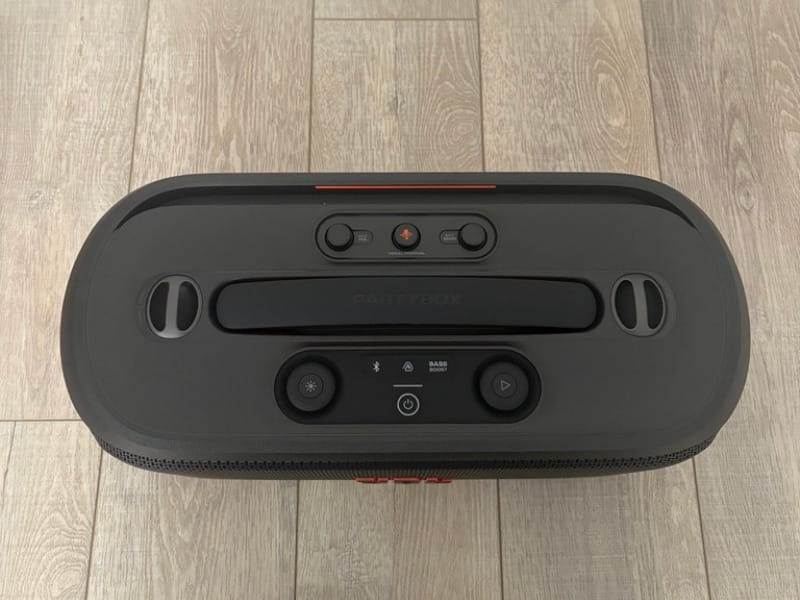
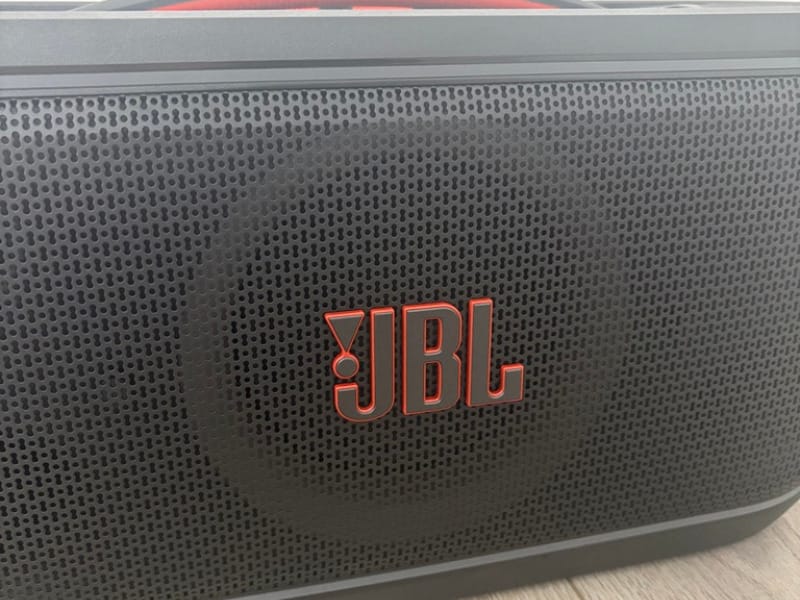
The PartyBox On-The-Go 2 Plus sticks closely to the visual identity JBL has built across its PartyBox family, with a rounded, barrel-style cabinet finished in black. It’s an unmistakably party-oriented design, with a mesh grille wrapping around the front driver array and a chunky, rugged build that doesn’t try to hide the fact it’s meant to get knocked around at gatherings.
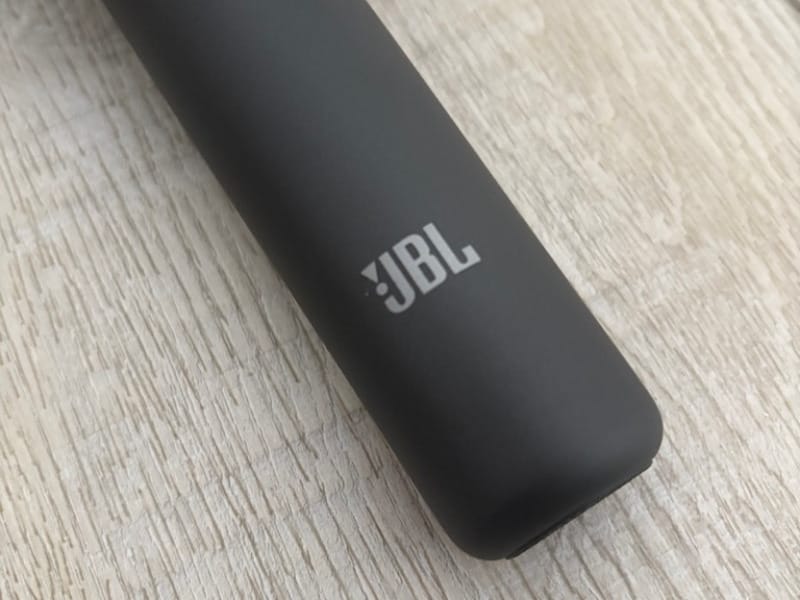
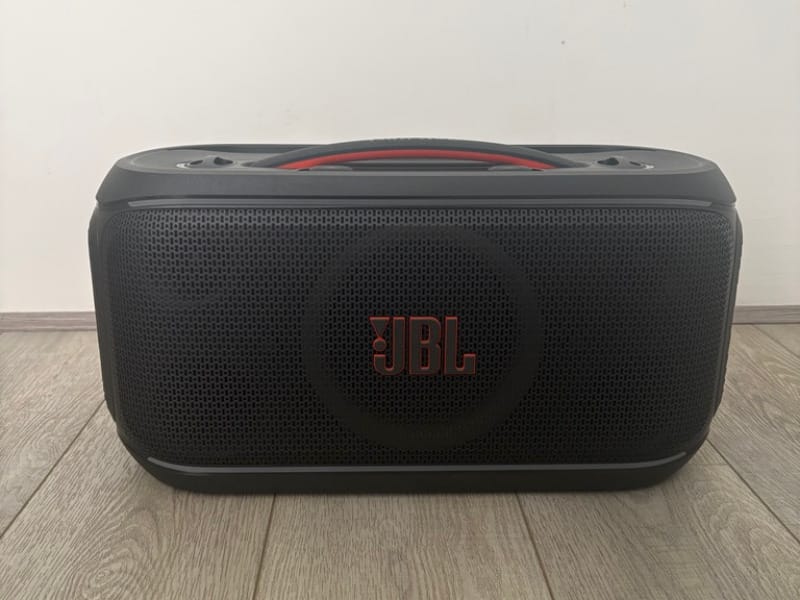
Dimensions come in at 501 x 258 x 221mm, and the unit weighs 6.45kg, making it noticeably more substantial than JBL’s smaller Flip or Charge-series speakers but still manageable for one person to carry. It sits in that sweet spot where it’s big enough to fill a backyard with sound but not so bulky that hauling it to the beach or a mate’s place feels like a chore.
JBL has redesigned the central carry handle on this model specifically to improve weight balance when lifting or moving the speaker, and it’s a small but noticeable improvement over earlier PartyBox On-The-Go units. The handle sits directly above the cabinet’s centre of gravity, so the speaker doesn’t tip awkwardly to one side when picked up.
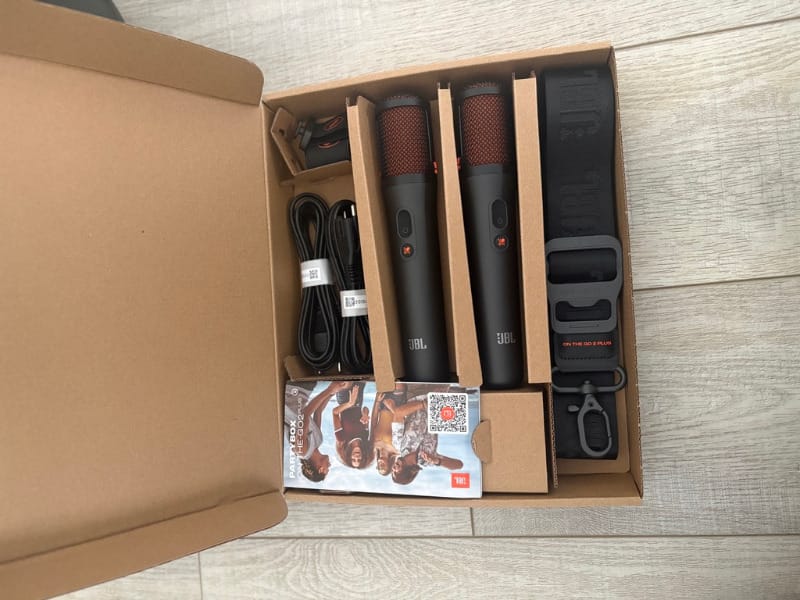
A wider, thicker shoulder strap is also included, which makes a genuine difference when carrying the speaker over longer distances. Anyone lugging this from a car park to a picnic spot will appreciate the extra padding, since the strap distributes weight across the shoulder rather than digging in.
Inside the cabinet, the audio hardware consists of dual 0.75-inch silk-dome tweeters paired with a 5.25-inch woofer, delivering a combined output of up to 100 watts. This driver configuration is designed to split high-frequency detail from low-end punch, which pays off in how balanced the sound feels even at higher volumes.
Surrounding the woofer is JBL’s signature dynamic lightshow, a ring of LEDs that pulses, strobes and shifts colour in time with the music. It’s a feature that has become a hallmark of the PartyBox range, and it’s just as effective here as on larger models like the JBL PartyBox 520.
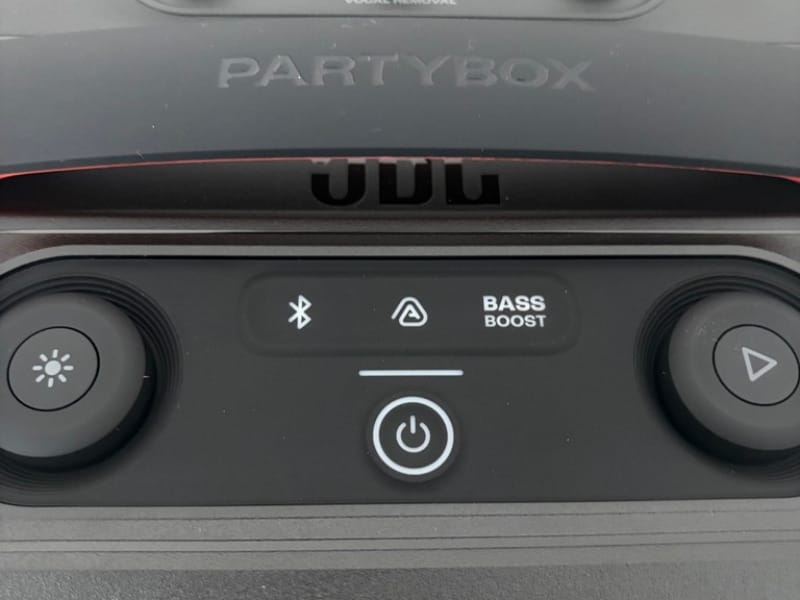
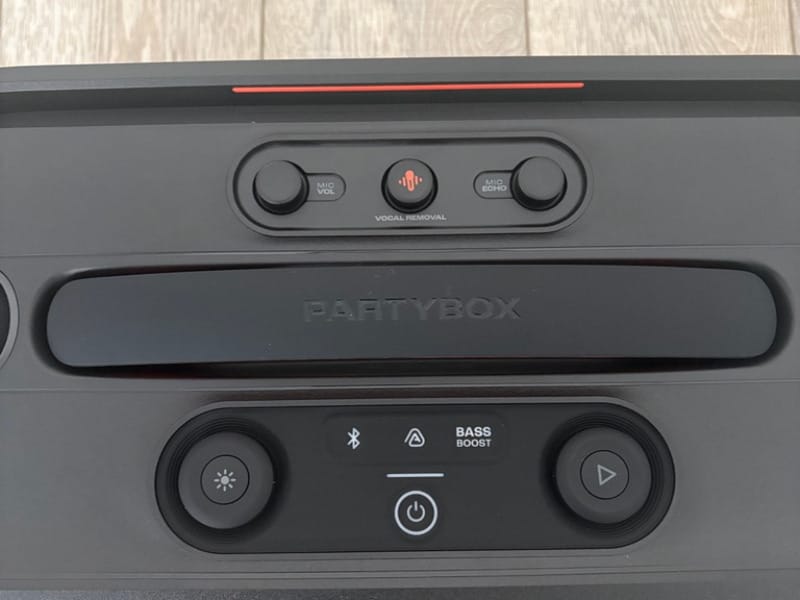
On top of the cabinet sits a straightforward control panel with buttons for power, bluetooth pairing, lightshow toggling, EQ presets and microphone volume. Everything is clearly labelled and laid out in a logical row, so there’s no need to dig through an app just to turn the lights off or adjust the bass.
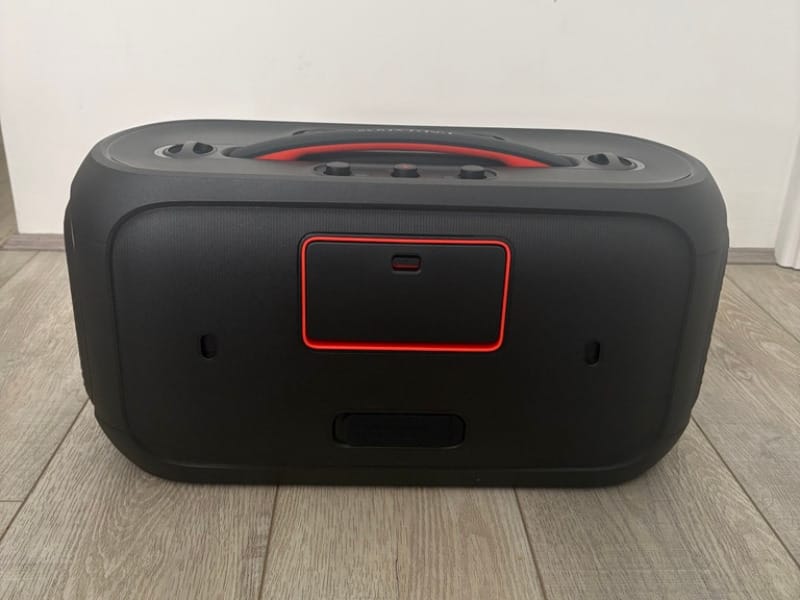
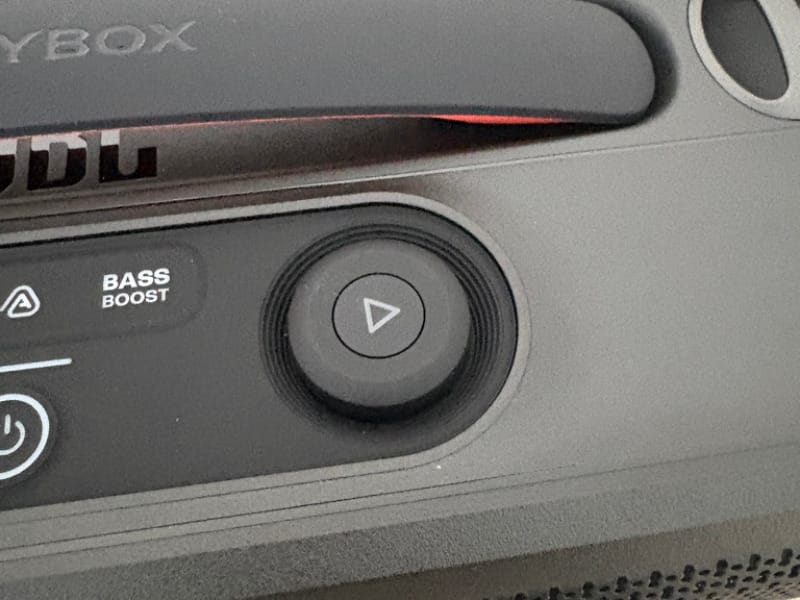
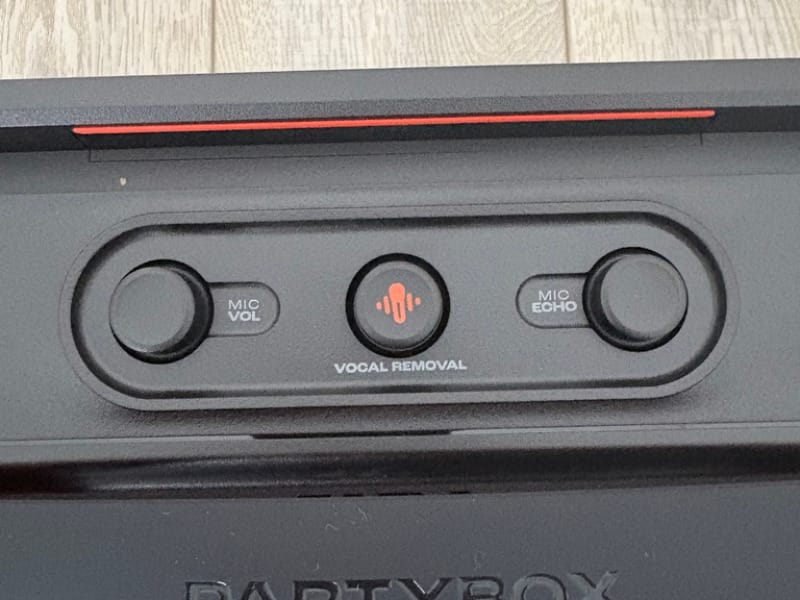
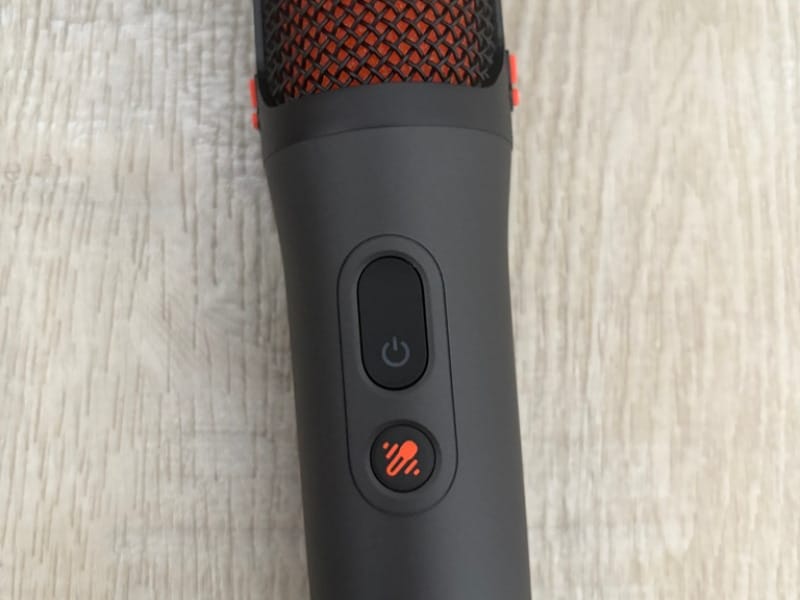
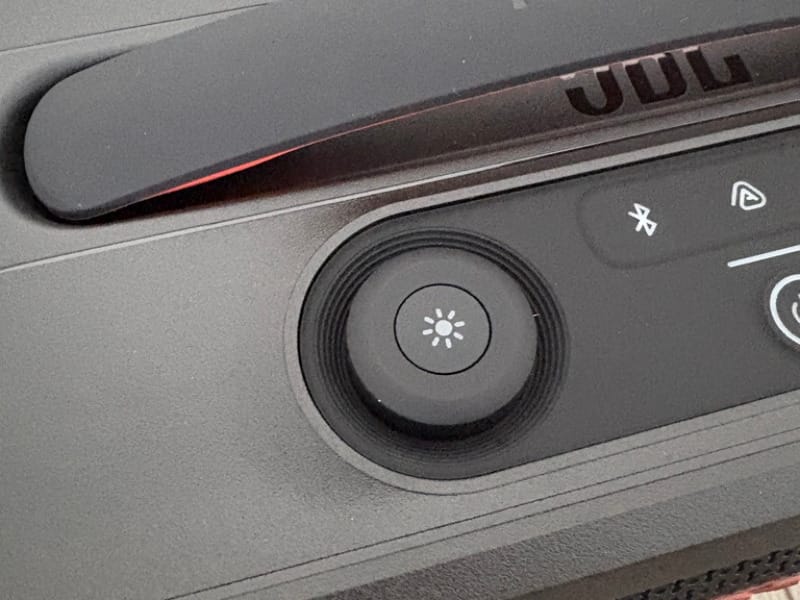
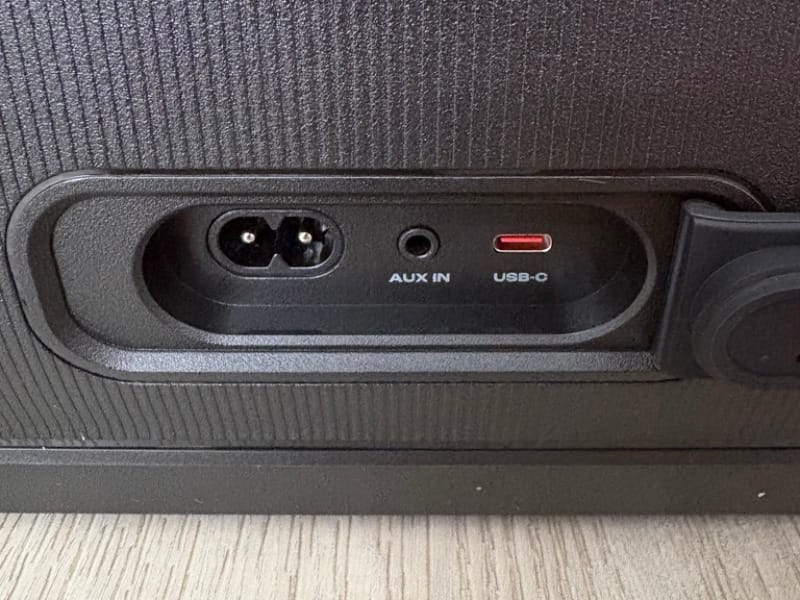
Around the back and sides, JBL has included a USB-C port for playback and charging duties, a 3.5mm aux-in jack for wired sources, a microphone input, and the main power socket. This mix of wired and wireless options means the speaker isn’t solely reliant on bluetooth, which is handy in venues with patchy wireless conditions.
An IPX4 splash resistance rating covers the cabinet, meaning it can handle light rain, spilled drinks or pool splashes without drama. It’s not designed for submersion, but for outdoor parties where the odd bit of moisture is inevitable, that rating offers useful peace of mind.
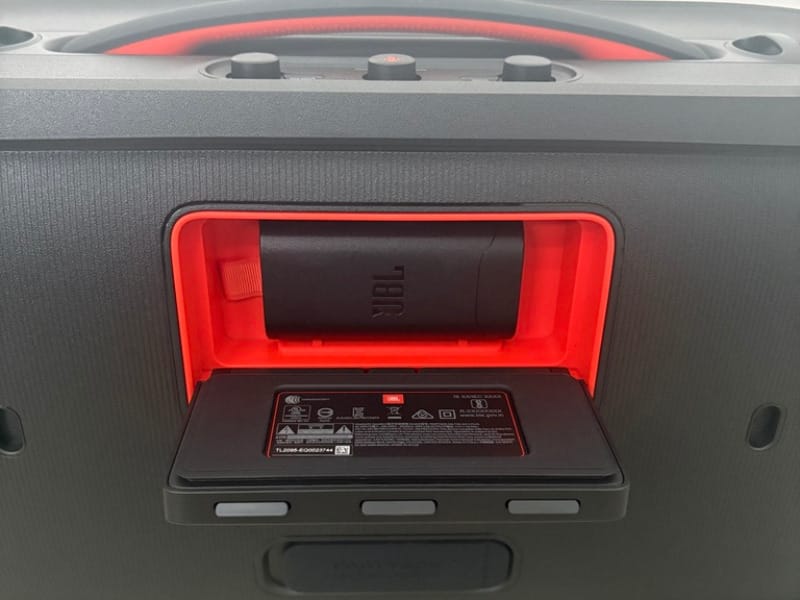
One of the more practical design choices is the replaceable battery compartment, accessible via a panel on the rear of the unit. Owners who want to extend a party well past the 15-hour mark can simply swap in a spare battery pack, sold separately, and keep the music running.
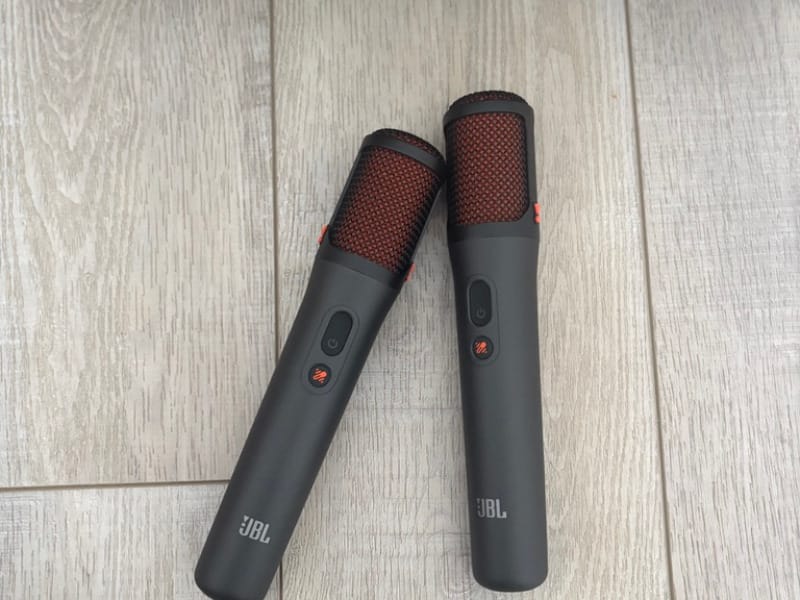
A dedicated slot for storing the wireless EasySing microphone is built into the cabinet, keeping the mic secured and charged when it’s not in use. It’s a thoughtful touch that stops the microphone from becoming a separate item that gets left behind or lost between events.
Compared with the standard PartyBox On-The-Go 2, the Plus variant carries a marginally heavier build, largely down to the microphone dock and the internal componentry supporting EasySing processing. The size difference is negligible in practice and won’t affect how the speaker is carried or stored.
Handling the unit solo is comfortable thanks to the redesigned handle, while the shoulder strap comes into its own when navigating stairs, sand or uneven ground where a two-handed grip isn’t practical. Both carrying methods feel considered rather than tacked on as an afterthought.
Visually, the speaker fits naturally alongside other members of JBL’s lineup, including the JBL Boombox 4, sharing the same bold, rugged aesthetic that signals its outdoor and social-gathering intent at a glance.
Build quality throughout feels purposeful rather than flashy. Every panel, button and port seems designed with the assumption that this speaker will be dragged from house to garden to car boot on a regular basis, and it holds up to that expectation.
Taken together, the design leans heavily into function, prioritising portability, durability and ease of use over minimalism. It’s a speaker built to be picked up, thrown in a car, and set up in minutes, which is exactly what a party speaker in this category needs to be.
Key Features
The headline feature of the PartyBox On-The-Go 2 Plus is JBL’s EasySing technology, which uses on-device AI processing to separate vocals from instrumentation in real time. Unlike older karaoke solutions that rely on pre-processed backing tracks, this system works with virtually any song streamed through the speaker, stripping out the original vocal on the fly.
Users aren’t limited to an all-or-nothing vocal removal either. The system allows the original vocal to be dialled down to 25%, 50%, or removed entirely, giving singers the flexibility to keep a bit of the original performance as a guide or go fully solo on the mic.
Voice Boost is layered on top of this, enhancing the clarity of high frequencies in the live vocal being sung through the microphone. It helps voices cut through the mix cleanly rather than getting buried under the backing track’s bass and mids.
Built-in effects round out the karaoke package, with reverb, echo and noise suppression all processed directly through the speaker. These effects add a bit of studio polish to an otherwise raw vocal, which matters more than it might sound for anyone self-conscious about singing in front of friends.
Smart Key Change, accessible through the JBL One app, shifts the pitch of a track to better match a singer’s vocal range. It’s a feature aimed squarely at people who love karaoke but don’t necessarily hit every note in the original key, and it removes one of the more common frustrations of singing along to a fixed recording.
The JBL One app itself extends well beyond karaoke controls, offering remote access to EQ settings, lightshow patterns and general playback management. It means the speaker doesn’t need to be touched directly once a party gets going, since volume, lighting and effects can all be adjusted from a phone.
| Specification | Detail |
|---|---|
| Output Power | 100W RMS |
| Drivers | 1 x 5.25-inch woofer, 2 x 0.75-inch dome tweeters |
| Battery Life | Up to 15 hours |
| Fast Charging | 10 minutes charge for up to 80 minutes playtime |
| Bluetooth Version | 5.4 with Auracast support |
| IP Rating | IPX4 splash resistant |
| Weight | 6.45kg |
| Dimensions | 501 x 258 x 221mm |
| Microphone Range | Up to 30 metres |
| Microphone Battery | Up to 10 hours |
The bundled EasySing wireless microphone is worth highlighting on its own, with a 30-metre wireless range and up to 10 hours of battery life on a charge. It’s a genuinely capable karaoke mic rather than a basic bluetooth accessory bolted on for marketing purposes.
This same EasySing ecosystem extends across other JBL speakers, meaning the microphone and its features work with models like the PartyBox Club 120, PartyBox Encore 2 and PartyBox 520. That cross-compatibility gives the whole system more long-term value, since upgrading speakers later doesn’t mean starting the karaoke setup from scratch.
Auracast support allows the PartyBox On-The-Go 2 Plus to link wirelessly with other Auracast-enabled JBL speakers, expanding coverage across a larger area or multiple rooms. It’s a meaningful step up from older bluetooth multi-speaker systems, offering more stable and flexible group listening.
Two units can also be stereo paired directly with each other, widening the soundstage and giving music more separation between channels. For anyone hosting a bigger event, running a stereo pair delivers a noticeably fuller listening experience than a single unit alone.
Bluetooth 5.4 connectivity brings a tangible improvement in stability and range compared with the original PartyBox On-The-Go’s Bluetooth 4.2, resulting in fewer dropouts when phones move further from the speaker or when there’s interference from other wireless devices nearby.
Battery performance is backed by fast charging, delivering roughly 80 minutes of extra playtime from just 10 minutes plugged in. Combined with the swappable battery pack, this makes the speaker far less likely to run dry in the middle of a long event.
Wired connectivity hasn’t been forgotten either, with aux-in and USB-C both supported for devices that either lack bluetooth or where a stable wired connection is preferred. USB-C also doubles as a power-out option, letting the speaker top up a phone in a pinch.
Experience Using the Product and Performance
Unboxing the PartyBox On-The-Go 2 Plus reveals a fairly compact set of inclusions: the speaker itself, a quick-start guide, safety and warranty documentation, the EasySing wireless microphone, a microphone holder, an AC power cord and the shoulder strap. Setup takes only a couple of minutes before the first song is playing.
Pairing over bluetooth is quick and reliable, with the speaker announcing itself clearly to a paired phone and reconnecting automatically on subsequent uses. There’s none of the fumbling that sometimes plagues cheaper bluetooth speakers when trying to get a stable connection established.
Downloading the JBL One app adds a layer of control that’s genuinely useful rather than gimmicky. Within a few taps, EQ presets can be adjusted, the lightshow can be switched between patterns, and karaoke settings for the EasySing mic can be fine-tuned.
Everyday music listening is where the speaker’s tuning really shows its strength. Bass-heavy tracks land with satisfying punch without turning muddy, while vocal-forward tracks and acoustic recordings come through with clarity thanks to those dual tweeters.
Taking the speaker outdoors into a backyard setting demonstrates just how much headroom it has. At higher volumes it fills an open space convincingly, projecting sound outward without the harshness that some portable speakers develop when pushed hard.
Indoors, in a living room or apartment setting, the speaker is arguably even more impressive, since walls and furnishings help the low end feel fuller. It’s easy to forget how much power is packed into a unit this size once music starts playing at a moderate volume in a smaller room.
Volume headroom for parties is genuinely one of the standout traits here. Cranking the speaker up doesn’t introduce noticeable distortion until well past the point most home gatherings would ever need, which speaks to how well the drivers and amplifier are matched.
The soundstage feels wider than the compact cabinet suggests, with the two tweeters doing a good job of separating instruments and vocals rather than collapsing everything into a single, congested frequency block. It’s not audiophile-grade separation, but for a party speaker, it’s more than enough to keep a dance floor moving.
Bass response in particular deserves a mention, since the 5.25-inch woofer manages to deliver a punchy low end without overwhelming the mix. Electronic music and hip hop tracks especially benefit from this tuning, hitting hard without drowning out vocals or melody lines.
Treble clarity from the dual silk-dome tweeters holds up well even as volume increases, avoiding the harsh, brittle edge that cheaper tweeters often develop under pressure. Cymbals, synths and higher vocal registers stay crisp rather than fatiguing.
Switching the lightshow on for an evening gathering transforms the whole vibe of a backyard or living room setup. The LED ring pulses convincingly in time with the beat, and having it controllable via the app means the intensity can be dialled up or down depending on the mood of the room.
The real test of this speaker, though, is the karaoke experience, and it’s here that the PartyBox On-The-Go 2 Plus earns its “Plus” branding. Cueing up a well-known pop track and switching on EasySing produces a genuinely convincing vocal removal, especially on tracks with a clear separation between lead vocal and instrumentation.
The AI-driven vocal removal handles busier, more layered mixes reasonably well too, though as expected, the cleanest results come from tracks with straightforward vocal-and-instrumental arrangements. It’s a noticeable step up from older karaoke systems that rely on pre-stripped tracks and limited song libraries.
Adjusting the original vocal level between 25%, 50% and fully removed gives singers a genuinely useful safety net. Less confident singers can leave a bit of the original vocal in as a guide, while more experienced performers can strip it entirely and take full control of the mic.
Voice Boost makes a real difference once singing starts, lifting the mic’s vocal presence so it doesn’t get lost beneath the backing track. It’s particularly noticeable on higher-pitched vocal lines, which tend to cut through far more cleanly than they would through a standard, unprocessed microphone signal.
The built-in reverb and echo effects add a surprising amount of polish to casual singing. Even an average singer sounds noticeably more confident with a touch of reverb applied, and the effect doesn’t feel artificial or overdone at moderate settings.
Noise suppression proves genuinely useful outdoors, where wind and ambient chatter can otherwise bleed into the microphone signal. It keeps the vocal track sounding cleaner without needing to shout directly into the mic.
Smart Key Change is one of those features that sounds like a novelty until it’s actually used. Shifting a track down a key or two for a singer who’s struggling to hit the original range makes karaoke sessions considerably more enjoyable for everyone in the room, performer and audience alike.
Handling the EasySing microphone itself feels solid, with a comfortable grip and a weight that doesn’t tire the arm over an extended singing session. The mic’s own battery indicator makes it easy to keep track of when a recharge might be needed.
Testing the microphone’s wireless range across a backyard confirms the quoted 30-metre distance holds up well in open-air conditions, with no noticeable dropouts even when moving well away from the speaker itself. It’s more than enough range for most home party layouts.
Battery life across a full evening of mixed music playback and karaoke sessions comfortably approaches the rated 15 hours, particularly at moderate volume levels. Even at higher volumes throughout a longer event, the speaker easily handles a full night without needing a top-up.
Testing the fast-charge feature during a short break confirms JBL’s claim of roughly 80 minutes of extra playtime from a 10-minute charge, which is genuinely useful when a party runs longer than expected and the battery indicator starts flashing low.
For anyone who picks up a spare battery pack, swapping it in takes only moments via the rear panel, and it means a party genuinely never has to stop for a charging break. It’s a small feature that ends up mattering a lot for people who host regularly.
Pairing two PartyBox On-The-Go 2 Plus units together for stereo playback noticeably widens the sound field, giving music a sense of left-right separation that a single unit simply can’t replicate. For bigger backyard events, this stereo pairing option elevates the whole listening experience.
Testing Auracast connectivity alongside another compatible JBL speaker shows how easily multiple units can be linked for larger gatherings, extending coverage across a bigger backyard or even between rooms. It’s a considerably smoother process than juggling separate bluetooth connections to multiple speakers.
Taking the speaker out for more portable use, whether to a beach setup or a camping trip, highlights how well the IPX4 rating holds up against light rain and incidental splashes. It’s reassuring for outdoor use without inviting overconfidence around water exposure.
Compared with speakers like the JBL Xtreme 5, which focuses more purely on sound quality and rugged portability, the PartyBox On-The-Go 2 Plus carves out its own space by leaning heavily into the karaoke and social-entertainment angle. It’s a different priority set, and one that pays off for anyone who wants more than just background music at a gathering.
Everyday practicality extends to fallback options too, since the aux-in jack means older devices without bluetooth can still connect without issue. It’s a small inclusion, but one that broadens who can actually use the speaker at a shared event.
For families or friend groups who host regularly, whether that’s weekend barbecues, birthday parties or casual get-togethers, the combination of solid sound, genuine portability and a built-in karaoke system makes this speaker feel like it earns its keep well beyond a single event.
By the time a full weekend of testing wraps up, across music playback, karaoke sessions, outdoor use and multi-speaker pairing, the PartyBox On-The-Go 2 Plus consistently delivers on what it promises. It’s a speaker that clearly knows its audience and builds every feature around making social gatherings more fun.
Conclusion
JBL has taken a familiar portable speaker format and given it a genuinely useful point of difference with the PartyBox On-The-Go 2 Plus, blending solid 100W sound with an AI-powered karaoke system that actually works well in practice. The EasySing microphone, real-time vocal separation and Smart Key Change combine to turn a regular playlist into a genuine karaoke night without any extra subscriptions or setup hassle.
Build quality, portability and battery life all hold up their end too, with the redesigned handle, wider strap, replaceable battery and fast charging making this a speaker built for extended, repeated use rather than the occasional outing. IPX4 splash resistance and Auracast multi-speaker support round out a feature set that’s clearly aimed at people who host often.
Anyone who already enjoys JBL’s PartyBox range, or who’s been looking for a portable speaker that can double as a proper karaoke machine, should find a lot to like here. The blend of punchy sound, genuine portability and clever AI-driven karaoke features gives it a broader appeal than most speakers in this size class.
Full specifications and further detail can be found on JBL’s PartyBox On-The-Go 2 Plus product page, and for anyone comparing it against other options in JBL’s lineup, it stands out as one of the more feature-packed portable speakers currently available for backyard entertaining and karaoke nights alike.