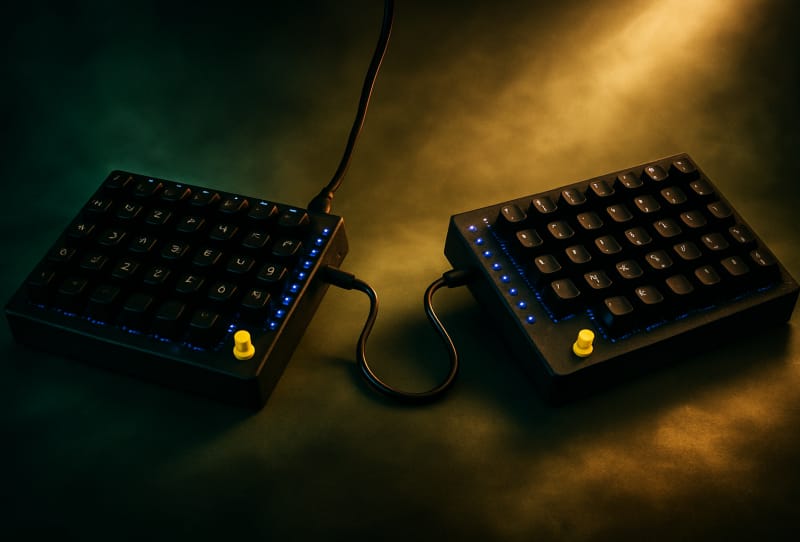
The Tiwaz split keyboard has emerged from a hobbyist workbench project into one of the more unusual entries in the split ergonomic keyboard scene, adding something almost no rival offers: built-in joysticks that turn each half into a standalone gaming controller. Designed by Timo Strube and published as an open-source build on GitHub, the Tiwaz was never meant to be just another comfortable typing tool. It was built from the ground up with gaming in mind, a detail that sets it apart from the ergonomics-first crowd it otherwise resembles.
Most split keyboards, including well-known designs like the MoErgo Glove80 and the ZSA Voyager, are engineered to reduce wrist and shoulder strain for people who type all day. Gaming performance is rarely a priority in that world; if anything, the thinner, minimalist cases favoured by ergonomic designs tend to work against the sturdier build many gamers want. Strube’s project takes the opposite approach, treating gaming capability as a core requirement rather than an afterthought.
Table of Contents
What the Tiwaz split keyboard actually does
According to Strube’s project notes on GitHub, each half of the Tiwaz can function entirely on its own, either as a one-handed game controller or as a dedicated macro pad. That flexibility means left-handed and right-handed users can both use a single half independently, without needing to buy or build the complete pair. It is a practical touch that acknowledges how differently people actually play games, rather than assuming a symmetrical two-handed setup is always the goal.
Every switch position on the board uses hot-swap sockets built for standard MX-style mechanical switches, so owners are not locked into whatever switches shipped with their build. That is a meaningful decision for a project aimed partly at gamers, since switch feel and actuation force are often personal preferences that change over time or between games.
Layout, joysticks and construction details
The Tiwaz uses a split ortholinear layout, meaning keys sit in straight rows and columns rather than the diagonal offsets found in row-stagger or columnar-stagger boards. That alone would make it a fairly conventional split keyboard. What makes it stand out is the pair of thumb joysticks, with one positioned on the inner edge of each half. These can be configured to send cardinal directional input, analog gamepad-style movement, or even mouse cursor control, depending on how the user sets up the firmware.
The board also carries far more keys than most split designs attempt. With 76 keys in total, split 38 per side, the Tiwaz comfortably exceeds the 50 to 60 keys typical of comparable ergonomic keyboards. Strube also chose a gasket-mounted case, a construction method that improves typing feel and dampens vibration but adds thickness and complexity, both things many ergonomic keyboard designs deliberately avoid in the name of a slimmer, lighter case.
| Feature | Tiwaz | Typical split ergonomic keyboard |
|---|---|---|
| Total keys | 76 (38 per side) | 50 to 60 |
| Layout | Split ortholinear | Columnar or row stagger |
| Case mounting | Gasket-mounted | Often minimal or tray-mounted |
| Switch support | Hot-swap, MX-style | Varies, often soldered |
| Gaming input | Dual thumb joysticks per half | Not typically included |
| One-handed use | Each half works standalone | Rarely supported |
How it compares to the split keyboard field
The split keyboard market has grown steadily on the back of ergonomics enthusiasts and typing purists, with boards like the Glove80 and Voyager building loyal followings around comfort rather than competitive input. The Tiwaz sits in a different lane entirely. It borrows the physical logic of a split board, separated halves, adjustable positioning, reduced wrist strain, while bolting on functionality more commonly associated with dedicated controllers or macro pads.
That combination puts it closer in spirit to projects like another open-source split keyboard project using Hall effect switches, where hobbyist designers are pushing past the standard template rather than refining it. It also echoes the broader trend seen in crowdfunded hot-swap keyboards like the Mchose Ace75, where customisation and modularity have become the main battleground for smaller keyboard makers competing against established brands.
What it means for the DIY keyboard community
Because the Tiwaz is open-source, its design files and firmware notes are available for anyone with the soldering skills and patience to attempt a build. That matters more than it might seem. Open hardware projects like this tend to seed ideas that later show up, in refined form, on commercial products once a manufacturer notices genuine demand. A split keyboard with usable analog input is a niche idea today, but it addresses a real gap for players who want ergonomic relief without giving up quick access to directional or cursor control.
For now, the Tiwaz remains a project for builders rather than a retail product, and anyone wanting one will need to source parts, wire switches and flash firmware themselves. That puts it out of reach for casual buyers, but it gives enthusiasts a genuinely fresh template to experiment with, one that treats gaming and ergonomics as compatible goals rather than a trade-off.