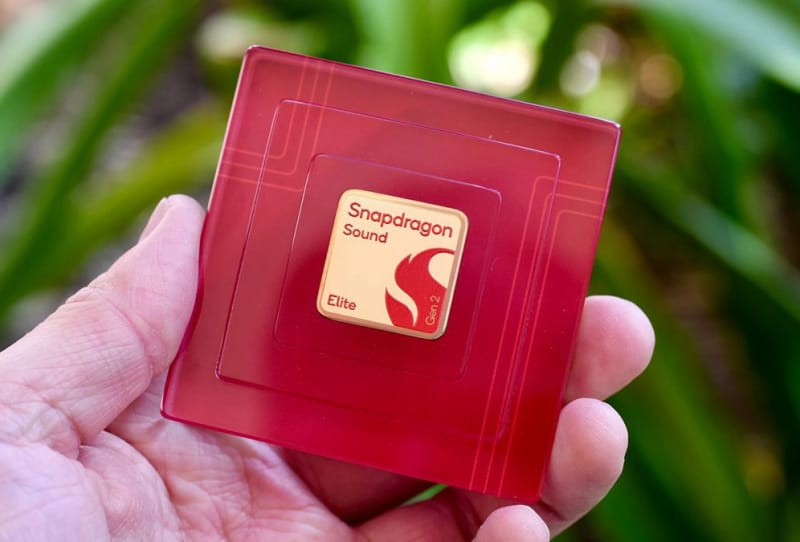
Qualcomm has revealed the Snapdragon Sound Elite Gen 2, a new chip platform designed to let wireless earbuds, smart glasses and other wearables run AI features on their own, without needing a smartphone connected nearby. The company announced the platform at its annual Snapdragon Summit in Hawaii, positioning it as the next step for gadgets that currently rely on a paired phone to do any real thinking.
Until now, most AI-enabled earbuds and glasses have acted as glorified microphones and speakers, streaming audio and voice queries back to a phone or cloud service to get anything smart done. Snapdragon Sound Elite Gen 2 changes that equation by putting enough processing power directly into the accessory itself, so it can interact with AI assistants even when a phone is switched off, out of range or simply left at home.
Table of Contents
What the Snapdragon Sound Elite Gen 2 actually changes
The core idea behind Snapdragon Sound Elite Gen 2 is independence. Rather than treating earbuds or glasses as a dumb accessory tethered to a handset, Qualcomm wants the audio chip itself to handle AI interactions locally. That means a wearer could ask an AI assistant a question, get real-time translation, or trigger a voice command, all without the round trip to a paired smartphone.
This matters because latency and reliability have long been the weak points of voice-driven wearables. Every dropped Bluetooth connection or laggy cloud response undermines the promise of hands-free AI. By moving more of that capability onto the chip inside the earbuds or glasses, Qualcomm is betting that manufacturers can build devices that feel faster and more dependable, even in areas with patchy phone signal.
Qualcomm has built its reputation over the past several years on the original Snapdragon Sound platform, which focused on improving Bluetooth audio quality and stability across certifying earbud and headphone products. Elite Gen 2 extends that lineage into AI territory, suggesting Qualcomm sees standalone intelligence, not just better sound quality, as the next battleground for wearable audio.
Why untethering wearables from phones is a bigger deal than it sounds
Smart glasses have struggled for years to find a workable form factor, largely because they have needed a phone in a pocket to do anything useful. A chip that lets glasses handle AI queries independently removes one of the biggest practical barriers to adoption. Wearers could get real-time information, translations or reminders without first unlocking a handset.
The same logic applies to earbuds. Many buyers already use earbuds as their primary way of talking to voice assistants, but the experience still depends on a stable phone connection. A standalone AI audio chip could make features like live translation or contextual assistance work reliably during a run, a commute on the train, or anywhere connectivity to a paired device is inconsistent.
It also opens the door to new device categories that do not fit the traditional earbud-plus-phone model. A pair of glasses or a clip-on wearable built around Snapdragon Sound Elite Gen 2 could theoretically function as a lightweight AI companion in its own right, rather than existing purely as an accessory to a smartphone.
Part of Qualcomm’s wider AI hardware push
The announcement fits a pattern of chipmakers racing to embed AI processing closer to where people actually use their devices, rather than leaving everything to the cloud. Other silicon makers are chasing on-device AI performance as well, whether that is graphics chips aimed at mobile gaming or processors built for local machine learning tasks. Qualcomm’s move into standalone audio AI slots neatly into that broader industry direction.
It also arrives against the backdrop of Qualcomm’s broader chip pricing strategy, as the company continues expanding its lineup across phones, PCs and now wearables. Positioning Snapdragon Sound Elite Gen 2 as a premium, AI-capable platform gives Qualcomm another avenue to differentiate its silicon from rivals building simpler Bluetooth audio chips.
What it means for buyers and device makers
For everyday shoppers, the immediate impact will depend on which earbud and glasses makers choose to adopt the new platform and how quickly. Chip announcements at events like the Snapdragon Summit typically precede actual consumer products by months, so nobody should expect standalone AI earbuds on shelves immediately.
For manufacturers, the appeal is clear: a ready-made platform that handles AI interaction locally saves them from building that capability from scratch. Companies like Apple have already shown strong demand for smarter earbuds, with Apple’s AirPods 5 already leaning on on-device AI features such as active noise cancellation tuned by onboard processing. Qualcomm’s pitch to Android-aligned brands is a similar promise, but extended further into full AI assistant functionality without a phone in the loop.
Whether Snapdragon Sound Elite Gen 2 becomes the standard that earbud and smart glasses makers build around will come down to real-world products, battery life trade-offs, and how well the promised standalone AI actually performs outside a controlled demo. Qualcomm has laid out the ambition; turning it into gadgets people actually want to wear is the next test.
Frequently asked questions
What is Snapdragon Sound Elite Gen 2?
It is a chip platform from Qualcomm, announced at the Snapdragon Summit in Hawaii, designed to let earbuds, smart glasses and other wearables interact with AI assistants without needing a connected smartphone.
Does this mean earbuds won’t need a phone at all?
Not entirely. The platform is built to let AI features work independently of a paired phone, but many devices will likely still support phone pairing for other functions like music streaming and calls.
When will products with this chip be available?
Qualcomm has not announced specific devices or release dates. Chip platform announcements typically arrive well ahead of consumer products, so actual earbuds or glasses using Snapdragon Sound Elite Gen 2 are expected to follow later.
How is this different from the original Snapdragon Sound?
The original Snapdragon Sound platform focused on improving Bluetooth audio quality and connection stability. Elite Gen 2 builds on that foundation by adding standalone AI processing, letting devices handle AI interactions on their own rather than relying on a paired phone.