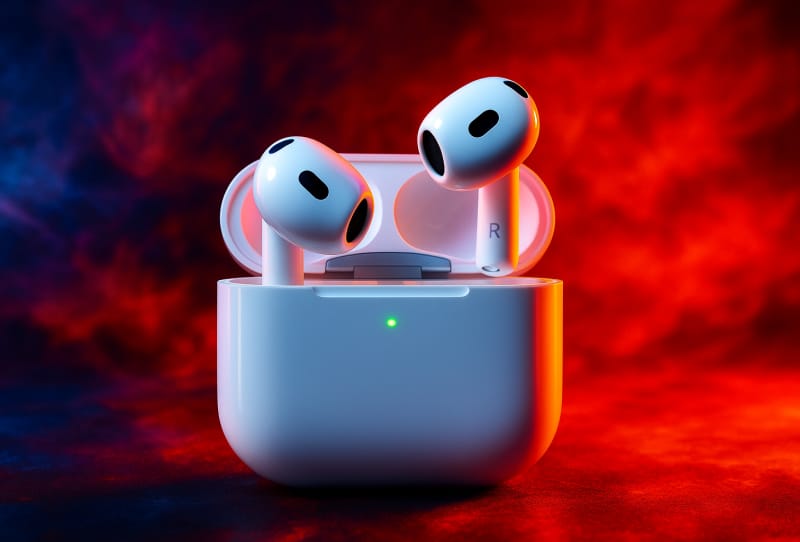
Apple has unveiled the AirPods 5 active noise cancellation upgrade, bringing its most-loved feature to the company’s most affordable earbuds for the first time. The new buds pair an open-ear design with noise cancellation that Apple claims is its best yet in this style, alongside richer sound, a hands-free Siri AI assistant and a new Live Translation tool. Pre-orders opened the day of the announcement, with stock reaching stores from 18 September.
Two versions are on offer. The standard AirPods 5 come with a USB-C charging case, while AirPods 5 with Wireless Charging Case add a force sensor for on-stem volume control and longer battery life. Both represent a notable jump from AirPods 4, particularly for anyone who skipped that generation’s ANC model. For shoppers specifically hunting for the best noise cancellation Apple offers below the Pro tier, AirPods 5 is now the model to watch, and the AirPods 5 noise cancellation upgrade is the single biggest reason this generation is worth a closer look.
Table of Contents
AirPods 5 active noise cancellation, explained
The headline change is noise cancellation performance. Apple says AirPods 5 remove up to 50 per cent more external noise than AirPods 4 with Active Noise Cancellation, a jump it attributes to a new multiport acoustic architecture combined with more advanced computational audio processing. That is a big claim for buds that sit in the ear rather than sealing it, and it puts real pressure on other open-ear designs trying to solve the same problem.
In practical terms, this means AirPods 5 should noticeably dull the low, constant hum of things like aeroplane engines, air conditioning units and passing traffic, even though the earbuds do not form the tight in-canal seal that dedicated noise-cancelling models such as AirPods Pro 3 rely on. Apple’s engineers have instead leaned on multiple microphones and a faster processing chip to model incoming noise and cancel it out digitally, updating that model many times per second as the wearer moves through different environments. It won’t match a sealed-fit earbud for blocking sudden, sharp sounds, but for everyday background noise it is a meaningful step up from the AirPods 4 ANC model it replaces.
Transparency mode has also been reworked, with Apple promising a more natural rendering of voices and ambient sound. Adaptive Audio blends Transparency and ANC automatically depending on the environment, so users are not manually switching modes on a train platform or in a quiet office. Conversation Awareness, meanwhile, automatically lowers media volume the moment the wearer starts speaking, a small but genuinely useful touch for anyone who takes calls with earbuds in.
Apple also points to a redesigned foam-free vent system that reduces the “occlusion effect” many open-ear ANC wearers notice, that slightly boomy, plugged-up sensation of hearing your own voice too loudly. By venting pressure more evenly around the driver, AirPods 5 aim to feel closer to a natural, unsealed listening experience even while active noise cancellation is running. Combined with the updated H2-class chip handling audio processing, the earbuds recalculate the ambient noise profile up to 48,000 times per second, which is why Apple is comfortable using ANC branding on an open-ear product for the first time.
Fit still plays a role in how well any earbud noise cancellation performs, even on an open-ear design. Apple ships AirPods 5 with multiple ear tip-free stabiliser options so wearers can find the snuggest possible placement without a silicone seal, since a looser fit lets more ambient noise leak in before the ANC circuitry has a chance to process it. Apple also recommends keeping firmware up to date, as noise cancellation tuning can be refined further through software updates, much like earlier AirPods generations received periodic ANC improvements after launch.
Richer sound from a redesigned acoustic architecture
Sound quality gets attention too. Apple says the new multiport acoustic architecture and next-generation Adaptive EQ, both inspired by the flagship AirPods Pro 3, deliver richer and more detailed audio across a wider range of ear shapes. In practice, that should mean fewer users complaining about thin bass or an inconsistent seal, since Adaptive EQ tunes the sound in real time based on how each ear fits the bud.
This acoustic redesign also plays a direct role in how well the noise cancellation performs. Because the multiport architecture manages airflow and pressure around the driver more precisely, Apple has been able to reduce the whistling or pressure-build sensation that sometimes affects open-ear ANC designs, while still allowing the earbud to sit comfortably without a silicone tip. The result, according to Apple, is noise cancellation that feels less intrusive over long listening sessions than earlier open-ear attempts.
Personalised Spatial Audio benefits from the same redesign, with Apple describing a more immersive, dynamic result when listening to compatible content. It is a meaningful upgrade path for anyone weighing up AirPods 5 against rival open-ear earbuds like JBL’s Endurance Zone, where spatial audio support and tuning consistency have often lagged behind Apple’s ecosystem advantages. Apple also notes that the driver placement has shifted slightly closer to the ear canal opening compared with AirPods 4, a small physical change that contributes both to the improved bass response and to how effectively the ANC circuitry can target low-frequency noise before it reaches the eardrum.
Siri AI and Live Translation, hands-free
Paired with an Apple Intelligence-supported iPhone, AirPods 5 unlock a noticeably smarter Siri. The new Siri AI, rolling out in beta through iOS 27, understands personal context across messages, emails and photos, and can take app actions using broad world knowledge rather than rigid commands. Apple’s example is asking Siri to play a song a friend mentioned in a text, or to navigate to a dinner booking buried in an email confirmation.
Siri Interactions let wearers respond to prompts by simply nodding or shaking their head, useful when speaking aloud is not practical. Live Translation, powered by Apple Intelligence, is activated by pressing both stems simultaneously or asking Siri directly, and currently supports languages including English, French, German, Italian, Japanese, Korean, Spanish, Portuguese and both simplified and traditional Mandarin Chinese. It builds on the same open-ear ANC design shift Apple already flagged for the AirPods 5 range, extending that groundwork into a genuinely practical communication tool.
Noise cancellation and Live Translation are also designed to work together rather than in isolation. Because ANC reduces the ambient noise the microphones need to filter out, Apple says speech recognition accuracy for both Siri commands and Live Translation improves in noisier settings like cafes or airports, where earlier AirPods models without ANC often struggled to isolate a speaker’s voice clearly.
Two models compared
Choosing between the two AirPods 5 models comes down to charging and control preferences rather than sound or noise cancellation, since both share the same acoustic upgrades. Whichever version you choose, the active noise cancellation, Transparency mode, Adaptive Audio and Conversation Awareness features behave identically, so buyers can base their decision purely on charging convenience and battery life rather than worrying about a compromised ANC experience on the cheaper model.
| Feature | AirPods 5 | AirPods 5 with Wireless Charging Case |
|---|---|---|
| Charging case | USB-C | USB-C plus Qi and Apple Watch charger support |
| Volume control | Standard stem controls | Force sensor with volume swipe |
| Listening time with ANC | Standard AirPods 5 battery life | Up to 22 hours with the case |
| Find My support | Yes | Yes, with a built-in speaker in the case |
| Durability | Improved dust, sweat and water resistance | Improved dust, sweat and water resistance |
Both cases include Find My tracking, though the Wireless Charging Case adds a built-in speaker so a misplaced case can be located by sound, not just a map pin. For buyers who regularly charge on the go without access to a Qi pad or Apple Watch puck, the standard USB-C-only case is arguably the more practical everyday choice despite the shorter maximum listening time.
What the AirPods 5 upgrade means for buyers
Bringing genuine ANC down to Apple’s entry-level earbuds changes the calculation for a lot of shoppers who previously had to pay more for AirPods Pro to get real noise cancellation. That matters because open-ear noise cancellation across every AirPods model was clearly the direction Apple was heading, and AirPods 5 is the clearest evidence yet that the feature is no longer reserved for the premium tier.
For the wider earbuds market, the pressure now shifts to brands chasing the open-ear category without Apple’s software ecosystem behind them. Siri AI and Live Translation are difficult features for third-party makers to match quickly, since both rely on Apple Intelligence running on a paired iPhone rather than anything built into the earbuds themselves. That said, the improved acoustic architecture and stronger ANC numbers are things any competitor can, in theory, chase with better hardware alone.
Existing AirPods 4 owners without ANC have a straightforward reason to consider upgrading, particularly if noise cancellation was the feature they wished they had paid for the first time. For everyone else, AirPods 5 lands as a rare case of Apple pushing a flagship feature further down its lineup rather than reserving it for the top of the range. Commuters, open-plan office workers and frequent flyers who found earlier open-ear buds too leaky for noisy environments are likely to notice the difference most, while anyone needing maximum isolation for very loud settings should still look to AirPods Pro 3 or a sealed third-party alternative.
Price positioning also matters here. By slotting genuine ANC into the mid-tier AirPods line rather than keeping it exclusive to AirPods Pro 3, Apple effectively narrows the practical gap between its cheapest and most expensive earbuds. Buyers who mainly want quieter commutes and clearer calls, rather than studio-grade isolation or advanced fitness features, may find AirPods 5 delivers most of what they actually use day to day at a noticeably lower price point.
Frequently asked questions
Does the AirPods 5 noise cancellation work as well as AirPods Pro 3?
Not quite. AirPods Pro 3 use an in-ear, sealed fit that physically blocks more sound before any digital processing happens, so they still offer stronger overall isolation. AirPods 5 close much of that gap for an open-ear design, cutting up to 50 per cent more noise than the AirPods 4 ANC model, but a sealed earbud remains the better choice for very loud environments like flights or busy building sites.
Can I use AirPods 5 noise cancellation without an iPhone?
Yes. Active noise cancellation, Adaptive Audio and Transparency mode are all processed on the earbuds themselves, so they work with any Bluetooth-paired device, including Android phones and laptops. Siri AI and Live Translation, however, require an Apple Intelligence-supported iPhone running iOS 27 to function.
Do both AirPods 5 models have the same noise cancellation?
Yes. The standard AirPods 5 and the AirPods 5 with Wireless Charging Case share identical acoustic hardware, Adaptive EQ tuning and noise cancellation performance. The only differences between the two models relate to the charging case and stem controls, not sound or ANC quality.
When do AirPods 5 arrive in stores?
Pre-orders opened on the day Apple announced AirPods 5, with general stock arriving in stores from 18 September.