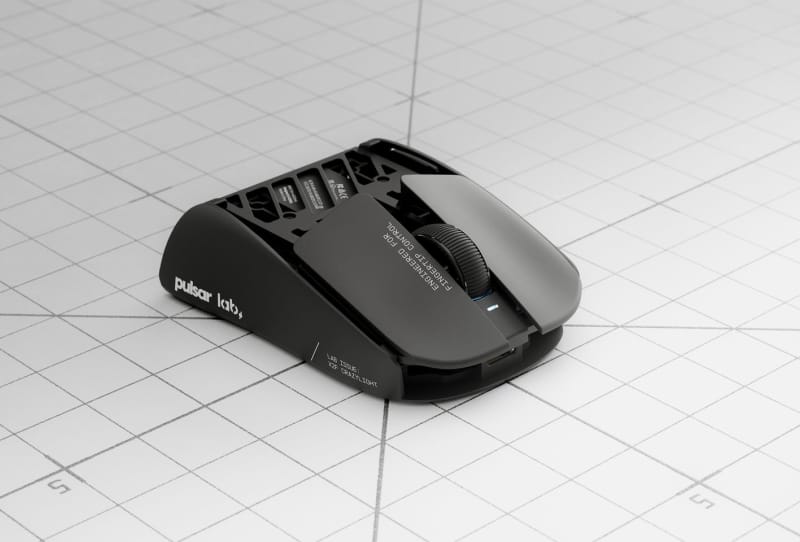
The Pulsar X2F CrazyLight is a new wireless fingertip gaming mouse that weighs just 29 grams, a 24 percent reduction from the original X2F. Pulsar has paired that weight cut with an updated sensor and faster response settings, aiming squarely at competitive players who grip their mouse by the fingertips and want every gram removed without losing tracking accuracy.
Key takeaways
- ✓The Pulsar X2F CrazyLight weighs 29 grams, a 24 percent cut from the original X2F.
- ✓It uses Pulsar's X2-S sensor with tracking up to 42,000 DPI, 800 IPS and 70G acceleration.
- ✓The mouse supports 8kHz polling and a 20K lock mode that trades battery life for response speed.
- ✓Pulsar Optical Switches are rated for 100 million clicks, paired with a dust-resistant TTC Gold scroll encoder.
- ✓Customisation is handled through Pulsar's downloadable driver or the software-free Bibimbap web driver.
Shaving 9 grams off an already light design is no small feat, and it signals how far fingertip-style mice have come in the past few years. Where lightweight gaming mice once meant drilled shells and fragile plastic, Pulsar has managed the cut while keeping the shape symmetrical and the internals more capable than before. That combination of lower weight and higher performance is the real story behind the launch.
Table of Contents
What changed in the Pulsar X2F CrazyLight design
The CrazyLight keeps the symmetrical, fingertip-friendly shape of the original X2F, measuring 87.5 by 31.1 by 31.6 millimetres. Nothing about the footprint has changed, which means existing X2F users switching to the CrazyLight should feel instantly at home with grip and hand position.
What has changed is everything inside. Pulsar rebuilt the internals around a new sensor and lighter components to hit the 29 gram figure, rather than simply hollowing out the shell further. The shell itself is a blend of ABS and nylon, chosen for a stiffness-to-weight balance that keeps the mouse feeling solid despite the aggressive weight target.
Sensor, polling rate and performance specs
At the centre of the update sits Pulsar’s X2-S gaming sensor, which the company claims can track accurately at up to 42,000 DPI, with 800 IPS of tracking speed and 70G of acceleration headroom. Those numbers put it comfortably in line with the sensors found in other premium wireless mice released over the past year, and they matter most to players making fast, low-sensitivity flicks in competitive shooters.
The mouse also runs an 8kHz polling rate, reporting its position to a connected PC eight times more often per second than a standard 1000Hz mouse. Pulsar has added a 20K lock mode on top of that, which fixes the frame rate for more consistent response timing at the cost of shorter battery life between charges. It is a trade-off aimed squarely at tournament and ranked play, where players may prioritise consistency over longevity.
| Spec | Detail |
|---|---|
| Weight | 29g (down 9g, or 24%, from the original X2F) |
| Sensor | Pulsar X2-S |
| Max tracking | 42,000 DPI, 800 IPS, 70G acceleration |
| Polling rate | 8kHz, with 20K lock mode |
| Dimensions | 87.5 x 31.1 x 31.6 mm |
| Switches | Pulsar Optical Switches, rated for 100 million clicks |
| Scroll encoder | TTC Gold, dust-resistant design |
| Shell material | ABS and nylon blend |
Build quality, switches and the scroll wheel
Pulsar has fitted the CrazyLight with its own optical switches, rated for 100 million clicks. Optical switches use a beam of light rather than a physical metal contact to register a click, which generally means less bounce and a longer service life before the switch starts double-clicking or misfiring.
The scroll wheel uses a TTC Gold encoder, which Pulsar says offers a more durable and dust-resistant design than the encoders found in earlier models. Underneath, the mouse ships with both dot skates and full-cover feet, letting players choose between a glidier, lower-friction feel or fuller surface contact depending on their mousepad and playstyle. It is a small inclusion, but one that matters to players who are particular about how a mouse feels mid-swipe.
Software and customisation options
Buyers can configure the X2F CrazyLight either through Pulsar’s downloadable driver software or via the Bibimbap web driver, a browser-based tool that lets owners adjust settings without installing anything locally. That second option is a genuinely useful touch for anyone using the mouse across multiple machines, such as a home rig and a LAN event laptop, since there is nothing to reinstall each time.
Both tools cover the expected ground: DPI stages, polling rate, button remapping and lighting where applicable. The presence of a lightweight web driver alongside a full desktop client gives the CrazyLight more flexibility than mice that lock configuration behind a single downloadable app.
How it stacks up and what it means for buyers
Sub-30 gram wireless mice were a rarity not long ago, and now they are becoming a genuine category, with brands including wireless rivals like the Logitech G502 X Plus pushing lighter designs while keeping wireless reliability intact. The CrazyLight’s approach, keeping the same shape as its predecessor while cutting weight through internal redesign, is a sensible way to iterate without asking loyal users to relearn their grip.
For players who already found the original X2F comfortable, the CrazyLight is a straightforward upgrade path: same shape, less mass, faster sensor and a higher ceiling on polling rate. Anyone considering a first Pulsar mouse might also look at Pulsar’s ergonomic X5 mouse for a different grip style within the same ecosystem. Full specifications and availability details are listed on Pulsar’s official website.
Frequently asked questions
How much does the Pulsar X2F CrazyLight weigh?
The Pulsar X2F CrazyLight weighs 29 grams, which is 9 grams, or 24 percent, lighter than the original X2F it replaces.
What sensor does the X2F CrazyLight use?
It uses Pulsar’s X2-S gaming sensor, rated for tracking up to 42,000 DPI, 800 IPS and 70G of acceleration.
Does the X2F CrazyLight support 8kHz polling?
Yes, the mouse supports an 8kHz polling rate, plus a 20K lock mode that fixes the frame rate for faster, more consistent response at the cost of battery life.
Can the X2F CrazyLight be customised without installing software?
Yes, alongside Pulsar’s downloadable driver, the mouse can be configured through the Bibimbap web driver, a browser-based tool that requires no local installation.