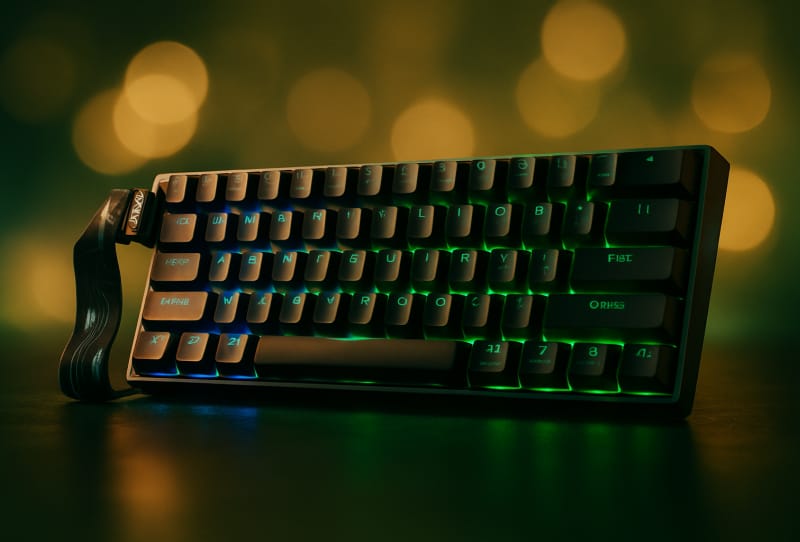
The Epomaker HE60 is a new 60% wireless gaming keyboard that brings Hall effect magnetic switches, dual wireless connectivity and 8 kHz polling to a price point well below most rivals in the category. It lands as a direct answer to the Wooting 60HE, borrowing its compact layout and much of its design language while undercutting it on cost.
Key takeaways
- ✓The Epomaker HE60 is a 60% wireless Hall effect keyboard aimed at the budget gaming segment.
- ✓It supports Bluetooth, 2.4 GHz and USB-C, with 8 kHz polling over 2.4 GHz and wired modes.
- ✓Adjustable actuation runs from 0.1 mm to 3.3 mm, with SOCD and DKS customisable via Epomaker Hub.
- ✓The design closely mirrors the Wooting 60HE, including its tray-mount ABS case and carry strap.
- ✓Stock Creamy Jade Magnetic linear switches use a POM stem with 30 to 55 gf actuation force.
Epomaker released the HE60 shortly after launching the HE65 V2, continuing a rapid run of Hall effect releases aimed at gamers who want magnetic switch performance without paying flagship prices. Hall effect keyboards use magnetic sensors under each key instead of mechanical contacts, which lets manufacturers offer adjustable actuation points and rapid-trigger style features that were once limited to a handful of premium boards.
Table of Contents
Epomaker HE60 design and build
Visually, the HE60 leans heavily on the Wooting 60HE’s playbook. It uses the same tray-mount ABS case construction and even includes an identical carry strap along the left edge, a detail that makes the resemblance hard to miss. Rather than treat that as a shortcut, Epomaker has used it as a starting point and worked to address the usual downside of tray-mount cases: hollow, reverberating keystrokes.
To tame that sound, the company has packed the case with five separate layers of damping material. These include PCB foam, a dedicated switch pad, what Epomaker calls a “sound-enhancing pad,” latex foam wrapped around the switch sockets, and a silicone pad on the base. An aluminium plate sits beneath the switches, paired with plate-mounted stabilisers, which should help keep larger keys like the spacebar and shift consistent rather than wobbly or rattly.
The 60% layout strips away the function row, navigation cluster and numpad, which keeps the footprint small and desk space free for mouse movement, a layout choice that remains popular with competitive players despite requiring a layer-shift to access keys like F-row shortcuts or arrow keys.
Connectivity, battery and polling rate
Wireless flexibility is one of the HE60’s stronger selling points. It supports Bluetooth for everyday use across multiple devices, a proprietary 2.4 GHz connection for lower latency gaming, and a wired USB Type-C mode for when the battery runs dry or the lowest possible latency is required. A mode switch hidden under the Caps Lock key handles swapping between these connection types.
The headline figure here is 8 kHz polling, which the HE60 can hit over both the 2.4 GHz wireless link and the wired USB-C connection. That is a notably high polling rate for a keyboard at this price, since 8 kHz support typically appears on keyboards costing considerably more. A faster polling rate means the keyboard reports its state to a PC more frequently, which can translate into marginally lower input latency in fast-paced games.
Battery capacity comes in at 8,000 mAh, a sizeable cell for a compact board. Epomaker has not published an official runtime estimate, but a battery of that size should comfortably cover days of typical use between charges, particularly with Bluetooth rather than the more power-hungry 2.4 GHz mode engaged.
Switches, actuation and software
As a Hall effect keyboard, the HE60 supports adjustable actuation across a wide 0.1 mm to 3.3 mm range, letting users tune how far a key needs to travel before it registers. It also includes SOCD (simultaneous opposing cardinal directions) handling and DKS (dynamic keystroke) support, both of which can be configured through Epomaker’s browser-based Epomaker Hub software rather than a separate desktop app.
Out of the box, the HE60 ships with Epomaker’s own Creamy Jade Magnetic linear switches. These are closed-bottom switches rated at 30 to 55 gf actuation force, built with a POM stem, a polycarbonate upper housing and a PA66 bottom housing, plus a 20 mm spring. That combination of materials is aimed at delivering a smooth, consistent keystroke feel without the scratchiness that can affect cheaper linear switches.
The HE60 arrives into a crowded but fast-growing field. Boards like other recent entrants in the Hall effect keyboard space and a more experimental, open-source Hall effect board show just how quickly magnetic switch technology has spread beyond flagship products. For buyers comparing options, it is also worth weighing the HE60 against higher-end Hall effect keyboards like the ASUS ROG Azoth 96 HE, or against conventional wireless boards such as premium wireless keyboards such as the Logitech G915 X TKL, to see what the extra spend typically buys.
What it means for budget-conscious gamers
The real significance of the Epomaker HE60 is not any single spec, but where that spec sheet sits on the price ladder. Adjustable actuation, SOCD, DKS and 8 kHz polling were all once reserved for enthusiast-tier keyboards costing significantly more. Epomaker’s decision to bundle all of it into an affordable 60% board, while also addressing the acoustic weakness of tray-mount cases with heavy internal damping, suggests the Hall effect category is maturing fast.
For anyone shopping for a compact wireless gaming keyboard who wants magnetic switch flexibility without committing to a premium price bracket, the HE60 is a board worth watching. It will not suit everyone, since a 60% layout demands some adjustment, and buyers who rely heavily on dedicated arrow keys or a numpad may prefer a larger format. But for competitive players chasing low latency and tunable actuation in a small footprint, Epomaker has built a strong case for itself.
Frequently asked questions
What makes the Epomaker HE60 different from a normal mechanical keyboard?
The HE60 uses Hall effect magnetic switches rather than traditional mechanical contacts, which allows adjustable actuation points, rapid-trigger style features like SOCD and DKS, and more consistent long-term durability since there is no physical metal contact wearing down over time.
Does the Epomaker HE60 support 8 kHz polling over Bluetooth?
No, the 8 kHz polling rate is only available over the 2.4 GHz wireless connection or the wired USB Type-C connection. Bluetooth mode runs at a lower polling rate, which is typical for Bluetooth keyboards generally.
What switches come with the Epomaker HE60 by default?
The keyboard ships with Epomaker’s own Creamy Jade Magnetic linear switches, rated at 30 to 55 gf actuation force, featuring a POM stem, polycarbonate upper housing, PA66 bottom housing and a 20 mm spring.
How long does the Epomaker HE60 battery last?
Epomaker has not published an official battery life figure, but the keyboard uses an 8,000 mAh cell, which is a large capacity for a 60% board and should support several days of typical use between charges, especially over Bluetooth.