The DroidDeck Android app lets Snapdragon-powered phones run Steam and Windows PC games locally, with Cyberpunk 2077 hitting a playable 60 FPS in early testing. No PC, console or cloud server does the heavy lifting here. The games run directly on the handset’s own chip, which is a notably different approach from the remote-play tools most mobile gamers already know.
Key takeaways
- ✓DroidDeck is an open-source app that runs Steam and Windows PC games locally on Android, with no PC or cloud streaming involved.
- ✓Tester ETA Prime got Cyberpunk 2077 running at around 60 FPS on medium settings on a RedMagic 11 Pro.
- ✓The phone used a Snapdragon 8 Elite Gen 5 chip with 16 GB of memory.
- ✓Skyrim Special Edition also hit roughly 60 FPS at 720p, while Hogwarts Legacy struggled at around 40 FPS.
- ✓Unlike Steam Link, DroidDeck loads Valve's ARM64 Linux Steam client and Proton directly on the device, and it does not need root access or a replacement operating system.
The open-source project has started circulating online after YouTuber ETA Prime put it through its paces on a RedMagic 11 Pro, a gaming phone built around Qualcomm’s Snapdragon 8 Elite Gen 5 and loaded with 16 GB of memory. The results suggest that a reasonably specced Android phone can now do a passable impression of a Steam Deck, without any of the streaming lag that usually comes with playing PC games on a phone.
Table of Contents
How the DroidDeck Android app runs PC games without a PC
Most phone-based PC gaming until now has relied on streaming. Services like Steam Link send video from a desktop or laptop over a network connection, which means performance is capped by bandwidth and latency rather than the phone’s own silicon. DroidDeck skips that entirely.
Instead, it packages Valve’s ARM64 build of the Linux Steam client and runs it in Big Picture mode as a standard Android app. Windows-only titles are handled through Valve’s ARM64 version of Proton, the compatibility layer that translates x86 Windows instructions so they can run on ARM-based hardware. That is the same underlying technology that makes the Steam Deck’s Windows game library possible, just repurposed for a phone’s processor instead of a handheld PC’s.
Because everything happens on-device, DroidDeck also manages GPU driver switching and a handful of upscaling and frame generation tools, including AMD’s FSR, Qualcomm’s own Snapdragon GSR upscaling, and frame generation via Lossless Scaling. Those features matter more on a phone than on a desktop, since squeezing extra frames out of a mobile GPU is often the difference between a game being playable and being a slideshow.
Cyberpunk 2077, Skyrim and Hogwarts Legacy put to the test
Early results, as reported by VideoCardz, paint a genuinely promising picture for a project still in its early days. On the RedMagic 11 Pro, Cyberpunk 2077 ran at around 60 FPS on medium settings, a notable result for a game that still challenges plenty of gaming laptops.
Skyrim Special Edition performed similarly well, holding close to 60 FPS at 720p resolution. Hogwarts Legacy proved tougher, which lines up with how demanding that game remains even on dedicated PC hardware. It settled at roughly 40 FPS, and that was only achieved after dropping to lower settings and leaning on FSR upscaling to claw back performance.
Those numbers will shift as the project matures and as more phones get tested against it. A single RedMagic 11 Pro running three games is not a full benchmark suite, but it is enough to show that current flagship Snapdragon silicon has real headroom for native PC gaming, not just lightweight emulation of older consoles.
DroidDeck versus Steam Link and SteamOS phone mods
DroidDeck sits in an interesting middle ground between two existing approaches to phone-based PC gaming. Steam Link and similar streaming tools need a second device doing the actual game rendering, with the phone acting purely as a display and controller. That works well on a strong home network but falls apart the moment latency or bandwidth gets shaky.
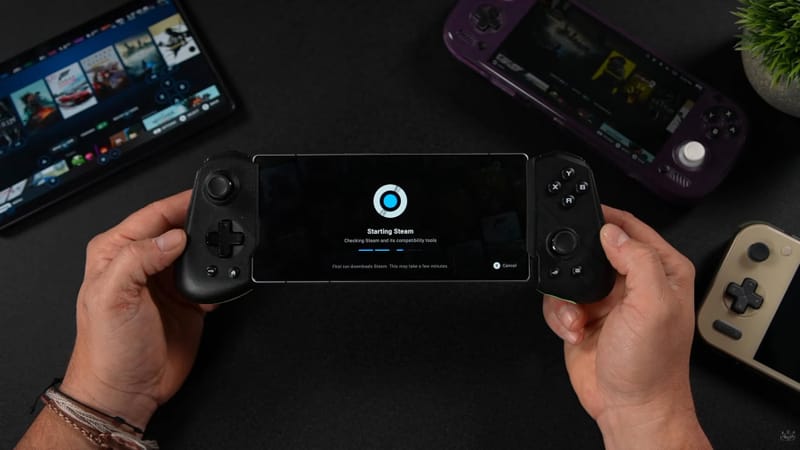
At the other extreme, projects like Armada take Android handhelds and replace the operating system entirely with SteamOS, Valve’s own Linux-based platform used on the Steam Deck. That delivers a more native experience but demands flashing a new OS onto the device, which is a bigger commitment and carries real risk for anyone unfamiliar with the process.
DroidDeck avoids both trade-offs. It installs as a normal Android app, needs no root access, and leaves the phone’s existing operating system untouched. For anyone curious about installing PC games through Steam on unconventional hardware, that low-friction setup is arguably DroidDeck’s biggest selling point over rival approaches.
What it means for mobile and handheld gaming
The timing is notable. Interest in handheld PC gaming has grown steadily since the Steam Deck’s launch, and Steam Deck’s library of verified games has swelled to tens of thousands of titles as developers optimise for ARM and Linux compatibility. DroidDeck effectively asks whether an everyday Android flagship, which most people already own, could do a similar job without any extra hardware purchase.
It also fits into a wider pattern of developers finding creative workarounds to run software outside its intended ecosystem, in the same spirit as other projects chasing console emulation without traditional emulators. Games such as Cyberpunk 2077 remain a popular benchmark for these efforts, partly because the title’s demanding visuals make any performance win easy to notice, and partly because Cyberpunk 2077 is also heading to the big screen, keeping the game firmly in the cultural conversation.
There are obvious limits. DroidDeck is an early, open-source project rather than a polished consumer product, and results will vary heavily by phone, chipset and game. Battery drain, heat management and controller support on non-gaming phones remain open questions. Still, the fact that a current Snapdragon flagship can run a game like Cyberpunk 2077 at a steady 60 FPS without touching a PC says something about how far mobile hardware, and the software built to exploit it, has come.
Frequently asked questions
What is the DroidDeck Android app?
DroidDeck is an open-source application that lets Snapdragon-powered Android devices run Valve’s Steam client and Windows PC games directly on the device, rather than streaming them from a PC or a cloud server.
Does DroidDeck need root access to work?
No. DroidDeck installs as a standard Android app and does not require root access or replacing the phone’s operating system, unlike projects that convert Android handhelds into SteamOS devices.
Which phone was used to test DroidDeck?
YouTuber ETA Prime tested DroidDeck on a RedMagic 11 Pro fitted with a Snapdragon 8 Elite Gen 5 chip and 16 GB of memory, where Cyberpunk 2077 reached around 60 FPS on medium settings.
How is DroidDeck different from Steam Link?
Steam Link streams gameplay from a separate PC over a network connection, while DroidDeck runs the Steam client and games locally on the phone itself using Valve’s ARM64 Steam build and Proton compatibility layer.