
MIT engineers have created a soft shape-sensing skin that reconstructs its own three-dimensional shape and touch in real time, accurate to within roughly half a centimetre. It is a development aimed squarely at gaming, virtual reality and physical rehabilitation technology, where soft, flexible materials that can still track precise movement have long been difficult to build.
Key takeaways
- ✓MIT engineers built a silicone sheet embedded with optical fibres that senses its own 3D shape and touch
- ✓The shape-sensing skin reconstructs movement with accuracy to within roughly half a centimetre
- ✓It is aimed at gaming controllers, VR haptic suits and physical therapy monitoring tools
- ✓Unlike rigid sensors or camera-based motion capture, the material stays soft and flexible under deformation
- ✓The technology remains a research prototype, with no confirmed commercial product or release timeline
The research tackles a problem that has quietly limited wearable tech for years: rigid sensors are easy to make accurate, but they do not bend or stretch the way skin, clothing or a game controller’s grip surface needs to. Soft materials solve the comfort problem but have historically struggled to report their own shape with any real precision. MIT’s new material is an attempt to get both at once.
Table of Contents
How the shape-sensing skin works
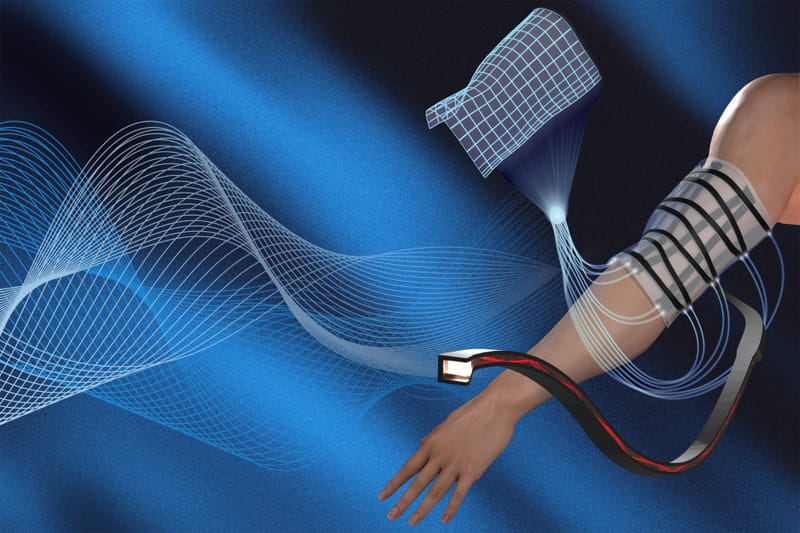
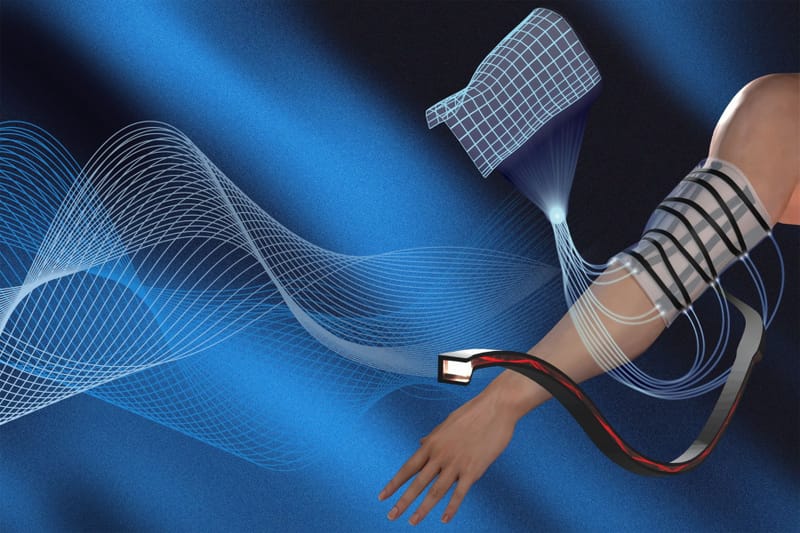
At its core, the shape-sensing skin is a thin silicone sheet with soft optical fibres woven through it. As the sheet stretches, bends or gets pressed by a finger, the fibres distort in subtle, measurable ways, changing how light travels and scatters through them.
Rather than relying on a grid of discrete sensors, the system uses the pattern of light changes across the whole sheet to computationally reconstruct its shape and the location of any touch. That whole-surface approach is what lets it report both broad deformation, such as the sheet bending around a joint, and localised contact, such as a fingertip press, from the same piece of material.
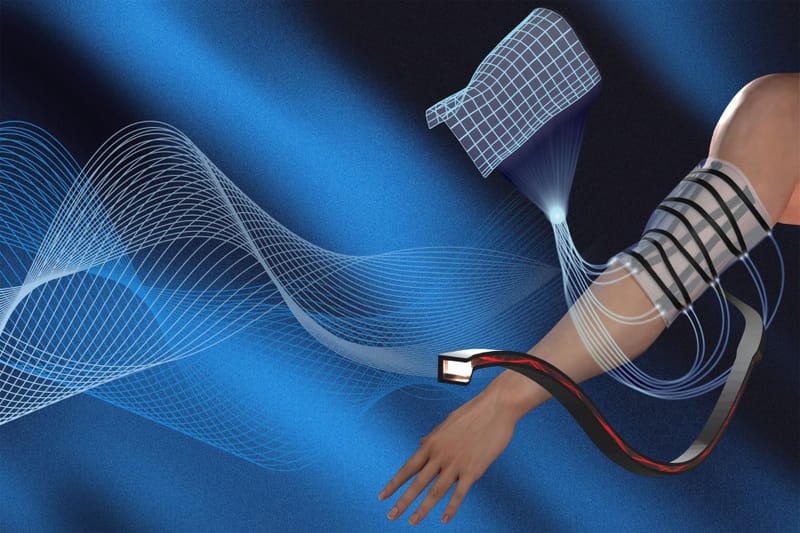
The sub-half-centimetre accuracy MIT reports is notable because it puts a genuinely soft, stretchable material in the same ballpark of precision as far more rigid sensing hardware, without sacrificing the flexibility that makes it wearable in the first place.
Why soft shape sensing has been so hard to crack
Most motion tracking used in gaming and VR today leans on one of two approaches. Camera-based systems, like those used in professional motion capture, need a clear line of sight and struggle when a limb or object is occluded. Inertial sensor suits, built from accelerometers and gyroscopes, avoid the line-of-sight problem but tend to drift over time and only measure at fixed points rather than continuous surfaces.
A soft sheet that senses its own shape sidesteps both limitations. It does not need a camera watching it, and because the sensing is spread across the whole material rather than concentrated at a handful of points, it can capture deformation anywhere on its surface, not just where a chip happens to sit.
That is also why the material has value beyond gaming. In physical therapy, a garment or wrap that can continuously report how a joint is moving and where pressure is being applied could help clinicians track recovery without needing a lab full of cameras or wired sensors stuck to the skin.
What it could mean for gaming and VR
For gaming specifically, a soft, self-sensing material opens up control surfaces that do not exist in current hardware. A deformable game controller shell that reads how hard and where it is squeezed, or a soft-touch panel built into a headset or haptic vest, could feed far richer input into a game than today’s buttons, triggers and rigid controller bodies.
Virtual reality is an obvious testing ground. VR already pushes hard on immersive input, from immersive gaming display setups through to full-body haptic suits, and a lightweight, flexible shape sensor fits naturally into gloves, suits or skin-tight attachments where rigid electronics are impractical. It also complements the kind of compact, unconventional controller designs hardware makers have been experimenting with as they look for new ways to pack sensing into smaller, more comfortable form factors.
There is a direct line, too, to the broader push for more sensitive, more precise precision input devices built for gaming, where manufacturers are constantly chasing finer-grained sensing in smaller packages. A soft material that reports shape and touch across an entire surface, rather than through a single sensor chip, represents a genuinely different direction for that race.
A prototype, not a product
It is worth being clear about where this sits today. MIT’s shape-sensing skin is a research prototype, developed and demonstrated in a lab setting, not a shipping component inside any headset, controller or wearable. There is no confirmed timeline for commercialisation, no named manufacturing partner, and no indication yet of cost or durability outside controlled testing.
That said, the gap between a university lab demonstration and a shelf product has narrowed noticeably for soft robotics and flexible electronics over the past decade. Hardware makers in gaming and VR are actively hunting for new ways to make controllers, suits and headsets feel more natural, and a material that senses its own deformation without rigid components addresses a genuine gap rather than a novelty. Whether it ends up in a shipping product or simply influences the next generation of soft sensors, the underlying idea, that an entire surface can sense itself rather than relying on scattered sensor points, is likely to show up in future gaming and VR hardware in some form.
Frequently asked questions
What is MIT’s shape-sensing skin made of?
It is a thin silicone sheet with soft optical fibres embedded throughout. The fibres distort as the sheet bends, stretches or gets pressed, and those changes in light are used to reconstruct the sheet’s shape and touch location.
How accurate is the shape-sensing skin?
MIT reports accuracy to within roughly half a centimetre, which is a strong result for a soft, stretchable material and puts it close to the precision typically associated with rigid sensor hardware.
Will this technology appear in gaming or VR products soon?
Not yet. It remains a research prototype with no confirmed commercial partner, product or release date. Soft sensing materials like this typically take years to move from a lab demonstration into consumer hardware.
Why does soft shape sensing matter for VR specifically?
VR relies heavily on tracking natural body movement and touch. A soft material that senses its own shape without cameras or rigid electronics could enable more comfortable, more accurate gloves, suits and controller surfaces than current tracking methods allow.