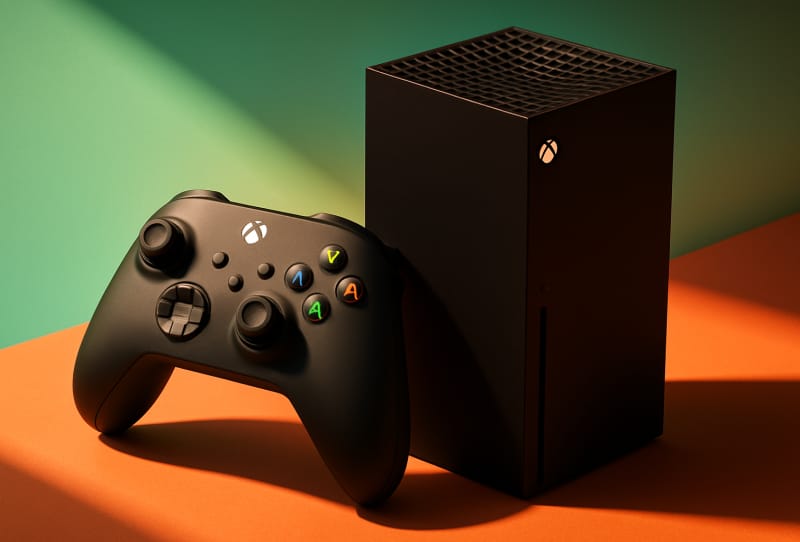
AMD’s machine-learning upscaler is reportedly on its way to Microsoft’s console, with FSR 4.1 on Xbox Series X said to bring the kind of sharper, more stable image quality that Sony’s PlayStation 5 Pro has already offered through its own AI-driven upscaling. If the move happens as described, it would mark the first time Xbox’s current generation hardware gets access to AMD’s newest upscaling model rather than the older, shader-based version it has relied on since launch.
Key takeaways
- ✓AMD's machine-learning upscaler FSR 4.1 is reportedly coming to Xbox Series X and Series S
- ✓FSR 4 launched in 2025 exclusively on RDNA4 Radeon graphics cards before expanding further
- ✓Xbox Series X's older RDNA2 GPU lacks FSR 4's dedicated AI hardware, so results may differ from PC
- ✓Sony's PS5 Pro already runs a comparable AI upscaler called PSSR, raising pressure on Microsoft
- ✓AMD and Microsoft have not confirmed an official rollout date or supported game list yet
The news matters because upscaling has become one of the biggest levers for console image quality this generation. Native 4K rendering is still too demanding for most big-budget games to hit 60 frames per second on a console GPU, so developers lean on upscalers to reconstruct a sharp image from a lower internal resolution. Whichever platform has the better upscaler effectively has the better-looking games, even when the underlying silicon is similar.
Table of Contents
What FSR 4.1 Actually Changes
FidelityFX Super Resolution has gone through several distinct generations since AMD first launched it in 2021. The earliest versions used spatial and temporal reconstruction techniques, essentially clever maths running on standard shader hardware. FSR 4, which debuted in 2025 alongside AMD’s Radeon RX 9070 series, was a much bigger departure. It replaced that older approach with a machine learning model trained to reconstruct detail, closing much of the quality gap with Nvidia’s DLSS.
FSR 4.1 is the refined follow-up to that release, reportedly improving motion clarity and reducing the ghosting artefacts that affected earlier ML-based builds. Because the technology relies on a trained neural network rather than hand-tuned algorithms, AMD can keep improving image quality through software updates without requiring new silicon, at least on hardware built to run it properly.
That caveat is the whole story here. FSR 4 was originally tied to RDNA4, the architecture inside AMD’s newest Radeon cards, because it leans on dedicated AI acceleration hardware those chips carry. Bringing any version of it to Xbox Series X means solving a problem AMD didn’t have to deal with on PC: the console’s GPU is a generation and a half older.
How It Stacks Up Against PlayStation’s Upscaler
Sony got ahead on this front with the PS5 Pro, which shipped in late 2024 running PlayStation Spectral Super Resolution, an AI-based upscaler built around custom machine learning hardware inside that console’s GPU. It was widely seen as a meaningful jump over the base PS5’s temporal upscaling, giving Pro owners cleaner edges and more stable detail in motion without the usual performance hit.
Xbox Series X, released in 2020, never had that kind of dedicated AI hardware baked in. Its GPU is based on RDNA2, the same broad family used in the base PS5, which means any FSR 4-class upscaling on Xbox has to run through a different path than it does on a Radeon 9070 graphics card.
| Technology | Approach | Hardware required | Platform |
|---|---|---|---|
| FSR 3.1 | Temporal, shader-based | Any modern GPU | PC, Xbox, PS5 (current) |
| FSR 4 / 4.1 | Machine learning model | RDNA4 AI accelerators (PC); software path reported for Xbox | Radeon RX 9070 series, reportedly Xbox Series X|S |
| PSSR | Machine learning model | Custom ML hardware in PS5 Pro GPU | PlayStation 5 Pro only |
That table shows the gap Microsoft is trying to close. PSSR only runs on the Pro model, while standard PS5 owners are stuck with the older approach. If FSR 4.1 on Xbox Series X works across the existing console fleet rather than a hypothetical “Pro” refresh, it would actually give Microsoft a broader install base for the better upscaler, even without new hardware.
Why Older Hardware Makes This Tricky
Running an AI model without dedicated AI acceleration hardware generally means borrowing compute power from elsewhere in the chip, usually the general shader cores that would otherwise be rendering the game itself. That trade-off is why AMD originally restricted FSR 4 to RDNA4 cards in the first place: without the right hardware, the upscaler could end up costing more performance than it saves.
Whether AMD and Microsoft have found a workable compromise for Xbox Series X is still unclear from current reporting. A software-only implementation could mean the console version behaves a little differently from the PC version, perhaps trading a fraction of visual fidelity or frame rate for broader compatibility. None of that has been confirmed in detail, and neither company has published technical specifics or a firm release window.
It is also worth separating what has actually been announced from what is simply expected. Microsoft has previously confirmed a multi-year partnership with AMD covering future Xbox hardware and software, which makes AI-assisted upscaling a logical feature to prioritise. But a partnership roadmap for next-generation hardware is not the same as a shipping update for today’s console, and reports around FSR 4.1 on Xbox Series X should be treated as developing rather than locked in.
What It Means for Xbox Owners
For anyone playing on the current Xbox Series X or Series S, the practical upside would be better image clarity in supported titles without buying new hardware, something PS5 owners without the Pro model don’t get from PSSR. That alone would be a meaningful competitive point for Microsoft, particularly as both console makers lean harder on upscaling to stretch ageing silicon through this generation.
It also signals how central AMD’s upscaling technology has become to the next round of console competition. FSR 4 is also being adapted for handheld gaming PCs, and a fan-made mod already brings much of Nvidia’s DLSS suite to Radeon cards, which shows just how much pressure there is on AMD to match or beat Nvidia’s long head start in this space. Set against Xbox and PlayStation’s ongoing rivalry over console market share, a genuine upscaling upgrade could give Microsoft a tangible selling point heading into the back half of this console generation.
Until AMD or Microsoft issue an official statement, the sensible approach is to treat FSR 4.1 on Xbox Series X as a credible but unconfirmed upgrade. Specific details, including which games will support it and when it will actually arrive, remain the key unknowns worth watching for.
Frequently asked questions
What is AMD FSR 4.1?
FSR 4.1 is a refined version of AMD’s machine learning based upscaling technology, designed to reconstruct a sharper image from a lower rendering resolution with less ghosting than earlier FSR releases.
Will FSR 4.1 work on existing Xbox Series X consoles?
Reports suggest it is being brought to the current Xbox Series X and Series S hardware rather than a future console, though AMD and Microsoft have not confirmed full technical details publicly.
How does FSR 4.1 compare to the PS5 Pro’s PSSR?
Both are machine learning upscalers aiming for similar results, but PSSR relies on dedicated AI hardware built into the PS5 Pro specifically, while Xbox Series X would reportedly need a different implementation given its older GPU architecture.
When will FSR 4.1 arrive on Xbox consoles?
No official release date has been confirmed by AMD or Microsoft, and the rollout should currently be treated as a developing story rather than a locked-in feature.