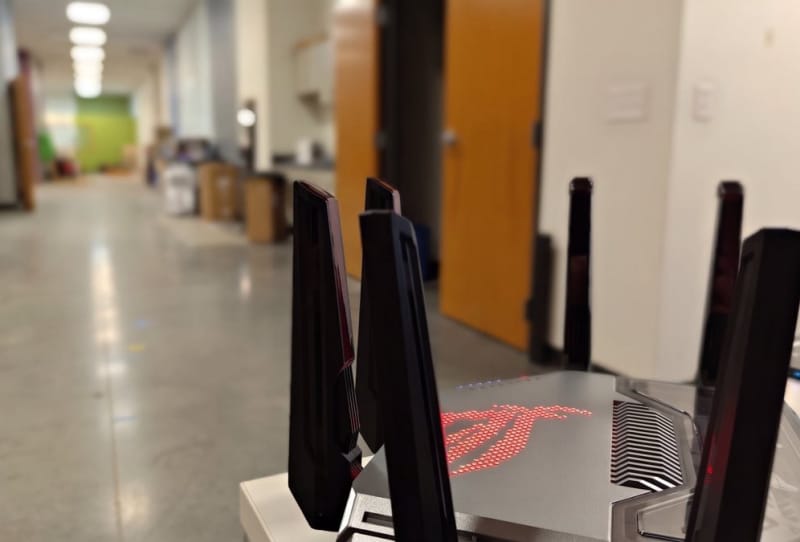
Wi-Fi 8 router speeds just got their first real-world test, and the early numbers suggest something big is coming for home networks, even though no Wi-Fi 8 phones, laptops or other client devices exist yet to take advantage of it. A newly released Asus Wi-Fi 8 router showed only modest gains on most frequency bands when paired with a current Wi-Fi 7 laptop, but delivered an enormous jump in close-range 6GHz throughput, more than a gigabit per second faster than one of the fastest Wi-Fi 7 routers on the market.
Key takeaways
- ✓Early Wi-Fi 8 router speeds showed only slight gains over Wi-Fi 7 on the 5GHz band
- ✓Close-range 6GHz throughput jumped by more than a gigabit per second versus a top Wi-Fi 7 router
- ✓The 2.4GHz band improved by just 39Mbps, but that band carries the most crowded, device-heavy traffic
- ✓No Wi-Fi 8 phones, laptops or other client devices exist yet; only routers are shipping so far
- ✓Dynamic Sub-Band Operation and Dynamic Bandwidth Expansion let Wi-Fi 8 share spectrum more intelligently
That gap matters because it hints at what Wi-Fi 8 hardware might achieve once phones, laptops and other gadgets built for the standard start arriving, expected early next year. For now, anyone shopping for a new router faces a familiar dilemma: buy into a brand new standard before most devices can use it, or wait and see how the technology matures.
Table of Contents
What actually changes with Wi-Fi 8
Every new Wi-Fi generation gets marketed on raw speed, but the real story behind Wi-Fi 8 is how it manages bandwidth rather than how much of it exists. Wi-Fi 4, launched around 15 years ago, topped out at 40MHz-wide channels. Wi-Fi 7 and Wi-Fi 8 can both stretch to 320MHz channels, a jump of roughly 700 percent in available width. That extra room matters because the average household now connects dozens of devices, from laptops and game consoles to thermostats and smart locks, all competing for the same airwaves.
Wi-Fi 8 introduces two features designed to slice up that wider channel more intelligently. Dynamic Sub-Band Operation splits a single wide channel so several devices can use it at once, including simple gadgets that only talk on narrow bands. Dynamic Bandwidth Expansion works the other way, automatically widening a device’s slice of spectrum when traffic spikes, such as during a video call or a large download. Broadcom project manager Fred Olsson has pointed to video as the real driver behind this shift, noting that constant uploading and downloading of calls and clips is pushing bandwidth demand in both directions well beyond what older Wi-Fi standards were built for.
Qorvo product director Wayne Polonio summed up the philosophy succinctly, saying Wi-Fi 8 is less about chasing a faster headline number and more about staying reliable when dozens of devices are active at once. That mirrors the priority shift that shaped Wi-Fi 7’s development, and it marks a notable change in tone from the gigabit arms race of earlier generations.
What the first Wi-Fi 8 router speeds reveal
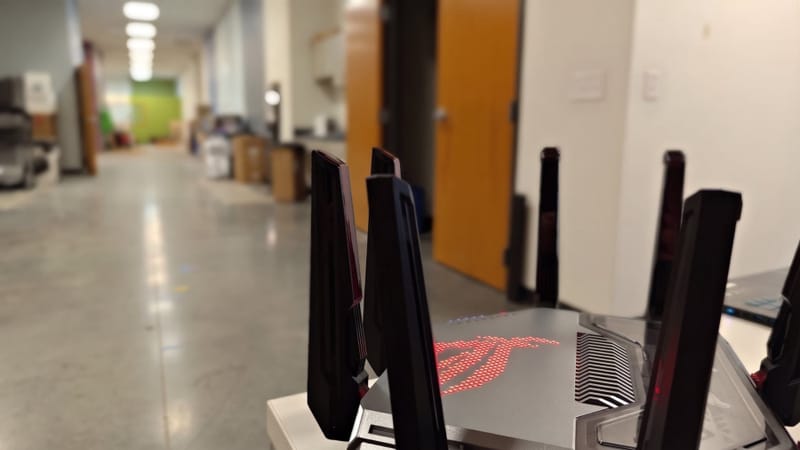
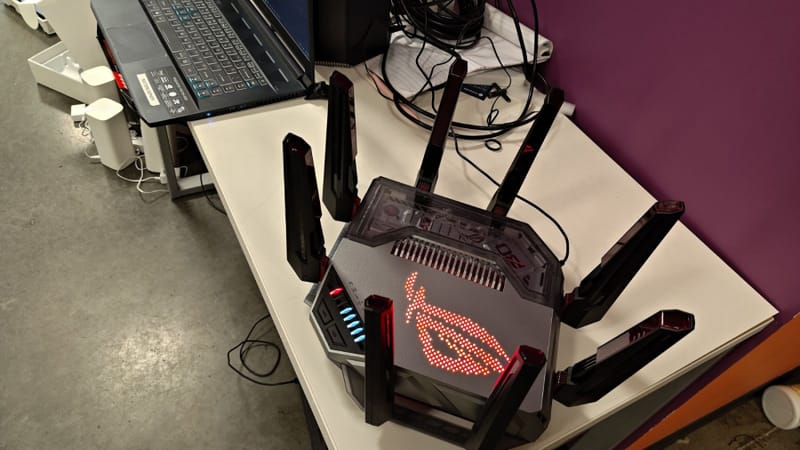
Testers set up an early Wi-Fi 8 router, the Asus ROG Rapture GT-BN98 Pro, and measured throughput against a Wi-Fi 7 client laptop at three distances: close range behind a single wall, a mid-range spot behind two to three walls, and a long-range position behind four or more walls. The router is pitched as a high-end gaming model, built with eight external antennas, two 10Gbps wired Ethernet ports, and quad-band throughput rated up to 30,000Mbps on paper. Asus and the Wi-Fi Alliance expect rivals including Eero, Netgear and TP-Link to follow with their own hardware before long.
| Band | Test distance | Result vs a leading Wi-Fi 7 router |
|---|---|---|
| 5GHz | Close range (one wall) | Slight gain or no improvement |
| 6GHz | Close range (one wall) | More than 1Gbps faster |
| 2.4GHz | Close range (one wall) | About 39Mbps faster |
The comparison used the Netgear Nighthawk RS700S, among the fastest Wi-Fi 7 routers tested in the lab, as the benchmark. The 6GHz result stood out because it showed such a wide gap at close range, even though both routers were talking to the same Wi-Fi 7 laptop rather than a native Wi-Fi 8 device. That suggests the new standard is already squeezing more out of existing hardware on the cleanest, least congested band, before any Wi-Fi 8 clients exist to push it further.
Why the slowest band might matter most
The 2.4GHz improvement looks unimpressive next to the 6GHz jump, just 39Mbps faster than Wi-Fi 7 at close range. However, 2.4GHz tends to be the busiest, most congested part of the spectrum in any home. It’s the band a microwave interferes with, and it’s often the only one that cheap or older smart home devices, such as thermostats and door locks, can use at all.
Dynamic Sub-Band Operation is aimed squarely at this problem, letting a router carve out reliable narrow slices for simple devices while still serving faster gadgets on the same wide channel. In a typical Australian household juggling smart plugs, security cameras, game consoles and multiple phones, that kind of traffic management may end up mattering more day to day than the headline 6GHz figure, even if it doesn’t make for as dramatic a chart.
What it means for buyers right now
Early test results come with an obvious caveat: they compare one Wi-Fi 8 router against one Wi-Fi 7 router, using a Wi-Fi 7 laptop as the client in every case, since no Wi-Fi 8 clients exist yet. Real-world performance will depend heavily on how phone and laptop makers implement the standard once their hardware ships. Despite that, the 6GHz numbers are promising enough to suggest Wi-Fi 8 is not merely an incremental update dressed up in new marketing.
Artificial intelligence isn’t formally part of the Wi-Fi 8 specification, but network engineers expect AI-driven traffic management to improve performance across routers generally, Wi-Fi 8 included, over the coming years. For households that already have a capable Wi-Fi 7 routers are only just reaching customers, there’s little urgency to jump immediately, particularly with compatible client devices still months away. Anyone who has already been burned by early-generation networking bugs might also recall that Asus recently had to patch a critical security flaw in its Wi-Fi 7 firmware, a reminder that brand-new wireless hardware sometimes needs a software fix or two before it settles down.
For now, Wi-Fi 8 router speeds look like a genuine step forward on the cleanest bands, with other manufacturers readying their own Wi-Fi 8 routers for release in the months ahead. The more interesting test will come once actual Wi-Fi 8 phones and laptops exist to push the standard to its limits.

Frequently asked questions
Is Wi-Fi 8 faster than Wi-Fi 7?
Early tests show only slight or no improvement on the 5GHz band compared with Wi-Fi 7, but a major jump on the 6GHz band at close range, more than a gigabit per second faster. Results will likely improve further once native Wi-Fi 8 client devices arrive.
Can current phones and laptops use a Wi-Fi 8 router?
Yes, but only at Wi-Fi 7 or earlier speeds, since no Wi-Fi 8 phones, tablets or laptops have launched yet. A Wi-Fi 8 router remains backward compatible with older devices while offering some of its new traffic management benefits.
What makes Wi-Fi 8 different from previous Wi-Fi generations?
Rather than just adding raw speed, Wi-Fi 8 focuses on managing wide 320MHz channels more intelligently through features like Dynamic Sub-Band Operation and Dynamic Bandwidth Expansion, aiming for more reliable performance when many devices share the network at once.
When will more Wi-Fi 8 routers and devices be available?
Additional Wi-Fi 8 routers and mesh systems from manufacturers beyond Asus are expected early next year, with compatible phones, laptops and other client devices likely to follow a similar timeline.