Kioxia has built a 157 petabyte storage rack by chaining together 640 of its enterprise SSDs, giving AI data centres a single cabinet that can hold roughly 157 million gigabytes of data. The project, developed with Dell, squeezes that capacity into one standard 42U server rack, which the company is calling a new storage density milestone.
Key takeaways
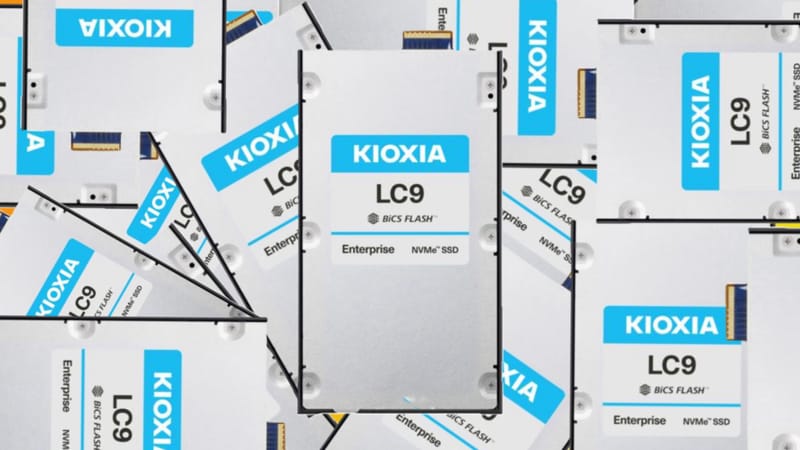
- ✓Kioxia and Dell built a 157 petabyte storage rack using 640 of Kioxia's 245.76TB LC9 Series SSDs.
- ✓The setup uses 16 Dell PowerEdge R7725xd servers, each holding 40 drives, in one 42U rack.
- ✓157 petabytes equals roughly 157 million gigabytes, or room for over 820,000 copies of a 190GB game.
- ✓The design targets AI data centres that need huge capacity without expanding floor space or power draw.
- ✓The announcement comes as consumer SSD prices climb amid an ongoing NAND flash supply shortage.
To put that figure in perspective, 157 petabytes is enough room to install a 190GB game like God of War: Ragnarok more than 820,000 times over. No consumer will ever need anything close to that, but AI data centres are a different story. They are consuming unstructured data at a pace that traditional storage architecture struggles to keep up with, and that is exactly the problem Kioxia and Dell say this setup solves.
Table of Contents
How the 157 petabyte storage rack is built
The build relies on Kioxia’s LC9 Series SSDs, enterprise drives rated at 245.76TB each. Fit 40 of those drives into a single Dell PowerEdge R7725xd server, then stack 16 of those servers into one rack, and the maths works out to 640 drives and just over 157 petabytes of raw flash capacity in one cabinet.
That is a dense arrangement by any measure. Traditional hard-drive based storage would need considerably more floor space, more power, and more cooling to hit the same capacity. Kioxia’s pitch is that high-capacity NVMe SSDs let data centre operators consolidate that same amount of data into a smaller, more power-efficient footprint, which matters when every extra rack means more electricity, more cooling infrastructure, and more concrete.

| Component | Specification |
|---|---|
| SSD model | Kioxia LC9 Series |
| Capacity per drive | 245.76TB |
| Drives per server | 40 |
| Servers per rack | 16 x Dell PowerEdge R7725xd |
| Total drives | 640 |
| Total rack capacity | Approximately 157 petabytes |
| Rack size | Industry-standard 42U |
Why AI data centres need this much storage
AI training and inference workloads generate and consume enormous volumes of unstructured data, from raw training sets to model checkpoints and logs. Kioxia’s own messaging points to that growth directly, framing the rack as a response to data centres that need higher capacity without a corresponding jump in space, power, or cooling demands.
That pressure is showing up across the industry in different ways. Storage vendors are racing to find denser, more efficient ways to hold AI data, whether that means flash at this scale or other approaches entirely. Fujifilm, for instance, has been pouring money into magnetic tape storage for the same AI boom, betting that tape still has a role to play for cold, archival-style data even as flash dominates the hot tier. Kioxia and Dell’s rack is effectively the flash-side answer to the same underlying problem: AI needs somewhere to put everything it generates, and data centre space is not infinite.
Physical footprint has become a genuine sticking point for the industry. Large data centre buildouts are facing local pushback over land use, power grid strain, and water consumption for cooling, so any design that packs more capacity into less physical space has an obvious appeal to operators trying to avoid those fights.
The timing is awkward for everyday buyers
There is a sharper edge to this story for ordinary consumers. Kioxia’s 157 petabyte storage rack arrives in the middle of a NAND flash shortage that has already pushed up prices on consumer SSDs and memory. Flash manufacturers are prioritising enterprise and AI customers who can pay for huge volumes of capacity, which leaves less supply, and less favourable pricing, for everyday gaming and productivity SSDs.
That same supply squeeze has had knock-on effects elsewhere in PC hardware. Even companies trying to work around tight storage budgets have run into trouble, as seen when AMD had to admit a driver bug that was hammering SSDs on some Radeon systems. It is a reminder that storage reliability and availability matter just as much as raw capacity, whether in a data centre rack or a home PC.
The broader AI hardware crunch is not limited to flash storage either. Graphics cards are facing their own supply pressure, with reporting on a worsening GPU VRAM shortage tied directly to AI demand. Flash and memory manufacturers are being pulled in the same direction, towards serving data centres first, and that trend is unlikely to reverse while AI workloads keep growing.
What this means going forward
For most readers, a single rack holding 157 petabytes will never be something they interact with directly. It matters because of what it represents: a sign of just how much infrastructure is being built specifically to feed AI systems, often with budgets and urgency that dwarf consumer product lines. Compare that scale to something like a four-bay NAS built for far more modest storage needs, and the gap between enterprise AI infrastructure and home storage becomes obvious.
Whether this particular design becomes an industry standard or simply a proof of concept remains to be seen. Dell and Kioxia have not detailed pricing or wider availability for the configuration, and it is squarely aimed at large-scale operators rather than anyone buying a handful of drives. What is clear is that the underlying trend, denser flash, bigger racks, and AI customers absorbing most of the available NAND supply, is shaping the storage market for everyone else too.
Frequently asked questions
How big is 157 petabytes really?
One petabyte equals roughly one million gigabytes, so 157 petabytes works out to about 157 million gigabytes. That is enough space to install a 190GB game more than 820,000 times, though in practice this capacity is intended for AI training data, model checkpoints, and other unstructured data sets, not games.
What drives are used in Kioxia’s 157 petabyte storage rack?
The rack uses 640 units of Kioxia’s LC9 Series enterprise SSDs, each rated at 245.76TB. They are installed 40 to a server across 16 Dell PowerEdge R7725xd servers, all housed in a single industry-standard 42U rack cabinet.
Will this affect consumer SSD prices?
Not directly, but it reflects the same forces pushing consumer SSD prices higher. NAND flash manufacturers are directing significant supply toward high-capacity enterprise and AI customers, which is contributing to tighter availability and higher prices for everyday consumer drives.
Is this storage rack available to buy?
Kioxia and Dell have announced the configuration as a joint engineering milestone aimed at AI data centre operators. Neither company has published consumer pricing or general retail availability, since the product is designed for large-scale enterprise deployment rather than individual purchase.