
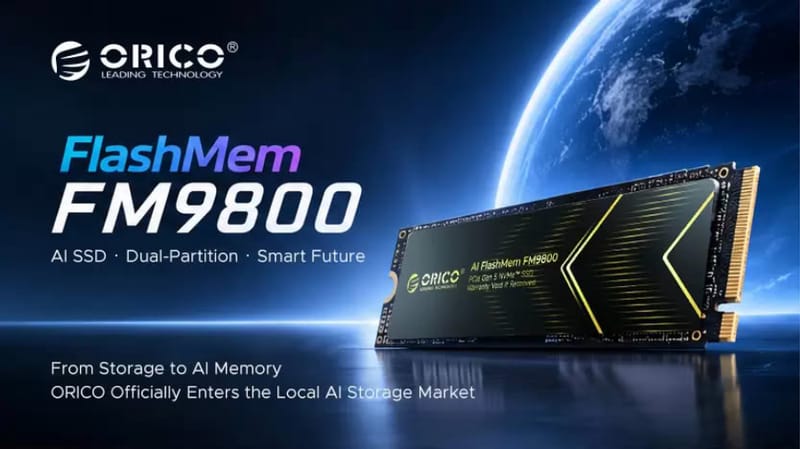
The ORICO FlashMem FM9800 SSD is a new PCIe 5.0 drive that sets aside part of its capacity as a dedicated cache for on-device AI workloads, rather than treating every gigabyte the same way. Instead of a single storage pool, the M.2 drive splits itself into two partitions: one for the operating system and everyday files, and another reserved purely for data used during local AI inference.
Key takeaways
- ✓The ORICO FlashMem FM9800 SSD splits storage into a Storage OS partition and a dedicated AI Cache partition.
- ✓The 1 TB model gives 85 GB to AI Cache and 768 GB to Storage OS.
- ✓The 2 TB model allocates 128 GB to AI Cache and 1,638 GB to Storage OS.
- ✓ORICO claims read speeds up to 9,800 MB/s over a PCIe 5.0 interface with 3D TLC NAND.
- ✓Pricing, warranty terms and availability dates have not yet been announced.
It is an unusual move for a consumer-facing SSD, and it signals how storage makers are starting to design specifically around the rise of on-device AI tools rather than treating storage as a generic, undifferentiated pool of space.
Table of Contents
What the AI Cache on the ORICO FlashMem FM9800 SSD actually does
ORICO, a Chinese peripherals and accessories maker, is pitching the FM9800 as a drive built for people running AI models locally rather than purely in the cloud. The Storage OS partition behaves like any normal SSD volume, holding Windows or Linux, installed applications, games, and personal files. The AI Cache partition is kept separate, and according to ORICO it uses its own wear-levelling strategy and its own read and write scheduling, distinct from the rest of the drive.
The idea is that the AI Cache can sit alongside system RAM and graphics card memory as an extra tier for AI workloads, rather than replacing either of them. ORICO has been clear that the cache does not substitute for RAM or VRAM. It is meant to supplement them when software is written to take advantage of it, which means the feature will only be useful once compatible applications actually support it. Right now, ORICO has not named which tools or frameworks will integrate with the AI Cache, so its real-world benefit is still unproven.
Specifications and the numbers ORICO has confirmed
The FlashMem FM9800 uses 3D TLC NAND flash and connects over a PCIe 5.0 interface, paired with a graphene thermal pad to help manage heat on a drive capable of high sustained throughput. It will launch in 1 TB and 2 TB capacities, which is standard for this class of high-speed NVMe drive. The capacity split between the two partitions is fixed per model rather than something a buyer can adjust at purchase.
| Capacity | Storage OS partition | AI Cache partition |
|---|---|---|
| 1 TB model | 768 GB | 85 GB |
| 2 TB model | 1,638 GB | 128 GB |
Those figures do not add up to the full rated capacity in either case, and ORICO has not explained what happens to the remaining space. Over-provisioning, which reserves flash for wear levelling and sustained write performance, is the likely explanation, though the company has not confirmed this directly.
On performance, ORICO’s own marketing material claims sequential read speeds of up to 9,800 MB/s, a figure consistent with a well-tuned PCIe 5.0 SSD. However, the company has not published endurance ratings, random read and write figures, or a formal warranty period, so buyers currently only have one headline number to go on rather than a full spec sheet.
How it stacks up against a typical PCIe 5.0 drive
Most PCIe 5.0 SSDs on the market today, from brands with drives built around similar NAND and controller combinations, simply offer one large, undivided pool of storage. Software decides how to use that space, and there is no vendor-level separation between system files and anything else. The FM9800’s partitioned approach is a genuine point of difference, even if it is currently more of a hardware feature waiting for software support than a benefit buyers can use immediately.
It also arrives at a moment when AI demand is already straining other parts of the PC hardware stack, including a worsening shortage of GPU memory for AI workloads. SSD makers positioning drives around local inference is a logical response to that pressure, since fast storage can sometimes offset limited RAM or VRAM when software is designed to lean on it. Storage vendors more broadly have been chasing the AI storage angle too, including Kioxia’s own push into massive SSD storage aimed at data centre scale AI rather than desktops.
What this means for buyers considering the ORICO FlashMem FM9800 SSD
For now, the practical upside of the FM9800’s AI Cache is limited by how few applications are likely to support it at launch. Buyers chasing raw PCIe 5.0 performance for gaming or general use should judge the drive mainly on its claimed 9,800 MB/s read speed and its 3D TLC NAND, since the AI-specific partitioning will not change day-to-day performance until software catches up.
Anyone building a machine around local AI tools, similar in spirit to mini PCs built around large amounts of RAM for local AI, may want to keep an eye on the FM9800 as a storage option once ORICO clarifies pricing, availability and which tools can actually use the AI Cache. Until then, it is a notable idea without a confirmed release date, warranty, or cost attached to it.
Frequently asked questions
What is the AI Cache on the ORICO FlashMem FM9800 SSD?
It is a dedicated partition on the drive set aside for data used during local AI inference, managed separately from the main storage partition that holds the operating system and files.
Does the AI Cache replace RAM or a graphics card’s VRAM?
No. ORICO has said the AI Cache is meant to work alongside system RAM and GPU memory, not replace either, and it will need compatible software to actually be used for that purpose.
How much storage does each capacity of the FM9800 offer?
The 1 TB model allocates 768 GB to general storage and 85 GB to the AI Cache, while the 2 TB model allocates 1,638 GB to general storage and 128 GB to the AI Cache.
When will the ORICO FlashMem FM9800 SSD be available, and how much will it cost?
ORICO has not announced a release date, pricing, or formal warranty details for the drive at this stage.