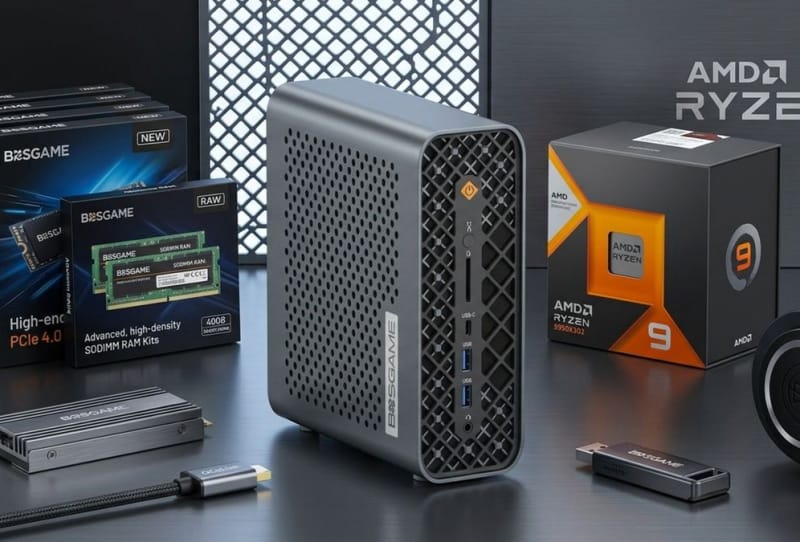
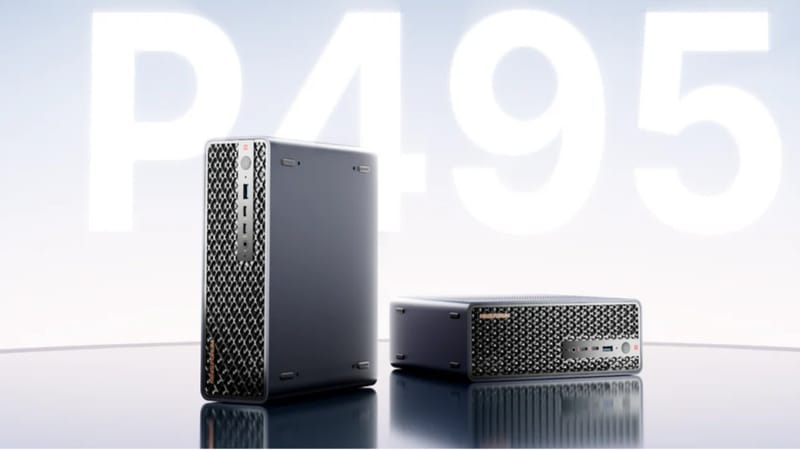
The Bosgame M5 MAX mini PC crams AMD’s flagship Ryzen AI Max+ PRO 495 chip, up to 192GB of memory, and an OCuLink expansion port into a case barely bigger than a lunchbox. That combination puts serious workstation-grade compute, and enough memory to run hefty local AI models, into a form factor that would normally sit under a monitor rather than beside a server rack.
Key takeaways
- ✓Bosgame's M5 MAX mini PC uses AMD's Ryzen AI Max+ PRO 495 APU with integrated Radeon graphics
- ✓The system can be configured with up to 192GB of unified memory shared between CPU and GPU
- ✓An OCuLink connector allows high-speed external storage or graphics expansion
- ✓Storage is expandable via onboard M.2 slots alongside the external OCuLink link
- ✓The chip's shared memory pool is designed to let large AI models run locally without a cloud connection
Mini PCs have quietly become one of the more interesting corners of the hardware world over the past couple of years, and Bosgame’s latest release shows why. Rather than chasing raw gaming performance, the M5 MAX is built around a chip designed specifically for AI workloads, paired with memory capacity that would be unusual even in a full-size desktop tower.
Table of Contents
What’s inside the Bosgame M5 MAX
At the centre of the machine sits AMD’s Ryzen AI Max+ PRO 495, a chip from the same family that has started showing up in a handful of compact workstations this year. It combines Zen 5 CPU cores with an integrated Radeon 8060S graphics engine, and AMD designed the whole package around unified memory, meaning the CPU and GPU share the same pool of RAM rather than each getting a separate, smaller allocation.
Bosgame has configured the M5 MAX to take that memory architecture to an extreme, offering up to 192GB of shared RAM. That is a huge number for a mini PC, and it matters because it directly determines how large an AI model the integrated graphics engine can hold and process without offloading to slower storage or a cloud service.
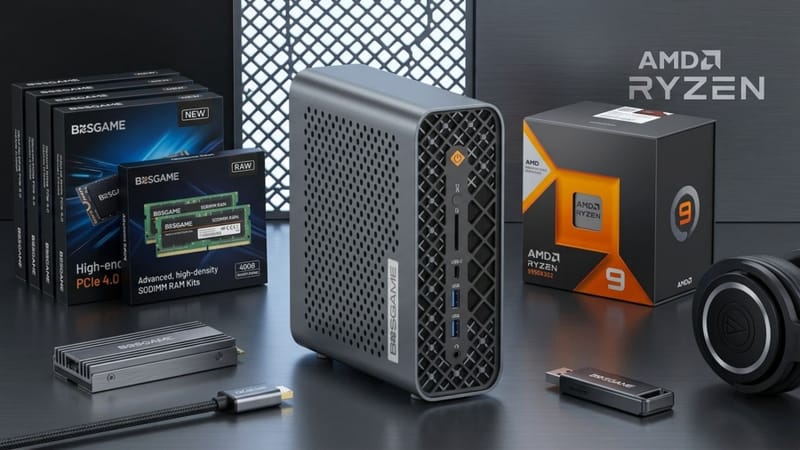
| Component | Detail |
|---|---|
| Processor | AMD Ryzen AI Max+ PRO 495 (Zen 5 cores with integrated Radeon 8060S graphics) |
| Memory | Up to 192GB unified memory, shared between CPU and GPU |
| Storage | Expandable via onboard M.2 slots, plus external expansion through OCuLink |
| Expansion | OCuLink connector for high-speed external storage or graphics |
| Form factor | Compact mini PC chassis |
Why the Ryzen AI Max+ PRO 495 matters
AMD’s Ryzen AI Max+ series was built to answer a specific question: how do you let a compact machine run AI workloads locally, without relying on a discrete graphics card or a cloud subscription? The unified memory design is the answer. Instead of splitting RAM between system memory and dedicated video memory, the whole pool is addressable by the Radeon 8060S graphics engine.
That matters for anyone experimenting with local large language models, image generation, or other memory-hungry AI tools, because model size is often constrained by available memory rather than raw processing speed. A machine that can offer 192GB to the graphics engine sidesteps a limitation that trips up most consumer hardware, including plenty of machines with dedicated graphics cards.
The OCuLink connector adds a second layer of flexibility. It is a high-bandwidth external connector, commonly used to hook up an external graphics card or a fast storage enclosure, and its presence here means the M5 MAX is not locked to whatever is soldered inside the chassis. Owners who need more storage, or who eventually want to attach a discrete GPU, have a path to do that without opening the case.
How it stacks up against other mini workstations
Bosgame is not the only company building around this chip. Acemagic’s own Ryzen AI Max+ PRO 495 workstation uses the same processor in a similarly compact body, and GMKtec’s EVO-X1 Pro pairs a Ryzen AI chip with its own OCuLink port, suggesting the combination of unified memory and external expansion is quickly becoming a template for this category of machine.
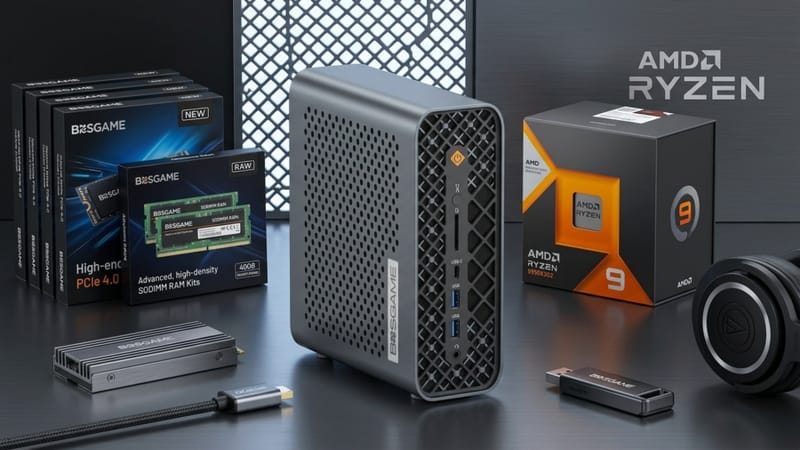
What sets the M5 MAX apart is the ceiling on memory. Plenty of mini PCs in this class top out well below 128GB, which makes Bosgame’s 192GB configuration one of the more generous options currently available. For buyers who have looked at other mini PCs chasing desktop-class performance with discrete graphics cards instead, the M5 MAX represents a different approach: skip the dedicated GPU, lean entirely on a chip engineered around shared memory, and let that memory pool do the heavy lifting for AI tasks.
What it means for buyers
This is not a machine aimed at casual shoppers. The combination of a workstation-class APU and this much memory points squarely at developers, researchers, and small studios who want to run AI models on local hardware rather than renting cloud compute by the hour. For that audience, a compact, relatively power-efficient box that can sit on a desk and handle serious memory-bound workloads is a genuinely useful proposition.
For anyone weighing up whether a mini PC can replace a bigger home server or workstation, it is worth reading a guide to picking the right mini PC for a home server before committing, since expandable storage and connector choices like OCuLink matter just as much as raw specs once a machine is actually in daily use. The broader trend is clear enough: AMD’s Ryzen AI Max platform, AMD’s own Ryzen AI Max series page outlines the chip family in more detail, is turning the mini PC into a legitimate alternative to bulkier AI workstations, and Bosgame’s M5 MAX, detailed further on Bosgame’s official site, is one of the more ambitious examples yet.
Frequently asked questions
What chip does the Bosgame M5 MAX use?
It runs on AMD’s Ryzen AI Max+ PRO 495, a processor built around Zen 5 CPU cores and an integrated Radeon 8060S graphics engine, with memory shared between the two rather than split into separate pools.
Why does 192GB of RAM matter for an AI-focused mini PC?
Because the chip’s integrated graphics engine draws on the same memory pool as the CPU, more RAM directly translates into the ability to run larger AI models locally, without needing a dedicated graphics card or a cloud connection.
What is the OCuLink connector used for?
OCuLink is a high-bandwidth external connector typically used to attach fast external storage or a discrete graphics card, giving the M5 MAX a way to expand beyond its built-in components.
Is the Bosgame M5 MAX aimed at gamers?
Not primarily. Its integrated graphics and huge memory allocation are tuned for AI and workstation tasks rather than gaming performance, making it better suited to developers and researchers running local AI workloads.