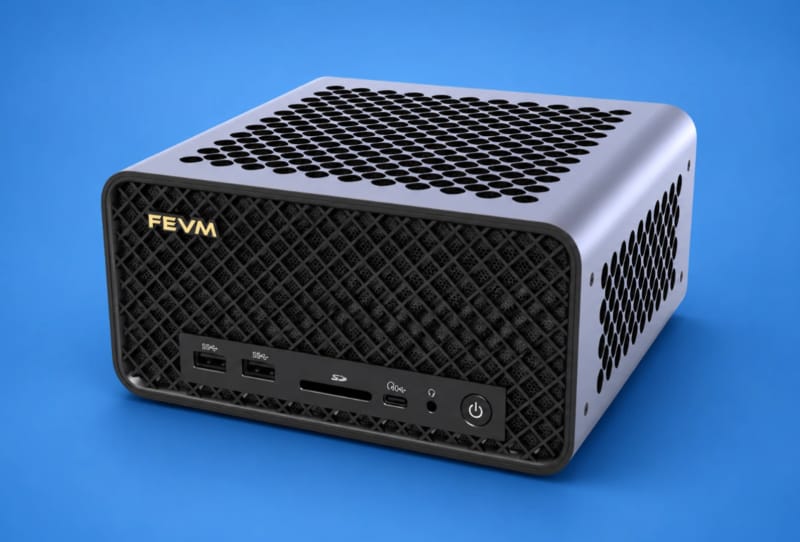
The FEVM FA80G mini PC pairs an AMD Ryzen 9 9950X3D processor with a 24GB Nvidia RTX 5090 Laptop GPU, squeezing both into a chassis of just 2.6 litres. FEVM claims this combination can outperform Apple’s M5 Ultra Mac Studio in gaming, a bold statement given the size difference between the two machines. As one of the first Ryzen 9 9950X3D mini PC builds from FEVM to pair a full desktop-class CPU with flagship laptop graphics, the FA80G is likely to draw attention from buyers who want desktop-tier gaming performance without the footprint of a traditional tower. For shoppers actively searching for a Ryzen 9 9950X3D mini PC from FEVM specifically, this is currently the standout release in that niche, and it arguably sets a new benchmark for what a sub-3-litre gaming machine can be expected to deliver.
Key takeaways
- ✓The FEVM FA80G mini PC combines a Ryzen 9 9950X3D CPU with a 24GB RTX 5090 Laptop GPU.
- ✓The entire system fits inside a 2.6-litre chassis, far smaller than a typical gaming tower.
- ✓FEVM claims the FA80G can outperform Apple's M5 Ultra Mac Studio in gaming benchmarks.
- ✓The RTX 5090 Laptop GPU carries 24GB of VRAM, matching the desktop card's memory capacity.
- ✓It follows FEVM's earlier mini PCs that already paired desktop-class CPUs with RTX 5090 graphics.
- ✓Pricing, release date and regional availability for the FEVM FA80G have not yet been confirmed.
That claim matters because mini PCs have traditionally traded performance for compactness. Buyers accepted weaker chips in exchange for a machine that fit on a desk shelf rather than under it. The FA80G appears designed to break that trade-off entirely, cramming desktop-class silicon into a footprint smaller than most game consoles. For anyone specifically searching for a Ryzen 9 9950X3D mini PC from FEVM, the FA80G is currently the clearest example of the company applying its small-chassis engineering to AMD’s flagship gaming CPU rather than a mid-range alternative. It also signals that FEVM views the 9950X3D, rather than the non-X3D 9950X or earlier Ryzen 9 chips, as the processor worth building its flagship compact system around.
Table of Contents
What the FEVM FA80G mini PC actually offers
At the heart of the FA80G sits AMD’s Ryzen 9 9950X3D, a 16-core, 32-thread chip built on the Zen 5 architecture with 3D V-Cache stacking for extra gaming performance. It is the same processor found in several enthusiast desktop builds, not a laptop-derived variant with reduced clock speeds or core counts. That distinction matters for buyers comparing mini PCs against full towers, since many small-form-factor systems quietly substitute mobile silicon for genuine desktop parts to manage heat and power draw. The 3D V-Cache technology works by stacking extra cache memory directly onto the CPU die, giving the processor faster access to frequently used game data and reducing the latency hits that normally come from reaching out to system RAM. That design is why 3D V-Cache chips tend to post noticeably higher frame rates in CPU-bound titles compared with otherwise similar processors that lack the stacked cache.
Graphics duties fall to Nvidia’s RTX 5090 Laptop GPU, carrying 24GB of GDDR7 memory. That memory allocation matches the desktop RTX 5090 card, which is unusual for a mobile-class GPU and suggests FEVM has prioritised memory bandwidth for demanding games and creative workloads alike. The extra VRAM headroom should also benefit users running large language models locally, high-resolution texture packs, or multi-monitor creative work where memory capacity, rather than raw core count, tends to be the limiting factor. Pairing a full desktop CPU with a laptop-grade GPU rather than a desktop GPU is also a deliberate power and thermal trade-off: laptop GPUs are tuned to run within tighter power limits than their desktop counterparts, which helps FEVM keep the FA80G’s cooling demands within reach of a 2.6-litre enclosure while still offering close to desktop-class graphics memory.
Cooling this pairing inside such a small enclosure is the real engineering challenge, since both components generate substantial heat under load, and how FEVM manages thermals will likely determine whether the Ryzen 9 9950X3D can sustain its boost clocks during extended gaming sessions rather than throttling after a few minutes. In a chassis this size, airflow typically has to be engineered around a handful of small, high-RPM fans and carefully routed heat pipes, since there simply isn’t room for the larger radiators or multiple 120mm fans that full towers use to keep flagship components cool. Buyers who have followed small-form-factor PCs before will know that sustained performance, not just peak benchmark numbers, is usually the real test of whether a compact chassis design has succeeded.
Beyond raw thermals, prospective buyers of this Ryzen 9 9950X3D mini PC from FEVM should also think about power delivery. Running a 16-core desktop chip alongside a flagship laptop GPU in a 2.6-litre enclosure typically demands either an external power brick or a compact internal power supply rated well above what a standard mini PC needs, and the combined draw under full load could realistically sit close to what a mid-range gaming tower pulls from the wall. FEVM has not detailed the exact power supply configuration for the FA80G, but it is one of the practical questions worth asking before ordering, alongside noise levels under sustained load, since small high-RPM fans in a tight chassis can be noticeably louder than the larger, slower fans found in full-size cases.
FEVM has not published full pricing or availability details yet, and the company has a track record of iterating quickly on its mini PC lineup rather than sticking with a single flagship model for long. Buyers who want the specific Ryzen 9 9950X3D and RTX 5090 pairing found in the FA80G should keep an eye on official FEVM channels, since past releases from the company have sometimes shifted specification tiers between announcement and retail listing. It’s also worth watching for details on memory configuration, storage options and port selection once FEVM confirms them, as these can vary between regional listings even when the core CPU and GPU pairing stays the same. Given the price of both a Ryzen 9 9950X3D processor and an RTX 5090-class GPU individually, buyers should expect the FA80G to sit at a premium price point once official figures are released, likely positioning it closer to high-end custom builds than budget or mid-range mini PCs.
Specifications at a glance
| Component | Detail |
|---|---|
| Processor | AMD Ryzen 9 9950X3D (16-core, 32-thread, Zen 5 with 3D V-Cache) |
| Graphics | Nvidia RTX 5090 Laptop GPU, 24GB GDDR7 |
| Chassis volume | 2.6 litres |
| Form factor | Compact mini PC |
| Manufacturer | FEVM |
| Comparable rival claim | FEVM says it outperforms Apple’s M5 Ultra Mac Studio in gaming |
| Pricing and availability | Not yet confirmed by FEVM |
How it stacks up against rivals
FEVM is not new to this space. The company’s earlier mini PCs that packed desktop CPUs and RTX 5090 power already demonstrated that squeezing flagship components into a small chassis was possible, and the FA80G reads as a refinement of that formula with a stronger CPU. Moving from previous desktop chips to the Ryzen 9 9950X3D specifically targets gamers, since the 3D V-Cache design is tuned for the kind of frame-rate gains that matter most in competitive and graphically demanding titles. It also positions the FA80G as a more focused gaming mini PC compared with earlier FEVM models that leaned on more general-purpose desktop chips without the added gaming-specific cache.
The comparison to Apple’s M5 Ultra Mac Studio is worth unpacking rather than accepting at face value. Apple’s chip excels at efficiency and sustained workloads thanks to its unified memory architecture, but Nvidia’s discrete GPUs still generally hold an advantage in raw gaming frame rates, particularly in titles optimised for DirectX or Vulkan rather than Metal. If FEVM’s benchmarks hold up under independent testing, the FA80G would represent a meaningful shift in what a small-form-factor machine can deliver against Apple’s best. It’s also worth noting that Apple’s Mac Studio targets a different audience overall, with strengths in video editing, audio production and machine learning workloads that lean on unified memory rather than discrete VRAM. Buyers deciding between the two platforms should really be asking whether their workload is gaming-first or productivity-first, since the two machines are built around very different priorities despite the headline comparison.
Against traditional desktop towers, the calculus is different again. Full-size prebuilt desktops like the CyberPowerPC SLC8500WST pair similarly potent components with more generous airflow and easier upgrade paths, since a mini PC’s compact cooling and soldered components make later upgrades harder. Buyers choosing between the two are really weighing desk space against long-term flexibility, not raw performance alone. For a Ryzen 9 9950X3D build specifically, a full tower will typically allow for more aggressive cooling solutions, which can translate into higher sustained clocks under prolonged load than a 2.6-litre mini PC chassis can realistically match.
What this means for buyers and the mini PC market
The FA80G lands at a moment when small-form-factor gaming hardware is becoming genuinely competitive rather than a novelty. Machines like FEVM’s, alongside other compact gaming mini PCs such as the Piston V, suggest manufacturers see real demand for high-end gaming rigs that don’t dominate a room. This growing category of mini PCs built around flagship AMD CPUs and Nvidia laptop GPUs signals that compact form factors are no longer just a compromise choice for space-constrained setups, but a legitimate alternative for buyers who prioritise portability and desk footprint alongside performance.
For enthusiasts weighing a build like this against a custom tower, it is worth revisiting the basics of picking the right processor for a gaming build, since a mini PC locks in its CPU and GPU choices at purchase with little room to change course later. That permanence is the real cost of a 2.6-litre chassis, even when the components inside are as capable as AMD’s Ryzen 9 9950X3D and Nvidia’s RTX 5090 Laptop GPU. Anyone specifically drawn to the FA80G for its Ryzen 9 9950X3D and RTX 5090 pairing should weigh that fixed configuration against their own upgrade expectations before committing, and should also consider how much desk space and portability actually matter for their own setup versus the flexibility a tower offers down the line.
Whether the FA80G actually beats Apple’s M5 Ultra Mac Studio in practice will depend on independent benchmarks once units reach reviewers. FEVM’s internal claims are a starting point, not a verdict, and thermal throttling in such a small chassis remains the biggest unknown until the machine is tested outside controlled conditions.
Frequently asked questions
What CPU and GPU does the FEVM FA80G mini PC use?
It uses AMD’s Ryzen 9 9950X3D processor alongside Nvidia’s RTX 5090 Laptop GPU with 24GB of GDDR7 memory, both housed in a 2.6-litre chassis.
Can a mini PC really beat a Mac Studio in gaming?
FEVM claims the FA80G can outperform Apple’s M5 Ultra Mac Studio in gaming, largely because Nvidia’s discrete GPU architecture tends to outperform Apple’s unified memory design in traditional PC gaming titles, though independent testing will confirm the real gap.
Is the FEVM FA80G upgradeable later?
Mini PCs of this design generally offer limited upgrade paths compared with full desktop towers, since compact cooling and tight internal layouts make swapping the CPU or GPU far harder down the line.
When will the FEVM FA80G be available to buy?
FEVM has not confirmed a release date or regional availability for the FA80G, and details are expected to follow as the company finalises the design.