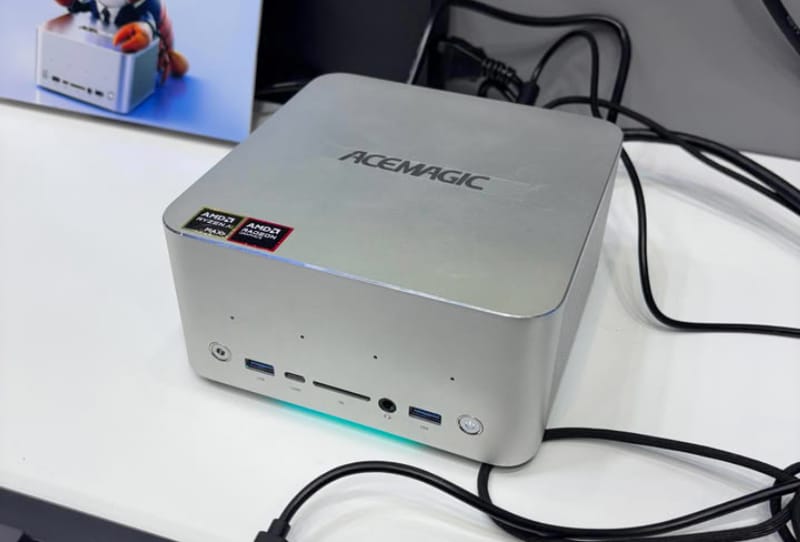
Acemagic used its stand at IFA 2026 in Berlin to show off a new Acemagic mini-workstation built around AMD’s flagship Ryzen AI Max+ PRO 495 “Gorgon Halo” APU, squeezing a 16-core desktop-class processor into a chassis barely bigger than a paperback book. The system measures just 158.5 x 158.5 x 81.5 mm and holds roughly two litres of volume, yet AMD’s spec sheet reads more like a workstation tower than a compact box. That contrast is exactly the point Acemagic seems to be making with this build.
Small-footprint PCs built around AMD’s high-end Ryzen AI Max chips have become a recurring theme at trade shows this year, and this Acemagic mini-workstation slots neatly into that trend. It borrows the same “Gorgon Halo” silicon found in a handful of rival machines, including GMKtec’s EVO-X1 Pro, another Ryzen AI Max mini PC with OCuLink expansion, though the specific memory and connectivity mix on Acemagic’s version gives it its own identity.
Table of Contents
What’s inside the Acemagic mini-workstation
At the heart of the machine sits AMD’s Ryzen AI Max+ PRO 495, a 16-core, 32-thread “Zen 5” processor capable of boosting to 5.2 GHz. Paired with it is Radeon 8065S integrated graphics, which handles everything from everyday productivity to more demanding creative and gaming workloads without a discrete GPU taking up space inside the tiny chassis.
AMD built a dedicated neural processing unit into the chip as well, rated at 55 TOPS of INT8 performance on its own. Combined with the CPU and integrated graphics working together, Acemagic quotes a total platform figure of about 131 TOPS at full tilt. That kind of on-device AI headroom is aimed squarely at running large language models locally, rather than leaning on cloud inference for every task.
| Component | Specification |
|---|---|
| CPU | AMD Ryzen AI Max+ PRO 495, 16-core/32-thread “Zen 5”, up to 5.2 GHz |
| Graphics | Radeon 8065S integrated GPU |
| NPU | 55 TOPS INT8; ~131 TOPS total platform performance |
| Memory | Up to 192 GB LPDDR5X at 8,533 MT/s |
| Storage | M.2 2280 PCIe 4.0 x4 NVMe, up to 4 TB |
| Chassis | 158.5 x 158.5 x 81.5 mm, roughly two litres |
Memory, storage and room to expand
Acemagic has configured this mini-workstation with support for up to 192 GB of LPDDR5X memory running at 8,533 MT/s. That is an enormous amount of fast memory for a machine this size, and it matters because large language models often need generous, high-bandwidth RAM more than they need raw storage speed. It puts the Acemagic mini-workstation in a similar bracket to full-size AI workstation towers, just without the bulk.
Local storage comes from a single M.2 2280 slot wired for PCIe 4.0 x4, accepting drives up to 4 TB. That is a sensible ceiling for a machine positioned around AI development and creative work rather than mass media storage, though it does mean buyers working with very large datasets will need to plan around a single-drive limit.
Perhaps the more interesting inclusion is the OCuLink interface, wired for PCIe 4.0 x4. It gives owners a path to attach an external GPU enclosure or another PCIe device down the line, without needing to open the chassis or accept the bandwidth compromises of a typical external GPU dock. It is the same idea GMKtec applied to its own Ryzen AI Max machine, and it is becoming something of a signature feature for this category of tiny AI-focused PC.
Connectivity built for a modern workstation
Ports are generous given the size of the box. Buyers get two USB4 connections, dual 2.5 GbE wired Ethernet ports, Wi-Fi 7, and Bluetooth 5.4 for wireless connectivity. Display output runs through both HDMI 2.1 and DisplayPort 2.1, covering high-refresh monitors and modern home theatre setups alike.
Dual 2.5 GbE Ethernet is a notable touch for a machine this compact, since it opens up link aggregation or dedicated network segregation for anyone running local AI inference alongside other network traffic. Combined with Wi-Fi 7, it suggests Acemagic is thinking about home labs and small studio setups just as much as desk-bound creative work.
Where it sits against the rest of the mini PC field
AMD’s Ryzen AI Max+ PRO 495 has quickly become the chip of choice for manufacturers chasing local AI performance in a small footprint. It shows up in GEEKOM’s GeekBook X16 Pro, which pairs a powerful AMD chip with a laptop form factor, and appeared elsewhere at the same Berlin show in Acer’s small-form-factor RTX Spark, unveiled at the same IFA 2026 show. What separates Acemagic’s take is the combination of maximum memory capacity, OCuLink expansion and dual 2.5 GbE networking in a genuinely pocketable case.
For buyers weighing memory bandwidth against raw core count, it is worth remembering that platforms like this increasingly pair with newer memory kits built around AMD’s EXPO tuning standard, though this particular design uses soldered LPDDR5X rather than upgradeable modules, trading flexibility for density and speed.
Acemagic has not detailed pricing or a firm release window for this configuration, and specifics on regional availability remain unconfirmed. What is clear from the IFA showing is the direction the mini PC market is heading: smaller chassis, workstation-grade AI silicon, and expansion options that used to be reserved for full-size desktop towers. For anyone wanting a compact machine to run local AI models, edit media, or just replace a bulky tower, this Acemagic mini-workstation is a strong sign of where that segment is going next.