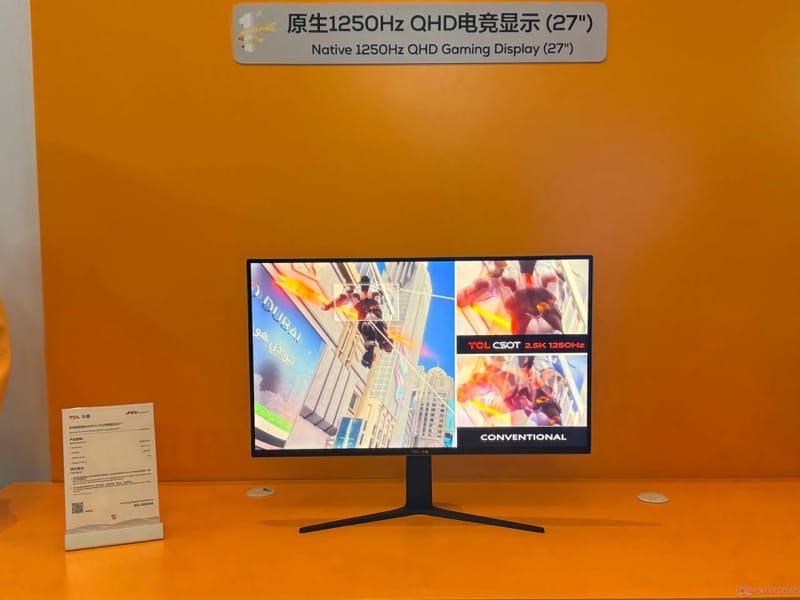
TCL CSOT has built a 1250 Hz QHD monitor prototype, the first panel anyone has managed to run at that refresh rate while keeping full 2560×1440 resolution. The company showed the 27-inch display at the DTC 2026 conference in Wuhan, China, alongside several other next-generation panel projects, and it’s easily the standout of the bunch.
Key takeaways
- ✓TCL CSOT's prototype panel hits 1250 Hz at native QHD resolution, a first for the industry
- ✓The display uses new UHMO oxide backplane technology rated at 50 cm²/V·s carrier mobility
- ✓Claimed response time is 1 ms, with refresh scaling smoothly from 1 Hz up to 1250 Hz
- ✓No price, release date, or confirmed panel type has been announced yet
- ✓TCL CSOT says it is working with partners to bring the monitor to market
Until now, chasing extreme refresh rates has always meant sacrificing resolution. Panels that claimed 1000 Hz or higher topped out at 1080p or even 720p, because pushing that many frames through a display’s electronics gets exponentially harder as pixel count rises. TCL CSOT’s demo breaks that pattern, at least in prototype form, and it’s worth understanding how.
Table of Contents
What TCL CSOT demonstrated at DTC 2026
The panel itself is a 27-inch QHD unit that scales its refresh rate anywhere from 1 Hz right up to 1250 Hz, with a claimed 1 ms response time. That kind of range matters for everyday use as much as benchmarks; a display that can drop to 1 Hz saves power during static content, while still being able to snap up to triple-digit-plus refresh for fast-paced games.
TCL hasn’t confirmed what underlying panel type sits behind the demo, whether it’s an LCD variant or something else entirely. Notebookcheck, which viewed the unit in person, reported that it appears to be a non-OLED display and described it as extremely responsive with no obvious motion blur during hands-on viewing. Details like the VRR standard it supports or the display interface used to drive it remain unconfirmed.
Because this is a working prototype rather than a shipping product, TCL CSOT hasn’t attached a price or a release window to it. The company has said only that it is working with manufacturing partners to bring a commercial version of the 1250 Hz QHD monitor to market, without specifying when that might happen.
The UHMO backplane behind the 1250 Hz QHD monitor
The technology making this possible is what TCL calls UHMO, short for ultra-high-mobility oxide. It’s a backplane architecture, essentially the layer of circuitry that controls how quickly each pixel can switch, rated at a carrier mobility of 50 cm²/V·s. Higher carrier mobility means electrons move through the backplane material faster, which in turn allows the panel to refresh more often without the signal degrading or introducing artifacts.
Conventional LCD backplanes typically rely on amorphous silicon or LTPS (low-temperature polysilicon), both of which have mobility ceilings that make maintaining high resolution at extreme refresh rates difficult. Oxide-based backplanes, and TCL’s UHMO variant specifically, appear to push past that ceiling, which is exactly why this panel can hit 1250 Hz while still rendering a full QHD image rather than dropping to 1080p or lower.
How it stacks up against existing high-refresh monitors
The closest real-world comparison is LG’s UltraGear 25G590B, which reached 1000 Hz but only at 1080p resolution. Several other monitors marketed around the “1000 Hz” figure have needed to drop all the way to 720p to hit that number. TCL CSOT’s prototype beats all of them on refresh rate while doubling the pixel count those displays were working with.
| Display | Resolution | Max refresh rate | Status |
|---|---|---|---|
| TCL CSOT UHMO prototype | QHD (2560×1440) | 1250 Hz | Prototype, shown at DTC 2026 |
| LG UltraGear 25G590B | Full HD (1920×1080) | 1000 Hz | Commercially available |
| TCL CSOT IJP OLED | QHD (2560×1440) | 500 Hz | Demonstrated at DTC 2026 |
| TCL 700 Hz OLED (planned) | QHD (expected) | 700 Hz | Targeted for 2028 |
TCL CSOT also used the same event to show a separate 27-inch QHD panel built on IJP OLED technology running at 500 Hz, and the company has previously flagged its own plans for 700 Hz OLED monitors by 2028. Taken together, these demos suggest TCL CSOT is pursuing both LCD-style oxide panels and OLED panels as parallel paths toward faster, sharper displays, rather than betting everything on a single technology.
What this means for gamers and monitor buyers
For most gamers, the practical benefits of refresh rates well above 240 Hz are debatable once diminishing returns set in, and 1250 Hz sits firmly in territory that mainly matters for esports players chasing every possible millisecond of input latency. Still, the real headline here isn’t really about whether anyone needs 1250 Hz. It’s that TCL CSOT has proven QHD resolution and extreme refresh rates aren’t mutually exclusive anymore, which should filter down into more usable products at lower refresh ceilings.
Shoppers currently weighing high refresh monitors already have plenty of QHD options in the 240 Hz to 360 Hz range, such as AOC’s dual-mode 5K and 360Hz QHD monitor and ViewSonic’s 240Hz QHD OLED gaming monitor, both of which already balance resolution and speed without the compromises older high-refresh panels demanded. TCL CSOT’s prototype points toward where that category heads next, even if a shipping 1250 Hz QHD monitor is still some way off.
There’s no confirmed timeline for when, or even whether, this exact panel reaches retail shelves. TCL CSOT’s track record of showing prototypes that later evolve into commercial products, as with its OLED development work, suggests this demo is a genuine signpost rather than a one-off stunt. Buyers shouldn’t expect to find this panel in a monitor anytime soon, but it does confirm the next leap in gaming display technology is already running in a lab in Wuhan.
Frequently asked questions
What makes TCL CSOT’s 1250 Hz QHD monitor different from other high-refresh displays?
Earlier panels claiming 1000 Hz or similar figures could only hit those numbers at lower resolutions like 1080p or 720p. TCL CSOT’s prototype is the first shown publicly to combine a 1250 Hz refresh rate with full native QHD resolution, thanks to its new UHMO oxide backplane.
Is the 1250 Hz QHD monitor an OLED display?
TCL CSOT hasn’t confirmed the exact panel type. Notebookcheck, which viewed the demo in person, reported that it appears to be a non-OLED display, though full technical details haven’t been released.
When can consumers buy this monitor?
There’s no release date or pricing yet. This is a prototype shown at the DTC 2026 conference, and TCL CSOT has only said it’s working with partners to bring a commercial version to market in the future.
Does a 1250 Hz refresh rate actually make a visible difference?
Beyond roughly 240 Hz, most gamers see diminishing visual benefits, though competitive and esports players chasing minimal input latency may still notice gains. The bigger significance here is proving QHD resolution and extreme refresh rates can coexist on one panel.