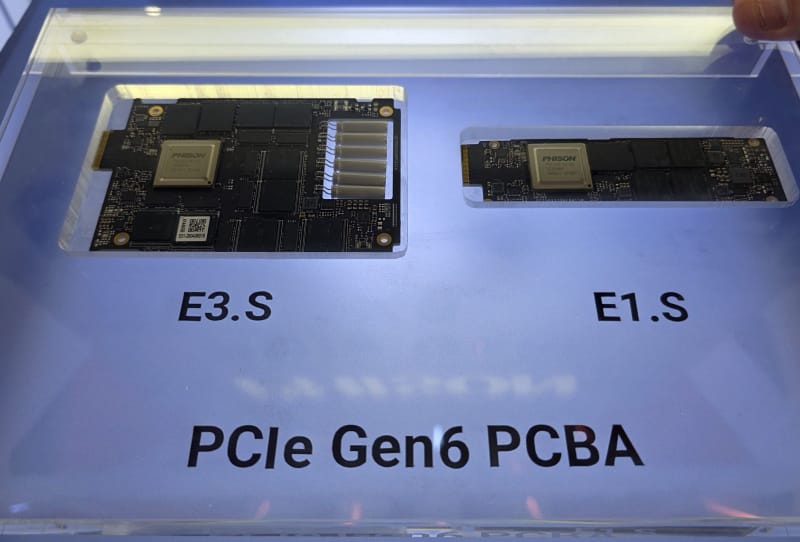
Phison has detailed a new computational storage SSD that packs a built-in NPU and 64GB of onboard memory, letting the drive run AI frameworks such as PyTorch, vLLM, OpenVINO and llama.cpp directly on stored data rather than shipping it all back to a server. The company showed the design, alongside a separate hybrid-flash drive called Mixed Media, at Supercomputer 2026 (SC26).
Key takeaways
- ✓Phison's computational storage SSD combines a built-in NPU with 64GB of memory rated at 130 GB/s
- ✓The drive runs AI frameworks including PyTorch, vLLM, OpenVINO and llama.cpp directly on stored data
- ✓Phison claims the design could cut data transferred to the host by 10 to 100 times for some workloads
- ✓A second drive, Mixed Media, blends fast pSLC cache with high-capacity QLC flash in one 16-channel part
- ✓Both designs remain in development, with Phison yet to confirm final specifications or a launch timeline
Both products remain works in progress. Phison has been upfront that “many of the products and features mentioned are still in development” and will ship once finalised, so none of this is available to buy yet. Still, the ideas behind them point to where enterprise storage is heading as AI workloads keep growing.
Table of Contents
What Phison showed at SC26
The computational storage SSD is built around a simple premise: rather than pulling an entire dataset off a drive and across a network to be processed by a server, the SSD processes the data itself and sends back only the results. Phison says this can mean “10 to 100 times less data transferred” for workloads suited to the approach, which would free up the host CPU for other jobs.
The Mixed Media drive solves a different problem. It combines fast pSLC cache and high-capacity QLC flash behind a single 16-channel controller, so every drive bay in a server contributes usable storage. No capacity gets set aside purely to act as a dedicated cache drive, which is how many high-capacity enterprise arrays work today.
Inside the NPU and its limits
Phison rates the integrated NPU at “36,800 DMIPS” of compute performance, a Dhrystone Million Instructions Per Second figure that is a fairly old benchmark dating back to 1980s-era CPU testing. NPUs are more commonly rated in TOPS, a measure Phison did not provide here. That gap suggests the DMIPS number likely describes the general-purpose processor cores sitting alongside the NPU, probably an Arm Cortex design, rather than the NPU’s actual AI throughput.
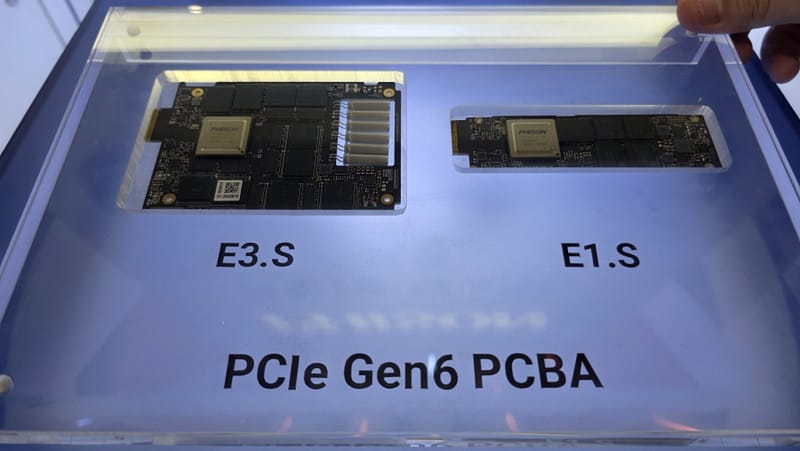
The 64GB of memory and its 130 GB/s of bandwidth matter more for the kind of workload this drive is meant for. Phison hasn’t confirmed the memory type, though LPDDR5X is a likely candidate given its use in Phison’s Topaz NPU card shown at Computex. For context, 130 GB/s sits at a bit less than half the memory bandwidth of Nvidia’s DGX Spark, a system built specifically for AI development, which gives a sense of how capable this drive’s onboard compute is meant to be relative to dedicated AI hardware.
Not the first attempt at compute on storage
Putting processing power directly on an SSD isn’t a new idea. Samsung demonstrated SmartSSD back in 2018, using an FPGA on the drive to process data without moving it off the chip. A 2022 refresh built on AMD’s Xilinx Versal FPGA claimed over 50 percent lower processing time and up to 97 percent lower server CPU usage for scan-heavy database queries. That drive has since vanished from Samsung’s own lineup, though a version reportedly still sold under the Xilinx name as of last year.
ScaleFlux took a narrower approach, handling compression inside the SSD controller so the drive looks like any ordinary NVMe device to the host, with no application changes required. Its CEO has claimed it is the only company running computational storage in production at hyperscale. Phison’s own CTO, Sebastien Jean, previously argued that generic computational storage had stalled because “each use case is highly unique and it’s simply not scalable,” calling the idea of running a full Linux stack on a drive’s bigger processors a “pie-in-the-sky approach.” The design shown at SC26 leans more general-purpose than that earlier stance might suggest, likely a reflection of how fast AI demand has shifted priorities.
The Mixed Media approach to cache and capacity
With Mixed Media, the pSLC portion of the flash runs the 4-bit QLC cells in a 1-bit SLC mode, trading some capacity for endurance and speed. Jean has described the endurance group as managed separately from the QLC region, with each appearing to the operating system as its own namespace. High-write data goes to the SLC-mode group, while QLC handles data that’s read more often than it’s written.
Phison argues this is more resilient than a dedicated cache drive setup: losing one drive out of 24 in a Mixed Media array costs around 4 percent of total cache, versus a 25 percent loss if four drives are set aside purely for caching. The trade-off is that a single drive failure now affects both capacity and a share of the cache simultaneously, rather than isolating the two. Kioxia showed a similar concept, called Mixed Mode, at FMS 2025, suggesting a pSLC-to-QLC ratio starting around 1:4, though most customers reportedly prefer pSLC closer to 0.5 to 2 percent of maximum QLC capacity.
What it means for enterprise buyers
Neither drive is aimed at consumers, and nothing here changes what’s available in retail today. But the direction is worth watching. Data centres are under pressure to run inference closer to where data sits, partly to cut network load and partly to reduce how much work lands on increasingly expensive host CPUs. ORICO’s recent SSD that reserves cache space for local AI and HP’s ZGX Fury workstation, built for running AI locally both point to the same trend from different angles, moving AI compute nearer to storage and memory rather than relying solely on a central processor.
Mixed Media, meanwhile, fits a broader shift toward QLC flash for raw capacity, paired with smarter ways to avoid the performance penalty QLC usually brings. It’s a similar philosophy to Seagate’s FireCuda Forge, which mixes SSD speed with hard drive capacity, just applied entirely within flash rather than across different storage types. With AI-driven demand also pushing hard drive makers to expand output, as seen in Toshiba’s recent expansion to meet surging AI-driven drive demand, the pressure on enterprise storage architecture looks set to keep building well before either of Phison’s drives reaches production.
Frequently asked questions
What is a computational storage SSD?
A computational storage SSD processes data directly on the drive instead of sending it all to a server’s CPU first. It returns only the relevant results, which can cut the amount of data moved across a network and reduce load on the host processor.
When will Phison’s computational storage SSD be available?
Phison hasn’t given a release date. The company has said the designs shown at SC26 are still in development and will launch once finalised, so no pricing or availability has been confirmed.
How does Mixed Media differ from a normal SSD?
A standard high-capacity enterprise setup often uses separate drives purely for fast cache. Mixed Media instead puts both fast pSLC cache and high-capacity QLC storage inside every drive, so no bays are dedicated solely to caching.
Has anyone tried putting compute on an SSD before?
Yes. Samsung’s SmartSSD used an FPGA for on-drive processing starting in 2018, and ScaleFlux has handled compression inside SSD controllers for years. Phison’s approach differs by supporting general AI frameworks rather than a single fixed function.