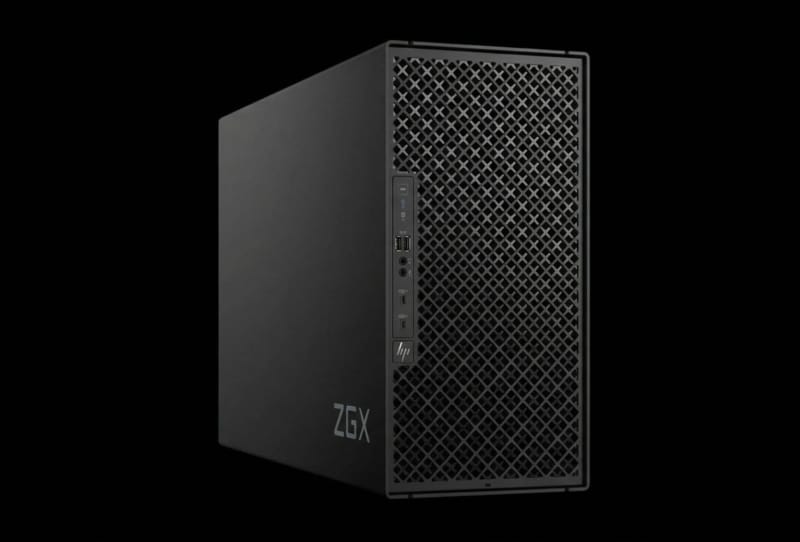
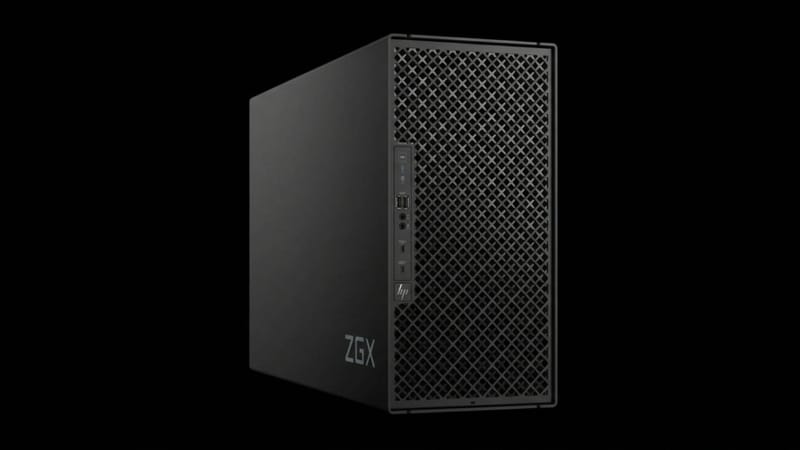
The HP ZGX Fury is a desktop workstation that squeezes Nvidia’s GB300 Grace Blackwell Ultra processor and 748GB of combined memory into an office-ready enclosure, built for organisations that want to run large language models locally instead of leaning entirely on cloud computing. It is not a machine aimed at everyday buyers. Instead, HP has designed it for research teams, AI developers, and technical departments that need serious local compute without renting rack space in a data centre.
Key takeaways
- ✓HP's ZGX Fury pairs Nvidia's GB300 Grace Blackwell Ultra processor with 748GB of combined memory
- ✓Memory splits into 496GB of LPDDR5X system RAM and 252GB of HBM3e GPU memory
- ✓HP says the system can locally fine-tune language models with up to 100 billion parameters
- ✓Liquid cooling and a 1,600W Titanium power supply manage the heavy thermal load
- ✓Twin 400Gbps ConnectX-8 networking ports allow multiple units to link into larger AI clusters
What sets the HP ZGX Fury apart from a typical high-end workstation is not just raw processing power but the sheer scale of memory on offer. Most professional desktops top out well short of a terabyte of combined system and graphics memory. This one gets close to it, and HP has engineered the whole system, from cooling to networking, around supporting that capacity under sustained AI workloads.
Table of Contents
Inside the HP ZGX Fury’s memory and processing power
At the centre of the machine sits Nvidia’s GB300 Grace Blackwell Ultra superchip, which combines a 72-core Arm Neoverse V2 Grace CPU with a Blackwell Ultra GPU on a single module. The CPU side draws on 496GB of LPDDR5X system memory running at 6,400 MT/s, while the GPU side carries 252GB of HBM3e, a high-bandwidth memory type purpose-built for graphics and AI acceleration. Combined, that adds up to the 748GB figure HP advertises for the standard configuration.
Buyers who add extra graphics hardware can push available video memory as high as 276GB through specific configurations. HP also offers versions of the ZGX Fury fitted with discrete Nvidia RTX PRO workstation graphics cards, including the RTX PRO 2000 and RTX PRO 4000, giving customers a choice depending on whether they prioritise the unified Grace Blackwell design or a more conventional CPU-and-GPU split.
| Component | Specification |
|---|---|
| Processor | Nvidia GB300 Grace Blackwell Ultra Superchip |
| CPU cores | 72-core Arm Neoverse V2 Grace CPU |
| System memory | 496GB LPDDR5X at 6,400 MT/s |
| GPU memory | 252GB HBM3e (up to 276GB with added graphics hardware) |
| Total combined memory | 748GB |
| Networking | Nvidia ConnectX-8 SuperNIC, dual 400Gbps QSFP112 ports |
| Power supply | 1,600W, Titanium-certified |
| Operating system | Ubuntu 24.04 LTS |
Why 748GB of memory matters for AI workloads
Large language models are memory hungry long before they are compute hungry. Fine-tuning or adjusting a model requires holding its parameters, gradients, and activations in memory simultaneously, which is why organisations typically rent large cloud instances for this kind of work. HP says the ZGX Fury’s memory pool is large enough to locally fine-tune models containing up to 100 billion parameters, a scale normally reserved for dedicated server clusters.
For inference rather than training, the ceiling goes even higher. Using FP4 quantisation, a technique that compresses model weights to reduce their memory footprint, the system can run inference on models reaching one trillion parameters, though HP notes that actual performance still depends heavily on the specific workload. That combination of local fine-tuning and large-scale inference is what separates the ZGX Fury from a conventional workstation upgraded with extra RAM.
The practical benefit for developers is control. Keeping sensitive training data and model weights on a local machine avoids some of the compliance and privacy questions that come with sending that data to third-party cloud providers, while also removing ongoing dependency on rented compute capacity for repeated experimentation.
Cooling, power and networking built for sustained AI work
Packing this much processing and memory into a desk-side chassis creates a thermal challenge that standard desktop fans cannot solve. HP has fitted the ZGX Fury with liquid cooling to manage heat generated under sustained load, paired with a 1,600W power supply carrying Titanium efficiency certification, the highest tier commonly used in enterprise hardware.
Networking is equally serious. An Nvidia ConnectX-8 SuperNIC provides two QSFP112 ports, each rated at 400Gbps, letting organisations link multiple ZGX Fury units together when a single machine’s memory and compute are not enough for a larger project. The chassis itself can sit under a desk or slot into a 5U equipment rack, giving IT teams the flexibility to deploy it as a standalone workstation or as one node in a small, locally managed cluster.
The system ships with Ubuntu 24.04 LTS rather than Windows, reflecting its target audience. Linux remains the preferred environment for most AI development frameworks and command-line tooling, so shipping it as the default operating system removes a setup step for the technical teams this machine is built for.
Who the HP ZGX Fury is actually built for
This is not a machine competing with mainstream creative or engineering workstations. It sits in a different category entirely, closer to a scaled-down data centre node than a desktop PC. HP’s own ZBook Ultra G3a mobile workstation, which packs 192GB of memory into a laptop form factor, shows the same local-AI thinking applied at a more portable scale, and the two products make sense as complementary parts of HP’s AI hardware lineup.
The approach also fits a broader trend across the industry, where vendors are racing to put large memory pools into smaller enclosures so developers can work with big models without cloud infrastructure. That shows up in other compact machines built for local AI, and in desktops built around flagship AMD and Nvidia hardware aimed at demanding workloads more broadly. The ZGX Fury simply takes that idea to its current extreme.
For most readers, the ZGX Fury will never land on a shopping list. Its real significance is what it signals: the line between workstation and data centre hardware is blurring, and organisations with genuine AI development needs now have a option that lives on their own premises rather than in someone else’s cloud. Teams already working with compact Linux-based desktop workstations will recognise the appeal of keeping serious compute close at hand.
Frequently asked questions
What is the HP ZGX Fury used for?
The HP ZGX Fury is designed for AI developers and researchers who need to fine-tune or run large language models locally, rather than relying on cloud computing resources for every workload.
How much memory does the HP ZGX Fury have?
The standard configuration offers 748GB of combined memory, made up of 496GB of LPDDR5X system memory and 252GB of HBM3e GPU memory, with video memory expandable to 276GB on select configurations.
Does the HP ZGX Fury run Windows?
No. It ships with Ubuntu 24.04 LTS as its default operating system, reflecting its focus on AI development tools and frameworks that are typically built around Linux environments.
Can multiple HP ZGX Fury units work together?
Yes. Each unit includes an Nvidia ConnectX-8 SuperNIC with two 400Gbps networking ports, allowing several machines to be linked for larger AI workloads, and the chassis can also be rack-mounted in a 5U enclosure.