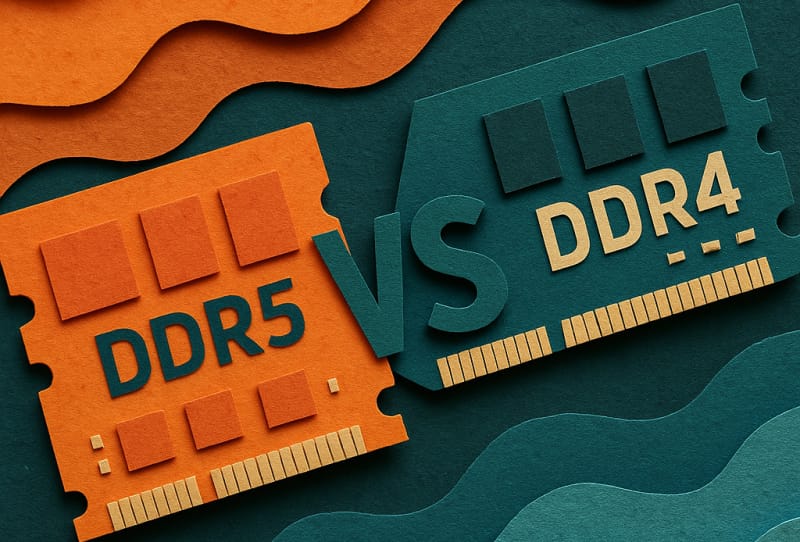
If you are building a new PC or thinking about upgrading an existing one, the DDR5 vs DDR4 upgrade question is one of the first things worth settling. This guide walks you through the real differences between the two memory standards, explains when the upgrade actually pays off in everyday use, and shows you how to make the switch properly if you decide it is time.
Table of Contents
What you’ll need
- A clear idea of your current CPU, motherboard, and RAM (check with a tool such as CPU-Z if you are unsure)
- A motherboard that supports the memory type you want to move to, since DDR4 and DDR5 are not interchangeable
- A compatible CPU, as many current processors only support one memory type
- A screwdriver and an anti-static surface if you plan to physically install new modules
Understanding the core differences
DDR5 is the newer memory standard and brings changes that go beyond just a higher number on the box. It runs at lower voltage than DDR4, splits each module into two independent subchannels for better efficiency, and moves voltage regulation onto the memory module itself rather than relying entirely on the motherboard. It also supports much higher module densities, which is why 32GB and 48GB single sticks have become common where DDR4 typically topped out lower for mainstream builds.
| Feature | DDR4 | DDR5 |
|---|---|---|
| Typical JEDEC speed range | Roughly 2133 to 3200 MT/s standard | Starts around 4800 MT/s and scales well beyond it |
| Operating voltage | 1.2V | 1.1V |
| Channel design | One 64-bit channel per module | Two 32-bit subchannels per module |
| Voltage regulation | Handled by the motherboard | Handled on-module via a built-in power management IC |
| Error correction | Not standard | On-die ECC included for reliability |
| Overclocking profiles | Intel XMP | Intel XMP and AMD EXPO |
How to decide if upgrading to DDR5 makes sense
- Check what your current CPU and motherboard actually support, since most platforms are locked to either DDR4 or DDR5 and cannot mix the two.
- Work out whether your bottleneck is really memory bandwidth or something else, such as an ageing CPU or graphics card, since DDR5 alone will not fix a slow processor.
- Consider your main use case: competitive gaming, video editing, 3D rendering, and multitasking with many browser tabs all benefit more from bandwidth gains than casual gaming or general browsing.
- Factor in that a genuine DDR5 upgrade usually means a new motherboard and often a new CPU as well, not just swapping memory sticks.
- Look at whether you plan to keep the rest of your system for several more years, since a full platform change is a bigger commitment than a simple RAM swap.
- If you are buying a new laptop or prebuilt PC, check the specification sheet carefully, since some new laptops still ship with DDR4 to keep the platform simpler.
How to upgrade from DDR4 to DDR5
- Confirm your new motherboard has DDR5 slots and that your chosen CPU officially supports DDR5, since this pairing is fixed by the platform, not a setting you can change later.
- Back up your data before making any hardware changes, especially if you are also reinstalling your operating system on new hardware.
- Power down the PC, unplug it, and ground yourself before opening the case to avoid static damage to components.
- Remove the old DDR4 modules by releasing the retention clips on the motherboard slots.
- Install the new DDR5 modules in the slots recommended in your motherboard manual, since correct slot placement affects dual-channel performance.
- Boot the system and enter the BIOS or UEFI settings to confirm the memory is detected at its rated capacity and speed.
- Enable an XMP or EXPO profile if you want the memory to run at its advertised speed rather than a conservative default, and consult the AMD EXPO memory profiles documentation if you are unsure how this works on your platform.
- Run a stability test or stress the system with normal workloads for a while to make sure everything is running cleanly before you consider the upgrade finished.
Tips and troubleshooting
If the system fails to boot after installing DDR5, reseat the modules firmly and check they are in the slots specified for dual-channel operation. A BIOS update is sometimes required on newer motherboards to properly recognise certain DDR5 kits, so check the manufacturer’s support page if the memory is not detected at the correct speed. When shopping, pairs of matched modules from a single kit, such as ultra low latency DDR5 kits or a solid DDR5-6400 kit for gaming and creative work, tend to behave more predictably than mixing modules from different batches. If you only need more capacity rather than more speed, reliable 32GB DDR5 kits are a sensible middle ground without chasing extreme clock speeds.
Frequently asked questions
Is DDR5 noticeably faster than DDR4 in everyday use?
For general browsing, office work, and most single-player gaming, the difference is often small. The gains become clearer in memory-heavy tasks like video editing, large spreadsheet work, virtualisation, and some competitive multiplayer titles where frame consistency matters.
Can I use DDR5 in a motherboard built for DDR4?
No. DDR4 and DDR5 modules have different physical notches and electrical designs, so they are not interchangeable. Moving to DDR5 requires a motherboard and CPU that officially support it, as explained by the official JEDEC DDR5 standard.
Should I wait before upgrading to DDR5?
If your current DDR4 system still handles your workload comfortably, there is little urgency. Upgrading makes more sense when you are already replacing your CPU and motherboard for other reasons, since bundling the change avoids paying for a platform swap twice.
Does DDR5 use less power than DDR4?
Yes, DDR5 typically runs at a lower voltage than DDR4, which helps reduce overall system power draw slightly, though the CPU and graphics card still account for the bulk of a system’s power use.