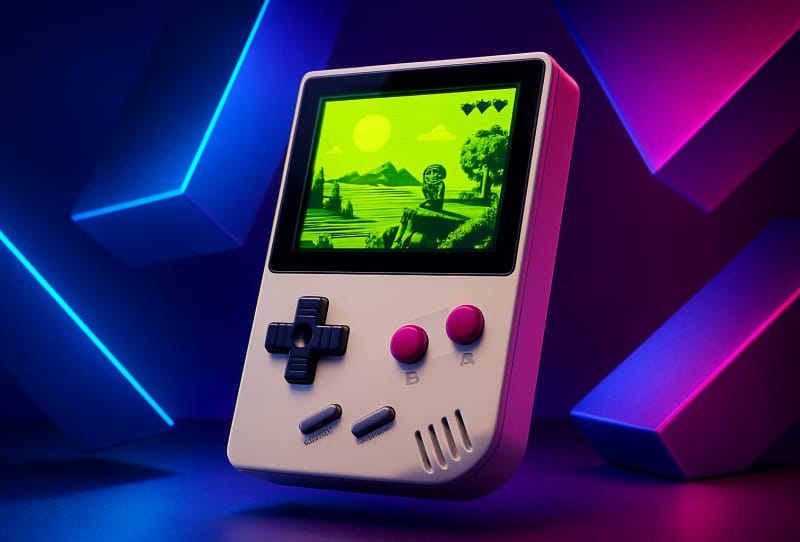
The FPGB Mini handheld is barely wider than the cartridges it plays, and that alone makes it one of the more novel retro gaming gadgets to surface this year. Built by FunnyPlaying, a company better known for its Game Boy and Game Boy Advance upgrade kits, the device is designed to slot original Nintendo cartridges straight into a pocket-sized shell and play them using dedicated hardware rather than software emulation.
It arrives at a moment when interest in FPGA-based retro handhelds has never been higher, largely thanks to Analogue and its long-running Pocket console. FunnyPlaying isn’t trying to match the Pocket feature for feature. Instead, it has built something smaller, simpler, and aimed squarely at players who just want to plug in an old Game Boy or Game Boy Color cartridge and have it work.
Table of Contents
What the FPGB Mini handheld actually does
Cartridge support is the headline feature, but it’s also where the FPGB Mini handheld shows its limits. Unlike the Analogue Pocket, which reads Game Boy, Game Boy Color, Game Boy Advance, and even Sega Game Gear cartridges through adapters, FunnyPlaying’s device only accepts original Game Boy and Game Boy Color carts. There’s no GBA compatibility here, so anyone hoping to relive Advance-era favourites will need to look elsewhere.
What the FPGB Mini handheld does offer is faithful playback. Like the Pocket, it uses field-programmable gate array technology rather than emulation to reproduce the original hardware’s behaviour, timing, and quirks as closely as possible. For purists who care about accuracy over convenience, that distinction matters a great deal.

A microSD slot rounds out the package, letting players store save files, screenshots, or ROM files that can be run through the handheld’s emulation mode when a physical cartridge isn’t available. It’s a practical inclusion that widens the device’s usefulness beyond just cartridge collectors.
Specs, screen, and battery life
Despite its tiny footprint, FunnyPlaying hasn’t skimped on the display. The FPGB Mini handheld uses a 2.98-inch LCD panel running at 800 by 720 pixels, a notably sharp resolution for a screen that size and one that should make sprite work and pixel art look crisp rather than smeared. An 1,800mAh rechargeable battery handles power duties, which is a solid capacity given how compact the whole unit is.
| Feature | FPGB Mini | Analogue Pocket |
|---|---|---|
| Cartridge support | Game Boy, Game Boy Color | Game Boy, Color, Advance, Game Gear (adapter) |
| Display | 2.98-inch, 800×720 | 3.5-inch, 1600×1440 |
| Battery | 1,800mAh | Larger internal cell |
| Storage | microSD slot | microSD slot |
| Core tech | FPGA | FPGA |
One trade-off of the compact design is compatibility with cartridges that carry extra hardware, such as rumble motors or built-in accessories. Those simply won’t fit or function properly in a shell this small. For the vast majority of standard Game Boy and Game Boy Color titles, though, that shouldn’t be an issue.

How it stacks up against Analogue’s Pocket
The comparison to Analogue’s Pocket handheld is unavoidable, given both devices lean on FPGA technology to play original cartridges as authentically as possible. The Pocket remains the more capable of the two, thanks to its broader cartridge support, sharper display, and wider accessory ecosystem built up over several years on the market.
Where the FPGB Mini handheld carves out its own space is sheer portability. Its dimensions are dictated almost entirely by the cartridge slot itself, resulting in a device that disappears into a pocket in a way the larger Pocket simply can’t match. For collectors who just want a straightforward way to play their Game Boy library on the go, that size advantage counts for a lot.
Early hands-on impressions from retro gaming outlet Retro Dodo, which spent several days testing a unit, have been positive so far, particularly around the build quality and how naturally the cartridge slot integrates into such a small chassis. FunnyPlaying’s first production run reportedly sold out quickly, and the company is said to be considering further hardware refinements before releasing another batch.

Why this matters for retro handheld fans
The rise of compact FPGA handhelds reflects a broader shift in how manufacturers are approaching retro gaming hardware. Rather than chasing feature parity with modern emulation handhelds like the Retroid Pocket Duo, companies such as FunnyPlaying are betting that a segment of players still values authentic cartridge playback above raw versatility.
That approach echoes tensions elsewhere in the industry over physical media, including Nintendo’s own approach to physical cartridges on newer consoles. As original Game Boy hardware continues to age and become harder to source in working condition, devices like the FPGB Mini handheld offer a modern, reliable way to keep decades-old cartridges playable without relying on ROM dumps or ageing original hardware.
Whether FunnyPlaying can scale production to meet demand remains to be seen, especially after its first limited run disappeared so quickly. For now, the FPGB Mini handheld stands as a compelling, tightly focused alternative for anyone who cares more about pocketability and cartridge authenticity than chasing the widest possible compatibility list.