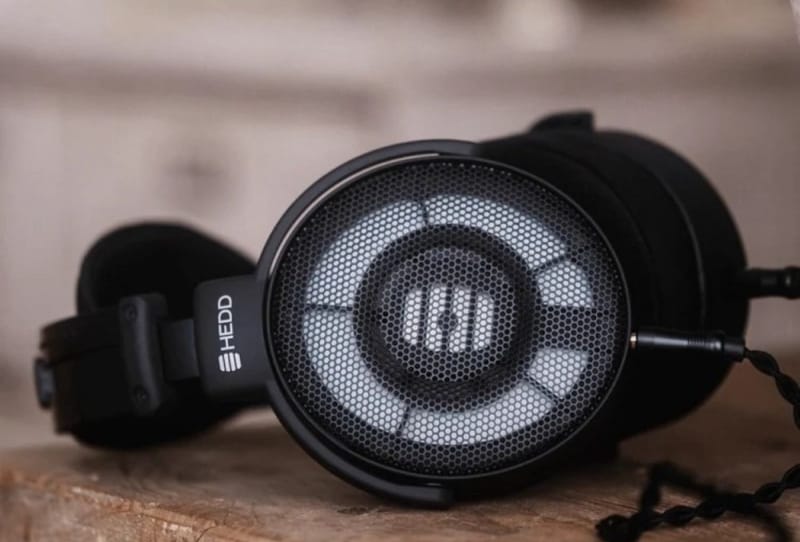
HEDD Audio’s new HEDDphone DX headphones promise full-level bass extension down to 20 Hz from a 50mm dynamic driver, but the measurements behind that figure all trace back to the company itself, not an independent lab. The Berlin-based manufacturer announced the open-back flagship on November 24, with pre-orders opening the same day, yet none of the early reviews published so far include the excursion or distortion data that would actually confirm the claim.
Key takeaways
- ✓HEDD Audio's HEDDphone DX headphones claim full-level bass output down to 20 Hz.
- ✓The frequency graphs cited in early reviews were supplied by HEDD, not measured independently.
- ✓None of the reviewed sources publish driver excursion or distortion figures for the bass claim.
- ✓The DX uses the same 50mm driver size as the earlier HEDDphone D1 but adds a thin-ply carbon diaphragm.
- ✓Open-back headphones naturally lose bass output compared with closed-back designs, making the 20Hz claim notable if confirmed.
That gap matters because bass extension is one of the hardest things for an open-back headphone to deliver convincingly. HEDD is positioning the DX as a studio-grade listening tool, built around a thin-ply carbon diaphragm the company first introduced on the HEDDphone D1. Whether the new driver genuinely reaches that low without audible strain is, for now, a question only HEDD has answered.
Table of Contents
What HEDD claims about the HEDDphone DX headphones
HEDD’s press material lists “full output to 20 Hz” as its headline bass specification, alongside a broader quoted frequency range of 5 Hz to 40 kHz. Neither figure comes with a stated level tolerance, which means there is no way to know from the spec sheet alone how loud the headphones actually play at either extreme of that range. A frequency response claim without a decibel tolerance is, in practice, closer to marketing copy than an engineering spec.
The DX carries over the 50mm driver size used in the earlier HEDDphone D1, so any extra low-frequency capability has to come from how far the new diaphragm can move, rather than from a larger surface area. HEDD has described tuning the DX’s bass to match the output of a flat studio monitor in a treated room, a reference point that sounds credible but is also difficult for a reader to independently check.
| Spec | HEDDphone DX | HEDDphone D1 (predecessor) |
|---|---|---|
| Driver size | 50mm dynamic | 50mm dynamic |
| Diaphragm material | Thin-ply carbon | Earlier carbon composite |
| Design | Open-back | Open-back |
| Claimed bass extension | Full output to 20 Hz | Not specified by HEDD |
Why the HEDDphone DX headphones’ bass claim is unverified
Four early reviews have covered the DX, and the pattern across them is consistent. Creative Bloq’s review notes that HEDD supplied a measurement taken on a Brüel & Kjær 5128 test head, along with a literature claim of near-zero distortion, rather than an independently captured graph. Music For The Masses reviewer Jürgen Kraus similarly states that HEDD measured the chart used in his review ahead of launch, attributing an 8 kHz peak in that data to an artifact of the measurement coupler rather than the headphone itself.
Major HiFi’s review describes the bass as deep and well defined but cites no measurements at all to support that impression. The Headphones.com product listing, meanwhile, shows no frequency graph whatsoever. Taken together, that leaves zero independently generated response curves among the four sources, and none that include excursion or distortion figures, the two numbers that would actually show whether a driver can hit 20 Hz cleanly or whether it is simply being pushed hard enough to produce audible breakup.
The physics problem open-back headphones face at low frequencies
Open-back designs have an inherent disadvantage at the bass end. Because there is no sealed enclosure behind the driver, sound radiating from the rear of the diaphragm arrives out of phase with the sound coming from the front, and the two partially cancel each other out. Closed-back headphones avoid this problem and typically produce stronger, more efficient bass as a result, which is part of why open-back bass claims deserve extra scrutiny rather than less.
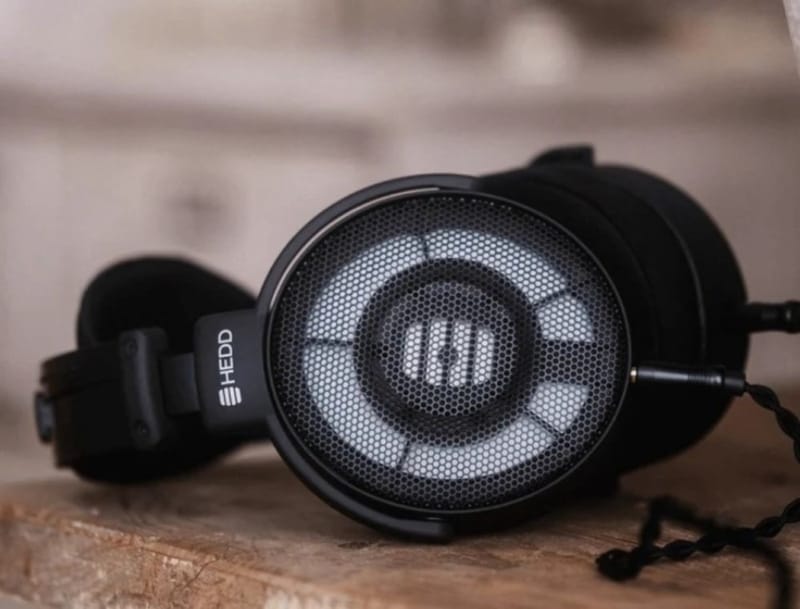
Headphone engineers compensate for that cancellation with excursion, meaning how far the diaphragm physically travels back and forth. A smaller diaphragm has to move farther than a larger one to shift the same amount of air, and HEDD’s use of a thin-ply carbon material is meant to allow that extra travel without the diaphragm flexing or breaking up. The trade-off is that greater excursion generally increases distortion, which is exactly the figure missing from every review published so far. Until an independent measurement set appears showing both frequency response and distortion together, the 20 Hz claim remains a HEDD assertion rather than a verified result.
What it means for anyone considering the HEDDphone DX headphones
None of this means the DX is a bad headphone. HEDD’s reputation in studio monitoring circles carries weight, and reviewers who have heard the DX describe its bass as convincing rather than exaggerated. The issue is purely one of evidence: a company-supplied graph on a company-chosen test rig is not the same thing as a third-party lab result, and buyers weighing a premium open-back purchase deserve to know the difference.
The open-back studio headphone category has grown busier recently, with options like Audio-Technica’s own open-back headphones, OLLO Audio’s X2 studio headphones, HIFIMAN’s open-back Ananda Unveiled and beyerdynamic’s Pro X studio headphones all competing for the same precision-listening audience. Anyone comparing the DX against those alternatives would be wise to wait for an independent measurement before treating HEDD’s 20 Hz figure as settled fact, and to check HEDD Audio’s own website for any updates once third-party testing starts to appear.
Frequently asked questions
What is the HEDDphone DX?
The HEDDphone DX is an open-back, over-ear headphone from German manufacturer HEDD Audio, built around a 50mm dynamic driver with a thin-ply carbon diaphragm and positioned as a studio-grade listening and mixing tool.
Does the HEDDphone DX really reach 20 Hz?
HEDD claims full-level output down to 20 Hz, but the frequency graphs published alongside early reviews were supplied by HEDD rather than measured independently, and none include the distortion or excursion data needed to confirm the claim.
How is the HEDDphone DX different from the HEDDphone D1?
Both models use a 50mm dynamic driver in an open-back design, but the DX adds HEDD’s thin-ply carbon diaphragm material and claims a specific low-frequency extension figure that HEDD never published for the D1.
When is the HEDDphone DX available?
HEDD opened pre-orders for the HEDDphone DX on November 24, alongside its official product announcement.