The Kioxia NVIDIA SSD collaboration shows how AI systems could soon treat flash storage as an extension of GPU memory rather than a bottleneck standing in its way. The two companies have jointly demonstrated software and hardware that stretches effective GPU memory capacity to petabyte scale, using banks of NVMe solid-state drives to back up the much smaller pool of high-bandwidth memory built into modern accelerators.
Key takeaways
- ✓Kioxia and NVIDIA demonstrated extending effective GPU memory to petabyte scale using SSDs
- ✓The test used 144 Kioxia XD8 Series 7.68 TB E1.S NVMe SSDs, around 1.1 petabytes of flash
- ✓NVIDIA's SCADA software lets GPUs pull small blocks of data straight from SSDs
- ✓The setup processed a database of 2 trillion vectors on a GB200 NVL72 rack
- ✓The approach targets AI workloads that have outgrown fixed HBM capacity on GPUs
Kioxia America detailed the work this week, built around NVIDIA’s SCADA software (short for Scaled Accelerated Data Access) and the broader Storage-Next initiative. The pairing is aimed squarely at a problem that has been building for years: AI datasets are growing faster than the memory sitting directly on GPUs can hold.
Table of Contents
What Kioxia and NVIDIA actually demonstrated
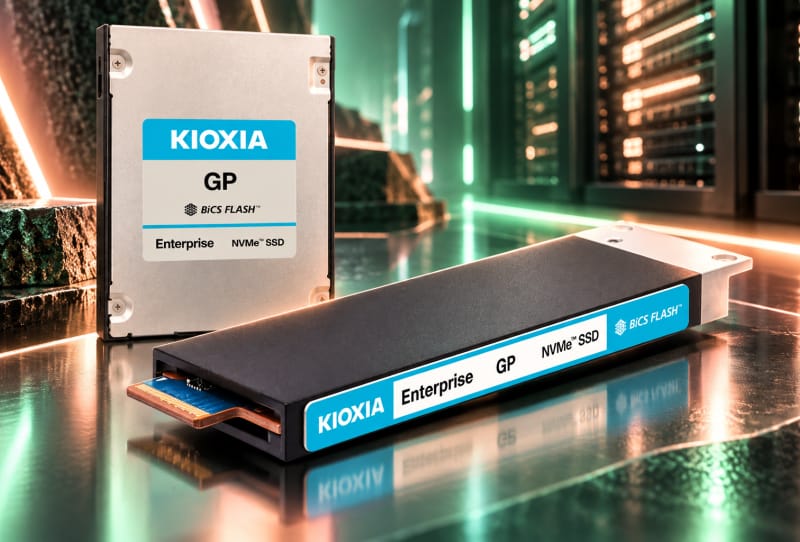
In the demonstration, engineers processed a database containing two trillion vectors, the kind of structure used in large-scale retrieval and recommendation systems, on an NVIDIA GB200 NVL72 rack-scale system. Rather than relying purely on the high bandwidth memory built into the GPUs, the setup leaned on 144 Kioxia XD8 Series NVMe SSDs, each with 7.68 TB of capacity in the compact E1.S form factor.
Added together, that is roughly 1.1 petabytes of flash storage working alongside the GPUs, acting as a fast overflow pool for data that would otherwise never fit in memory at once. NVIDIA’s SCADA software is the piece that makes this practical, because it lets GPUs request small blocks of data directly from the SSDs rather than forcing the system to shuffle entire datasets back and forth between storage and memory.
Why GPU memory has become the real bottleneck
High bandwidth memory is extremely fast, but it is also expensive and physically limited in how much can sit next to a GPU die. As AI models and the datasets behind them have ballooned in size, that fixed capacity has become a hard ceiling. Teams training large models or running huge vector searches have typically had to break datasets into smaller chunks, process each piece, then repeatedly move data between memory and slower storage tiers.
That constant shuffling eats into performance and adds complexity for anyone building AI infrastructure. The idea behind pairing SCADA with high-performance SSDs is to let GPUs treat flash storage almost like a slower, much larger extension of memory, cutting out a lot of that manual data juggling.
The hardware behind the test
| Component | Detail |
|---|---|
| GPU platform | NVIDIA GB200 NVL72 rack-scale system |
| SSDs used | 144 x Kioxia XD8 Series, 7.68 TB each, E1.S form factor |
| Combined SSD capacity | Approximately 1.1 petabytes |
| Software stack | NVIDIA SCADA (Scaled Accelerated Data Access) and Storage-Next |
| Workload demonstrated | Database of 2 trillion vectors |
That configuration gives a sense of scale. A rack-sized GPU system normally built for training and inference was reconfigured to lean on dense NVMe storage as a working extension of its memory pool, not just a place to park data before or after a job runs.
How this compares with existing Kioxia and NVIDIA work
This is not the first time Kioxia has pushed SSD density and performance for AI-scale infrastructure. Kioxia has previously packed 157 petabytes of SSDs into a single server rack, and its PCIe 6.0 SSD recently set an IOPS world record, showing a clear pattern of chasing both raw capacity and raw speed for data centre customers.

On the NVIDIA side, this effort sits alongside NVIDIA’s push into agentic AI hardware with Microsoft’s RTX Spark builder PCs, part of a wider strategy of making large AI workloads practical outside of the biggest hyperscale data centres. Extending effective GPU memory with SSDs fits that same direction, giving organisations a way to run far bigger AI jobs without needing to buy proportionally more expensive high-bandwidth memory.
What it means for AI infrastructure going forward
For data centre operators, the practical upside is straightforward: workloads that currently need to be split, staged, and reassembled because they do not fit in GPU memory could instead run closer to continuously, with SSDs quietly supplying data as needed. That matters most for vector databases, recommendation engines, and retrieval-augmented generation systems, all of which lean heavily on searching through enormous datasets quickly.
Neither company has announced specific products built on this demonstration, and there is no confirmed timeline for when SCADA-based configurations might reach commercial deployments. What the test does confirm is that extending GPU memory with dense, high-performance flash is technically viable at a scale measured in trillions of data points, which gives infrastructure planners a credible alternative to simply waiting for larger and pricier HBM pools.
Frequently asked questions
What is NVIDIA SCADA software?
SCADA stands for Scaled Accelerated Data Access. It is NVIDIA software designed to let GPUs pull small blocks of data directly from NVMe SSDs, effectively extending usable GPU memory beyond the fixed high-bandwidth memory built into the hardware.
How much storage was used in the Kioxia NVIDIA SSD collaboration?
The demonstration used 144 Kioxia XD8 Series NVMe SSDs, each with 7.68 TB of capacity, adding up to roughly 1.1 petabytes of flash storage working alongside the GPUs.
What workload did the demonstration process?
Kioxia and NVIDIA processed a database containing two trillion vectors on an NVIDIA GB200 NVL72 rack-scale system, a workload typical of large AI search and recommendation systems.
Is this technology available to buy now?
No specific product or release date has been announced. This is a technical demonstration showing the approach is viable, rather than a confirmed commercial offering.