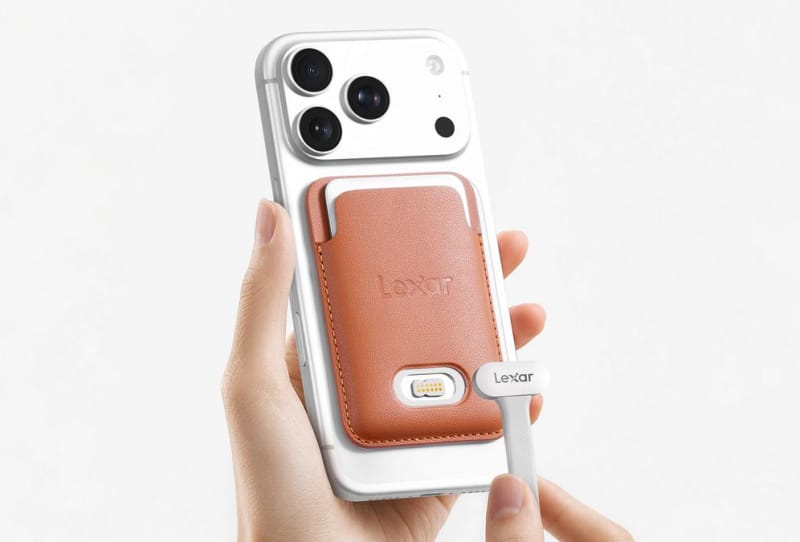
Lexar has unveiled a portable SSD so thin it barely looks like a storage drive at all. The Lexar Muse Ultra Slim portable SSD measures just 3.8mm thick, which the company says makes it the slimmest drive of its kind on the market. To get there, Lexar made an unusual trade-off: the Muse drops the familiar USB-C port entirely in favour of a proprietary magnetic connector.
That single decision separates the Muse from almost every other external drive sold today. Whether it pays off for shoppers depends on how much they value a sliver-thin design against the everyday convenience of a cable that works with literally everything else in their bag. For anyone researching the Lexar Muse Ultra Slim portable SSD ahead of a purchase, understanding that trade-off is the key to deciding whether it’s the right drive for their setup.
Table of Contents
A design built around shaving millimetres
Lexar has leaned heavily into the idea that thinness itself is the headline feature here. Most portable SSDs on shelves today sit somewhere between 8mm and 11mm thick, largely because they still need to house a full-sized USB-C port along with the NAND flash and controller inside. Removing that port is exactly what let Lexar shrink the Muse down to a fraction of that footprint.
A drive this thin slips into a laptop sleeve or a shirt pocket without adding any real bulk, which is clearly the pitch. It also suggests a lighter overall build, since a slimmer chassis typically means less metal or polycarbonate is needed to enclose the internals. The name itself, the Lexar Muse Ultra Slim portable SSD, leans into that positioning, framing the drive as a lifestyle accessory as much as a storage tool. Lexar has not detailed the exact capacities, transfer speeds, or materials used in the Muse, so those specifics remain unconfirmed ahead of a fuller rollout.
Design details aside, the Muse also hints at where Lexar sees the broader portable storage market heading. As laptops, tablets and even some smartphones get thinner, accessory makers are under pressure to match that aesthetic rather than clash with it. A bulky external drive can feel out of place next to an ultraportable notebook, and Lexar appears to be betting that shoppers upgrading to slimmer devices will want storage that looks and feels just as svelte, even if that means rethinking how the drive connects in the first place.
Why swapping out USB-C is such a gamble
USB-C has become close to universal. It charges phones, connects monitors, and links up almost every external drive released in the past five years, including rivals like Crucial’s X8 portable SSD and SanDisk’s Extreme PRO portable SSD. By moving to a bespoke magnetic connector instead, Lexar is asking buyers to carry a special cable that will not work with any other device.
That is not necessarily a dealbreaker on its own. Apple has proven with MagSafe that a magnetic connection can be genuinely useful, since it snaps into place quickly and avoids strain on a fragile port. However, MagSafe still works alongside a standard charging pathway. If the Muse requires its dedicated cable every time, and that cable gets lost or damaged, the drive becomes far less useful until a replacement turns up.
There is also the practical question of transfer speed. USB-C ports typically carry a known standard, whether that is USB 3.2 or Thunderbolt, so buyers can generally predict roughly how fast their files will move. A proprietary connector means Lexar controls that experience entirely, and until real-world benchmarks appear, it is impossible to know how the Muse stacks up against established drives on raw performance. Anyone hunting for a slim external drive should treat those unknowns as a genuine part of the buying decision, not just a footnote.
Compatibility with docks, hubs and multi-port adapters is another factor worth considering. A standard USB-C drive can be plugged into almost any modern dock without a second thought, but a proprietary connector on the Muse means it may only work when paired with its own cable, rather than sitting alongside other peripherals on a shared hub. For buyers who juggle multiple drives, monitors and accessories through a single dock, that limitation could matter more than the drive’s slim profile.
How the Muse fits against the rest of the portable SSD market
The portable SSD category has quietly gotten thinner and lighter over the past few years, but nobody has gone quite this far. The more affordable Crucial X6 and similar drives from Samsung and SanDisk still rely on standard USB-C, prioritising broad compatibility over an ultra-slim profile.
| Drive | Connector | Approximate thickness |
|---|---|---|
| Lexar Muse Ultra Slim | Proprietary magnetic connector | 3.8mm |
| Typical rival drives (Crucial, SanDisk, Samsung) | USB-C | Roughly 9mm to 11mm |
That gap is significant. Shaving five to seven millimetres off a drive most people already consider pocketable is a genuine engineering feat, even if the method used to get there raises questions. It also signals that Lexar sees a market for buyers who prioritise a minimalist, ultraportable design over drop-in compatibility with existing cables and docks, such as Lexar’s own Thunderbolt 5 dock. In effect, Lexar is carving out a new sub-category of ultra slim portable SSD that sits apart from the mainstream USB-C drives most shoppers already own, betting that a segment of buyers will happily trade a bit of convenience for a genuinely pocket-friendly design.
It is also worth noting how this positions the Lexar Muse Ultra Slim portable SSD within Lexar’s own line-up. Rather than replacing its existing USB-C drives, the Muse looks set to sit alongside them as a specialised option for buyers chasing the thinnest possible profile, while more conventional Lexar drives continue to serve those who want straightforward USB-C compatibility. That dual approach mirrors how some laptop makers offer both a standard model and an ultra-thin variant, letting shoppers choose which trade-offs matter most to them.
What it means for buyers weighing up a purchase
Anyone considering the Lexar Muse Ultra Slim portable SSD needs to think about how it will actually get used day to day. A creative professional who already travels with a dedicated bag of cables might not mind adding one more proprietary lead. Someone who just wants to grab a drive, plug it into whatever laptop is nearby, and start copying files will likely find the magnetic connector an unnecessary hurdle.
There is also the resale and longevity angle to weigh up. Drives built around standard USB-C tend to stay useful for years because the connector itself never becomes obsolete. A proprietary cable ties the Muse’s usefulness to Lexar continuing to support and supply that same connector long-term, which is a harder guarantee for any single manufacturer to make. Buyers who lean on external storage for backups or archiving may want to factor in whether they are comfortable depending on a single supplier for replacement cables down the track.
It is also worth thinking about how the Muse might be used alongside other devices over its lifetime. A drive bought today may need to connect to a different laptop, tablet or desktop in a few years’ time, and it is not yet clear whether Lexar plans to offer adapters that bridge the magnetic connector back to standard USB-C for those situations. Until that is confirmed, buyers should assume the Muse will largely stay tied to its own cable and ecosystem for as long as they own it.
For now, the Muse stands out mainly as a statement of what is technically possible in a portable drive. Until Lexar confirms pricing, capacities and performance figures, it is best treated as an intriguing design exercise rather than a settled recommendation, particularly for buyers who value flexibility over a few extra millimetres of thinness.
Frequently asked questions
What makes the Lexar Muse Ultra Slim portable SSD different from other portable drives?
Its standout feature is thickness: at 3.8mm, it is significantly slimmer than most portable SSDs, which typically measure between 8mm and 11mm. Lexar achieved this by removing the standard USB-C port and replacing it with a proprietary magnetic connector, freeing up space that would otherwise be needed for a full-sized port.
Does the Lexar Muse work with a standard USB-C cable?
No. The Muse relies on a bespoke magnetic connector rather than USB-C, meaning it requires its own dedicated cable to connect to a laptop or other device. It will not plug directly into standard USB-C cables, docks or ports used by most other drives on the market.
What are the confirmed specifications for the Lexar Muse SSD?
As of this article, Lexar has not published detailed specifications for capacity, transfer speeds, pricing or availability. The company has focused its announcement on the drive’s thinness and its magnetic connector, with further details expected ahead of a fuller product rollout.
Is a magnetic connector a dealbreaker for a portable SSD?
That depends on how the drive is used. A magnetic connector can offer a quick, secure connection similar to Apple’s MagSafe, but unlike MagSafe it does not sit alongside a standard connection option. Buyers who move files between many different devices may find a proprietary cable less convenient than universal USB-C, while those who use the Muse with a single dedicated setup may not notice much difference.