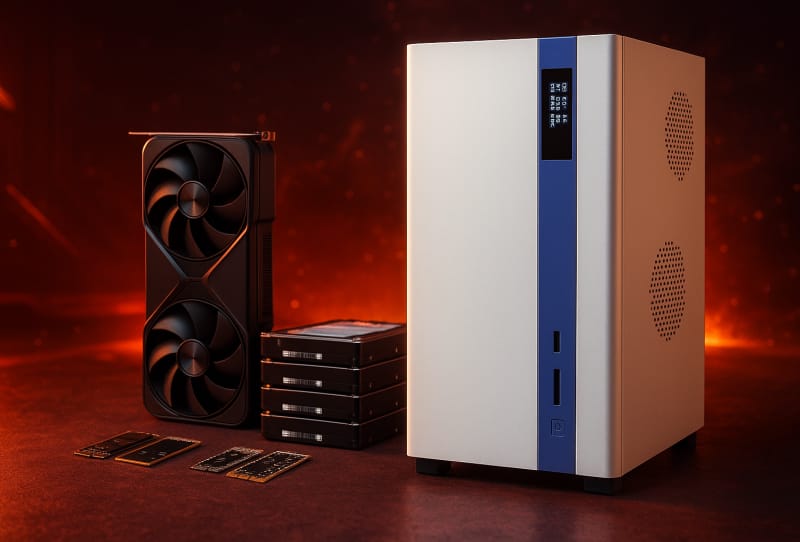
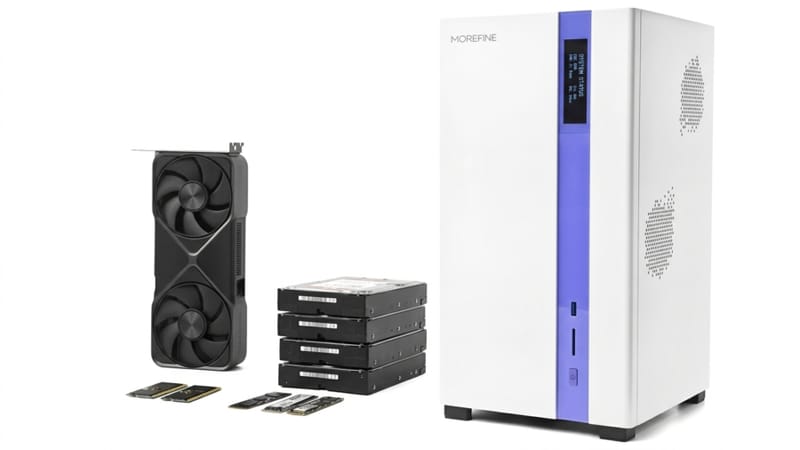
The Morefine MNAS-X1 NAS turns the usual network storage layout on its head, literally. Four swappable hard drives sit stacked above a Ryzen 7 motherboard, leaving the space below free for a full-size gaming graphics card. It is an odd bit of engineering, but it solves a problem that has annoyed small-form-factor builders for years: how to fit real storage and a real GPU into one compact box without one compromising the other.
Most mini PCs and compact NAS units force a choice. Either the chassis prioritises drive bays and cooling for storage, or it prioritises GPU clearance for gaming and AI workloads, rarely both. Morefine’s answer relies on a simple bit of physics: heat rises, and airflow moves more predictably when components are separated by function rather than crammed side by side. By placing the drive cage on top and the GPU compartment below, the MNAS-X1 keeps thermal zones distinct while still fitting everything into a single small enclosure.
Table of Contents
What the Morefine MNAS-X1 Actually Looks Like
Open the case and the layout is immediately unusual. The four drive bays load from the top, similar to a toaster, rather than sliding in from the front like a typical NAS. Each bay is tool-less and hot-swappable, so a failed or full drive can be pulled and replaced without powering down the whole system or removing other components.
Beneath that drive cage sits the Ryzen 7 motherboard, and below that, a compartment sized for a full-length graphics card. That is the genuinely notable part. Most NAS enclosures, even multi-bay ones aimed at prosumers, have no meaningful GPU support at all. Morefine has effectively built a small workstation chassis with NAS-grade storage flexibility bolted onto the top of it, rather than treating the GPU as an afterthought squeezed into leftover space.
Specifications and Hardware Inside the MNAS-X1
Morefine has not published every configuration option, but the core platform centres on an AMD Ryzen 7 processor paired with four drive bays and a discrete GPU slot rated for full-size cards. The table below summarises the key elements known so far.
| Component | Detail |
|---|---|
| Processor | AMD Ryzen 7 (mobile/embedded class) |
| Storage bays | 4x top-loading, hot-swappable, tool-less |
| GPU support | Full-size discrete graphics card, dedicated compartment |
| Form factor | Compact vertical chassis with separated thermal zones |
The Ryzen 7 chip handles everyday NAS duties comfortably, things like file serving, backup jobs, and light transcoding, while the GPU slot opens the door to workloads a standard NAS simply cannot do: local AI inference, video encoding acceleration, or even light gaming over a home network. AMD’s own Ryzen 7 mobile processor lineup is built around exactly this kind of balance between efficiency and multitasking headroom.
How It Compares to Traditional NAS Boxes and Mini Workstations
Compared with a conventional 4-bay NAS like the Asustor AS5404T, the MNAS-X1 trades some of the polished software ecosystem for raw hardware flexibility. Synology and QNAP style devices lean heavily on their own operating systems for backup scheduling, snapshots, and app support. Morefine’s approach looks closer to a general-purpose PC that happens to have excellent drive access, which suits a technically confident owner more than someone wanting a plug-and-forget appliance.
Against compact workstations, the comparison flips. Machines built for pure compute, similar in spirit to Acemagic’s own Ryzen-powered mini workstation, typically sacrifice storage expansion to fit a bigger cooler or GPU. The MNAS-X1 does not ask for that trade-off. Four bays and a full GPU slot in the same footprint is genuinely rare, and it puts the device in a category of its own rather than squarely against either NAS vendors or mini PC makers.
Anyone weighing up options in this space, including those still deciding between a dedicated NAS and a repurposed mini PC, may find it useful to work through picking the right mini PC for a home server before committing, since the ideal choice depends heavily on whether GPU acceleration actually matters for the intended workload.
Why the MNAS-X1 Matters for Home Lab Builders
Home lab enthusiasts and small studios have long cobbled together similar setups themselves, stuffing a GPU into a repurposed tower case alongside a handful of drives. Morefine packaging that concept as a single coherent product signals growing demand for machines that blur the line between storage server and compute node, rather than forcing buyers to pick one identity.
There are trade-offs worth weighing before treating the MNAS-X1 as a drop-in NAS replacement. Hot-swappable top-loading bays are convenient, but they are less common than front-loading trays, so cable routing and case rigidity during drive swaps deserve scrutiny once independent testing appears. Buyers used to a mature NAS operating system will also need to build their own storage management stack, whether that means TrueNAS, Unraid, or a Windows-based setup with NAS backups configured from a Windows PC.
Even so, the core idea is sound and overdue. A NAS with genuine GPU headroom opens up local AI model hosting, media transcoding at real speed, and even occasional gaming, all from a box that still holds four drives for bulk storage. Whether Morefine can price and support the MNAS-X1 well enough to reach beyond the DIY crowd remains the open question, but the layout itself deserves attention from anyone who has ever wished their NAS could do a little more than just serve files.