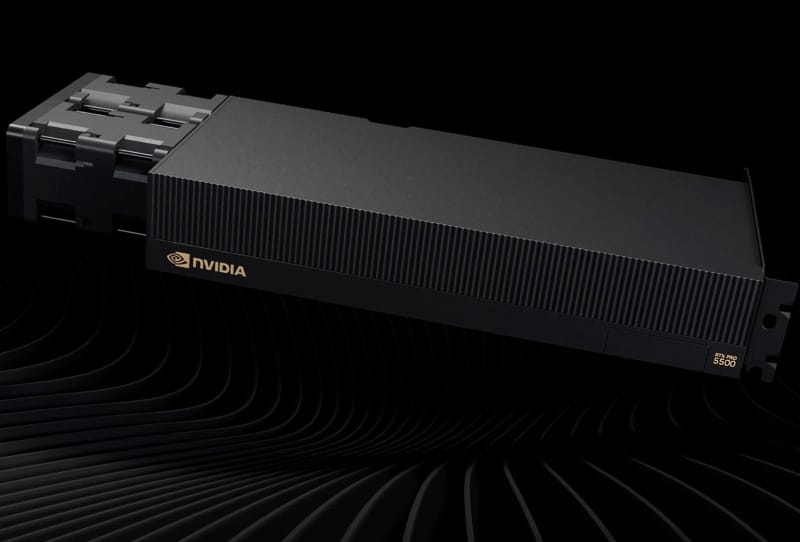
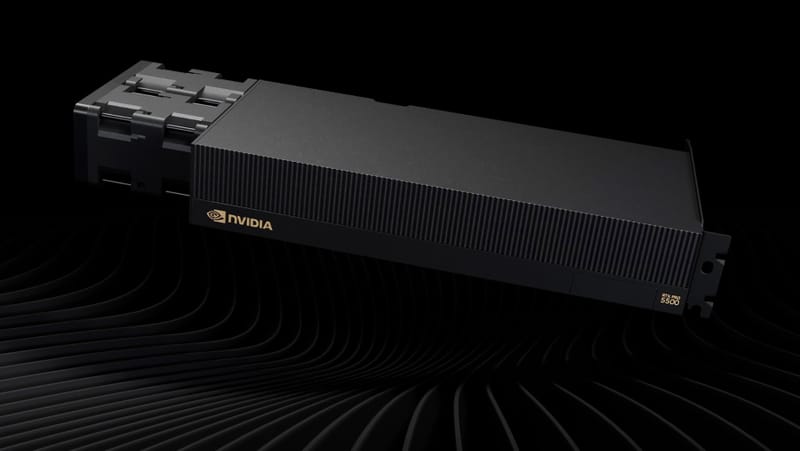
The Nvidia RTX Pro 5500 has arrived as the company’s latest attempt to squeeze more AI revenue out of its Blackwell silicon, and gamers are not the intended audience. Badged as the RTX Pro 5500 Blackwell Workstation Edition, the card shares its core specifications almost exactly with the GeForce RTX 5090, yet ships with 2.6 times the memory. That single change tells you everything about who Nvidia built this for.
Rather than chasing frame rates, the card is aimed at engineers, researchers and studios running agentic and generative AI workloads that live or die on how much data can sit in VRAM at once. It slots into a professional line-up that already spans several tiers, and its arrival fills a gap that has existed between two of Nvidia’s other workstation cards for a while.
Table of Contents
What the Nvidia RTX Pro 5500 actually offers
Under the hood, the RTX Pro 5500 uses the same GB202 die found in the GeForce RTX 5090, the RTX Pro 6000 and the RTX Pro 5000. Nvidia has enabled 170 of the die’s 192 available Streaming Multiprocessors, giving the card 21,760 CUDA cores. That is close enough to the GeForce RTX 5090’s core count that raw compute performance between the two should be broadly comparable in most workloads.
The real differentiator sits in the memory subsystem. Nvidia has fitted the RTX Pro 5500 with 28 GDDR7 memory chips arranged in a clamshell layout, with 14 modules mounted on each side of the circuit board. Each module holds 24 gigabits, or 3GB, of capacity, adding up to a total of 84GB of GDDR7 memory across a 448-bit bus. That is a substantial jump over the 32GB found on the consumer GeForce RTX 5090.
Bandwidth trade-offs behind the extra memory
Nvidia rates the RTX Pro 5500’s memory at roughly 1,398 GB/s of bandwidth, running at 25 Gb/s per pin rather than the 28 Gb/s speeds used on the RTX Pro 6000 and the GeForce RTX 5090. Samsung, Micron and SK hynix currently only mass-produce 28 Gb/s GDDR7 packages, so the slower clock appears to be a deliberate choice by Nvidia, likely made to hit specific power and thermal targets or to keep the card from encroaching too closely on pricier models above it.
The practical effect is that the RTX Pro 5500 offers only about 4 percent more bandwidth than the RTX Pro 5000, while trailing both the RTX Pro 6000 and the GeForce RTX 5090 by roughly 22 percent. For workloads bottlenecked purely by bandwidth, that gap matters. For workloads bottlenecked by capacity, such as loading large language models entirely into VRAM, the extra 84GB matters far more.
| Model | Memory | Memory bus | Bandwidth |
|---|---|---|---|
| RTX Pro 5000 | 72GB GDDR7 | 384-bit | ~1,344 GB/s |
| RTX Pro 5500 | 84GB GDDR7 | 448-bit | ~1,398 GB/s |
| GeForce RTX 5090 | 32GB GDDR7 | 512-bit | ~1,792 GB/s |
| RTX Pro 6000 | 96GB GDDR7 | 512-bit | ~1,792 GB/s |
Where it sits against the rest of Nvidia’s line-up
The RTX Pro 5500’s positioning is deliberate. It slots neatly between the RTX Pro 5000, with 72GB of memory, and the RTX Pro 6000, which tops out at 96GB. That leaves a clear tier structure for buyers who need more headroom than the RTX Pro 5000 offers but don’t want to pay for the flagship RTX Pro 6000. Nvidia has taken a similar approach before with the China-exclusive RTX Pro 6000D, which also shipped with 84GB of memory, making the RTX Pro 5500 the second card to carry that specific capacity.
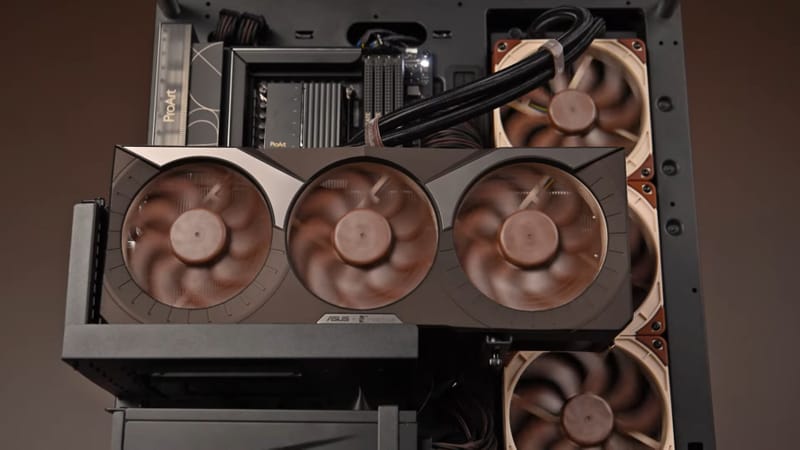
For anyone tracking Nvidia’s RTX Pro workstation line-up, the RTX Pro 5500 reinforces a pattern that has become obvious over the past year: the same GB202 silicon is being carved into ever more precise tiers, each one nudging buyers toward whichever card fits their memory needs and budget most closely. The strategy also lines up with Nvidia’s broader push into AI-focused hardware, from data-centre accelerators to smaller desktop systems built around similar priorities.
Why this matters for buyers and the wider market
Financially, the move makes plenty of sense for Nvidia. A recycled GB202 die sold as an RTX Pro 5500 likely commands a far higher margin than the same silicon sold as a GeForce RTX 5090, which has already climbed well above its official price in retail channels. By pairing near-identical compute specifications with dramatically more memory, Nvidia gives AI developers a compelling reason to choose the professional card over the consumer flagship, even though the extra VRAM does little for gaming performance.
Nvidia has not confirmed pricing for the RTX Pro 5500, and neither the company nor its partner PNY has responded to requests for that information. Context still offers a reasonable guide: the RTX Pro 6000 retails for around $15,599, while the RTX Pro 5000 with 72GB starts near $9,209. Given the RTX Pro 5500’s role as a bridge between those two cards, its eventual price will likely land somewhere in that range, though buyers should treat any specific figure as speculation until Nvidia confirms one.
For everyday gamers, the RTX Pro 5500 changes little directly, since it is not designed or priced for a gaming rig. Its arrival does, however, say something about where Nvidia sees its growth coming from. As AI workloads increasingly justify buying dedicated hardware, expect more Blackwell-based cards that reshuffle memory rather than compute, further blurring the line between work and gaming hardware. Nvidia’s approach to compact AI systems, including its work with partners on smaller desktop platforms, suggests this strategy of repurposing gaming silicon for professional buyers is only going to expand.