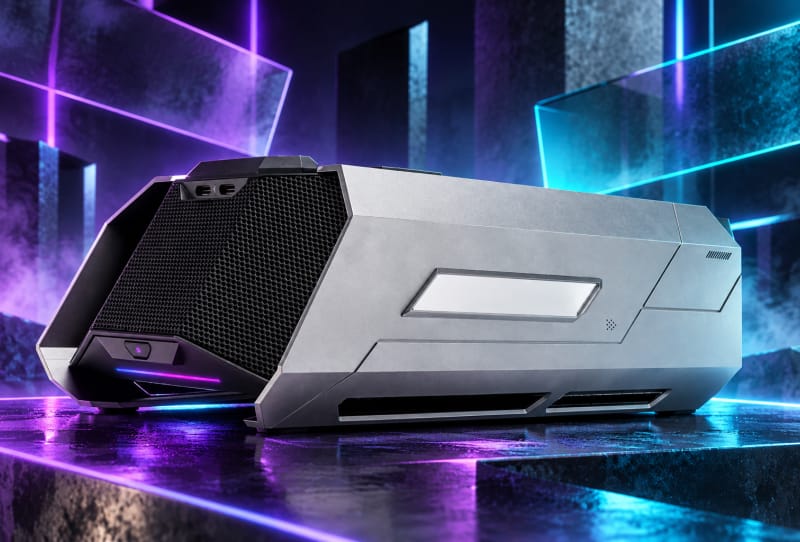
The ASUS ROG XG Station 3, a Thunderbolt 5 external graphics dock first revealed in early November, has started turning up on shelves at European retailers. The launch confirms that ASUS’s latest eGPU box is now a real, purchasable product rather than just an announcement, even though a US release date still hasn’t been locked in.
Key takeaways
- ✓The ASUS ROG XG Station 3 is now reaching retail shelves in Europe
- ✓It uses Thunderbolt 5 connectivity and supports ASUS's cable-free BTF 2.5 graphics cards
- ✓The dock delivers up to 140W of USB Power Delivery for charging laptops and handhelds
- ✓A US release date has not been confirmed despite European stock already arriving
- ✓It follows earlier ROG XG Station docks as ASUS pushes further into external GPU hardware
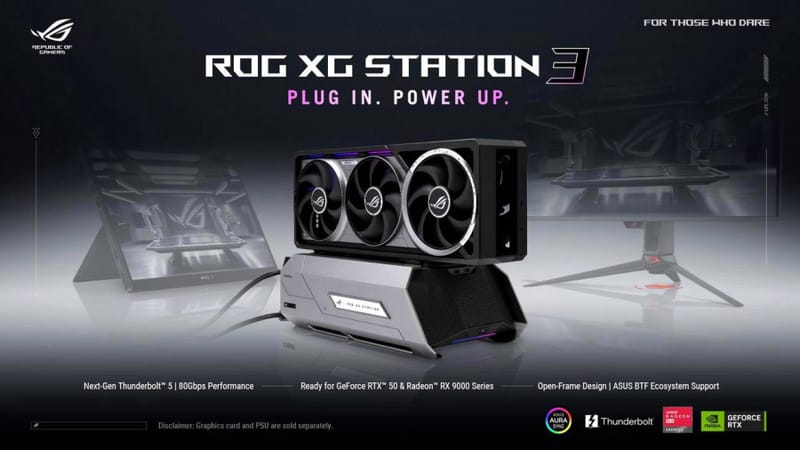
ASUS unveiled the dock with a fairly specific pitch: support for its own BTF 2.5 graphics cards, which route power through the motherboard rather than a tangle of PCIe cables, plus up to 140 watts of USB Power Delivery so it can charge a connected laptop or handheld while driving the display. At the time of the reveal, ASUS left out one important detail, pricing, and that gap has only recently been filled in by European retail listings rather than an official ASUS statement.
Table of Contents
What the ROG XG Station 3 actually offers
At its core, the ROG XG Station 3 is a box that lets a laptop, mini PC, or handheld gaming device tap into a full desktop graphics card over a single cable. That’s a familiar idea, ASUS and rivals like Razor and Gigabyte have all shipped similar docks before, but the jump to Thunderbolt 5 is what sets this generation apart.
Thunderbolt 5 roughly doubles the baseline bandwidth of Thunderbolt 4, running at 80Gbps with a boosted mode that can push up to 120Gbps in one direction for demanding display and GPU workloads. For an eGPU dock, that extra headroom matters because the connection between the external card and the host system is historically the biggest bottleneck in this kind of setup.
Key specifications
| Feature | Detail |
|---|---|
| Connection | Thunderbolt 5 |
| Power delivery | Up to 140W USB PD |
| GPU support | Standard PCIe cards plus ASUS BTF 2.5 cable-free cards |
| PSU | Sold separately |
| Target devices | Laptops, mini PCs, handheld gaming PCs |
BTF 2.5 support is the real differentiator
ASUS’s BTF cards do away with the usual rat’s nest of PCIe power cables by feeding power through a connector on the motherboard instead. It’s a tidy solution inside a case, but it has historically locked buyers into BTF-compatible motherboards and chassis. By building BTF 2.5 support directly into the ROG XG Station 3, ASUS extends that cable-free design philosophy to external docking as well, which is a meaningful step for anyone who has already bought into the ecosystem.

It also signals where ASUS wants this product line to sit. Rather than positioning the dock as a generic box for any graphics card, the company is clearly building it around its own hardware stack, from BTF cards through to its ROG motherboards and now this eGPU enclosure.
Why this matters for laptop and handheld owners
External GPU docks solve a specific problem: a thin laptop or a compact handheld can’t fit a full-sized graphics card, but it might still have enough CPU and connectivity to benefit from one when docked at a desk. That’s increasingly relevant as handheld PCs get more capable. Devices such as handheld PCs like the handheld PCs like the GPD Win Mini Ultra already pack serious mobile silicon, and a Thunderbolt 5 dock gives that kind of hardware a path to genuine desktop-class graphics performance without needing a second machine.
The 140W charging capability adds practical value too. Instead of needing a separate charger alongside the dock, a compatible laptop or handheld can draw power straight through the same Thunderbolt 5 cable that’s handling the graphics and display signal, simplifying a desk setup considerably.
Availability still has gaps
European retailers already have stock, which suggests ASUS has quietly moved the ROG XG Station 3 from “announced” to “available” in that region without much fanfare. The company has not published an official pricing page or an on-sale date for other markets, and nothing has been confirmed for a US launch, despite European retail activity indicating the hardware is further along in production than many expected.
For buyers outside Europe, that leaves some genuine uncertainty. ASUS’s track record with products across its its recent run of ROG hardware reveals suggests a broader rollout typically follows within a few months of European availability, but nothing is official yet. Anyone weighing up an eGPU dock alongside ASUS’s broader AM5 desktop lineup will want to wait for that confirmation rather than assume a timeline.
Frequently asked questions
What is the ROG XG Station 3?
It’s an external graphics dock from ASUS that connects over Thunderbolt 5, letting a laptop, mini PC, or handheld gaming device use a full desktop graphics card instead of relying on integrated or mobile GPU hardware.
Does it only work with ASUS BTF graphics cards?
No. The dock supports standard PCIe graphics cards as well as ASUS’s cable-free BTF 2.5 cards, so it isn’t locked to one specific card design.
Why does Thunderbolt 5 matter for an eGPU dock?
Thunderbolt 5 roughly doubles the bandwidth of Thunderbolt 4, with a boosted mode reaching up to 120Gbps in one direction. That extra bandwidth reduces the bottleneck between the external graphics card and the host device, which matters most for high-refresh gaming and demanding creative workloads.
Is the ROG XG Station 3 available outside Europe?
Not yet officially. European retailers already have stock, but ASUS hasn’t confirmed a release date or availability for the US or other regions.