ASUS ROG Gamescom 2026 announcements have given PC gamers plenty to talk about, and the star of the show is a monitor that pushes past 700Hz. The Republic of Gamers used the Cologne expo floor to show off a new lineup of displays and mice that lean hard into raw speed, flexibility, and precision, rather than incremental spec bumps.
Rather than chase a single headline number, ASUS Republic of Gamers spread its Gamescom reveal across three distinct products: an ultra-fast OLED monitor built for competitive play, a 4K screen that can switch modes on the fly, and a mouse sensor with a DPI figure that dwarfs almost everything currently on the market.
Table of Contents
A 720Hz OLED Monitor Built for Split-Second Reactions
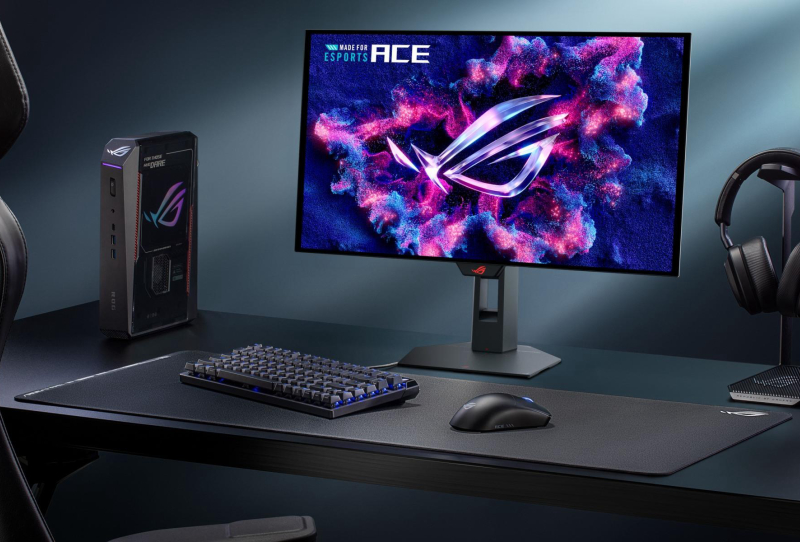
The headline act is a 720Hz OLED monitor, a refresh rate that would have sounded implausible just a couple of years ago when 240Hz panels were considered elite. OLED’s near-instant pixel response time has always made it attractive for fast-paced gaming, and pairing that technology with a refresh rate this high is aimed squarely at players who compete in titles like Counter-Strike or Valorant, where a few milliseconds of latency can decide a round.
High refresh rate OLED monitors have become something of an arms race among manufacturers over the past two years, with 480Hz and 540Hz panels already reaching shelves from several brands. A jump to 720Hz signals that ASUS ROG isn’t content to sit at the top of that ladder for long before pushing it higher again, even if the practical benefit beyond a few hundred hertz becomes harder for most players to perceive.
A 4K Triple-Mode Screen That Adapts to the Game
The second display ASUS ROG brought to Gamescom 2026 takes a different approach entirely. Instead of locking in one resolution and refresh rate, this 4K panel can dynamically swap between multiple display modes, effectively letting a single monitor behave like several different screens depending on what a game or task demands.
That flexibility matters because gamers often have to choose between sharp 4K visuals for slower, cinematic titles and lower resolutions with much higher refresh rates for fast, competitive games. A triple-mode panel removes that trade-off, letting a player switch from crisp 4K detail in a story-driven game to a faster, lower-resolution mode for an online shooter without needing a second monitor or a manual firmware reset.
Mice With a 65,000 DPI Sensor
On the peripherals side, ASUS ROG showed off gaming mice built around a sensor capable of a staggering 65,000 DPI. To put that in context, most gaming mice on the market today, including many of ROG’s own current models, top out somewhere between 26,000 and 36,000 DPI, which is already far beyond what most players actually use in practice.
Very few gamers will ever run a mouse at anywhere near 65,000 DPI, since most competitive players prefer far lower sensitivities for consistent aim. The real value of a sensor with that much headroom lies in accuracy and tracking consistency at the lower, more usable DPI ranges most people actually rely on, rather than the peak number itself. It also builds on the lightweight, esports-focused design language ASUS ROG has refined through ROG’s existing lightweight esports mice, which have already proven popular with professional and semi-professional players.
What the Gamescom 2026 Reveals Mean for Gamers
None of these products arrived at Gamescom 2026 with confirmed pricing or firm release dates, which is typical for early hardware showcases at a trade show rather than a formal product launch. What the reveal does confirm is the direction ASUS ROG is pushing its gaming hardware division: faster panels, smarter displays, and sensors with more precision headroom than almost anyone will fully use.
These announcements also reinforce how ASUS ROG treats its gaming lineup as a connected ecosystem rather than standalone products. The same event that introduced these displays and mice sat alongside its high-end mechanical keyboards and premium wireless headsets, all built around the same competitive gaming audience.
For everyday PC gamers, the practical impact will likely arrive gradually. Features that debut at the extreme end, such as 720Hz refresh rates and 65,000 DPI sensors, tend to filter down into more affordable mid-range products over subsequent generations. The triple-mode display concept in particular could prove the most useful of the three announcements long term, since it solves a genuine everyday problem rather than simply chasing a bigger number. Anyone shopping for a new monitor or mouse in the next year should keep an eye on how these Gamescom 2026 concepts translate into actual retail hardware.