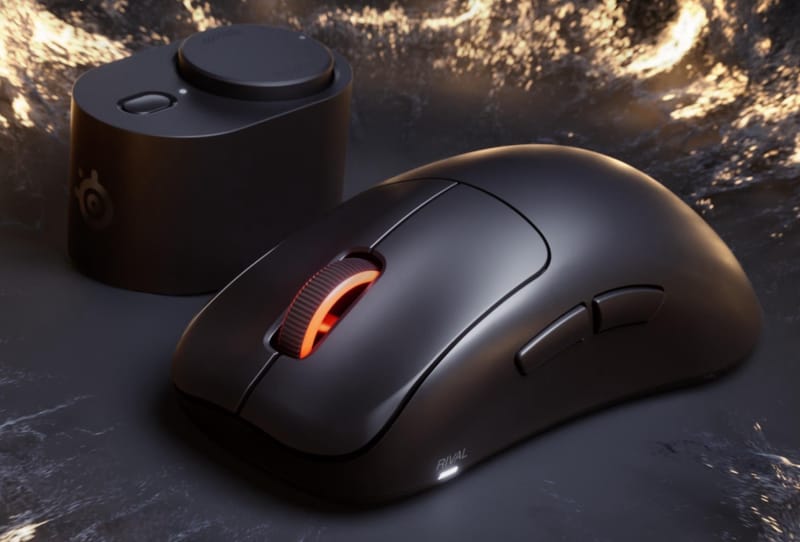
SteelSeries Rival Pro and its sibling, the Sensei Pro, are swapping the familiar 2.4GHz USB dongle for Ultra-Wideband wireless, a move the company says delivers a steadier connection and an 8,000Hz polling rate without the usual wireless trade-offs. Both mice target competitive players who have historically stuck with wired setups to avoid lag or dropped inputs, and SteelSeries is betting that UWB closes that gap for good.
Key takeaways
- ✓SteelSeries Rival Pro and Sensei Pro use Ultra-Wideband wireless instead of a standard 2.4GHz dongle
- ✓UWB operates in the 6.4GHz band, avoiding congestion from other wireless devices
- ✓Both mice support an 8,000Hz polling rate for sharper responsiveness
- ✓A hot-swappable dual-battery system delivers 16 hours of runtime per cell at full polling rate
- ✓Rival Pro suits a palm grip at 54g, while Sensei Pro suits a claw grip at 53g, with 49g mini versions of each
The decision to move away from standard 2.4GHz wireless is notable because that band has become crowded. Wi-Fi routers, Bluetooth peripherals, and other wireless mice all compete for the same limited spectrum, which can introduce tiny but real inconsistencies in mouse tracking during fast-paced play. Ultra-Wideband sidesteps that problem by operating in the 6.4GHz range, a frequency not commonly used by household electronics, which should mean fewer interruptions regardless of how crowded a desk setup gets.
Table of Contents
What Ultra-Wideband changes for the SteelSeries Rival Pro
Ultra-Wideband is not a brand-new concept. It already underpins precise location tracking in smartphones and smart home accessories, but SteelSeries is among the first to bring it to gaming mice at this scale. Because UWB spreads data across multiple wireless channels rather than a single narrow one, it can carry more information at once, which is what allows the Rival Pro and Sensei Pro to sustain an 8,000Hz polling rate wirelessly, something that has traditionally been easier to achieve over a wired connection.
In practical terms, polling rate determines how often a mouse reports its position to a PC. A higher rate means the cursor updates more frequently, which can translate into snappier, more predictable aiming in fast shooters and other reaction-heavy titles. SteelSeries joins a growing list of manufacturers chasing ultra-high polling rates, and this UWB approach is its answer to doing so without sacrificing the convenience of going wireless.
Rival Pro versus Sensei Pro: shape, weight and grip style
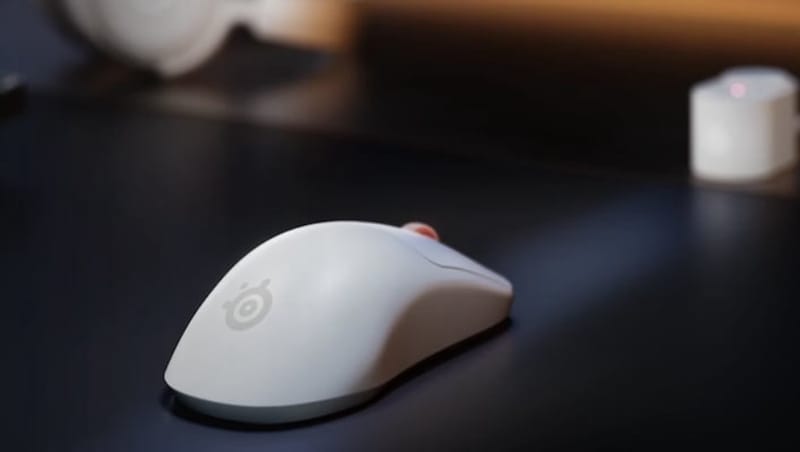
Both mice share the same internals and wireless technology, but they are built for different grip preferences. The Rival Pro uses an ergonomic shape suited to a palm grip and weighs 54 grams, while the Sensei Pro has a symmetrical body better suited to claw-grip players and comes in at 53 grams. Each is also available in a smaller Mini variant weighing 49 grams, and all four models come in black or white finishes.
| Model | Grip style | Weight | Wireless tech |
|---|---|---|---|
| Rival Pro | Palm grip, ergonomic shape | 54g | Ultra-Wideband, 8,000Hz |
| Rival Pro Mini | Palm grip, compact | 49g | Ultra-Wideband, 8,000Hz |
| Sensei Pro | Claw grip, symmetrical shape | 53g | Ultra-Wideband, 8,000Hz |
| Sensei Pro Mini | Claw grip, compact | 49g | Ultra-Wideband, 8,000Hz |
That spread of options means players who have previously picked a mouse shape based on wired alternatives, such as SteelSeries’ existing Rival 3 Gen 2, now have a direct wireless equivalent that doesn’t force a compromise on ergonomics or weight.
Solving the wireless battery problem
Running an 8,000Hz polling rate constantly draws more power than a typical wireless mouse, which is usually where high-refresh wireless peripherals fall short. SteelSeries addresses this with what it calls the Infinite Power System: two hot-swappable batteries, each rated for 16 hours of use at the full 8,000Hz rate. When one battery runs flat, a player can swap in the spare without needing to pause for a full recharge, effectively doubling practical runtime between charging sessions.
This kind of dual-battery design has started appearing across other SteelSeries hardware too, including its approach to SteelSeries’ recent Aeon Pro controller, suggesting the company sees hot-swap power as a core differentiator rather than a one-off feature. For competitive players who rarely want to stop mid-session to plug in a cable, that continuity matters more than outright battery capacity on paper.
Why this matters for competitive gamers
Wireless gaming mice have improved dramatically over the past few years, but the perception that wired remains the only safe choice for esports-level play has lingered. By pairing Ultra-Wideband with an 8,000Hz polling rate, SteelSeries is directly challenging that assumption, and the approach puts pressure on rivals like the Attack Shark Mega B2 and other brands chasing similarly high refresh rates to find their own answers to spectrum congestion.
The broader implication is that UWB could become a standard feature on premium gaming peripherals rather than a novelty, much as it has already found purpose in device tracking and smart accessories. If SteelSeries’ approach proves reliable in everyday use, expect competitors to follow with their own Ultra-Wideband implementations rather than continuing to push the limits of crowded 2.4GHz spectrum. For now, the Rival Pro and Sensei Pro lines stand as a genuine attempt to make wireless the default choice, not the compromise, for serious players.
Frequently asked questions
What is Ultra-Wideband and why does it matter for a gaming mouse?
Ultra-Wideband (UWB) is a wireless technology that spreads data across multiple channels in the 6.4GHz band, away from the crowded 2.4GHz spectrum used by Wi-Fi, Bluetooth and most wireless mice. That extra bandwidth is what lets the SteelSeries Rival Pro sustain a high, stable polling rate without the interference issues that can affect standard wireless connections.
How long does the battery last on the Rival Pro and Sensei Pro?
Each of the two hot-swappable batteries in SteelSeries’ Infinite Power System lasts around 16 hours when running at the full 8,000Hz polling rate. Swapping in the second battery while the first charges effectively extends total uptime well beyond that figure.
What’s the difference between the Rival Pro and the Sensei Pro?
The Rival Pro has an ergonomic shape designed for a palm grip and weighs 54 grams, while the Sensei Pro is symmetrical and built for a claw grip at 53 grams. Both come in Mini versions weighing 49 grams, and both use identical Ultra-Wideband wireless internals.
Do these mice work without the Ultra-Wideband receiver?
No, the Rival Pro and Sensei Pro rely on their dedicated Ultra-Wideband receiver to achieve the 8,000Hz polling rate and stable connection that define this lineup, rather than a generic USB wireless dongle.