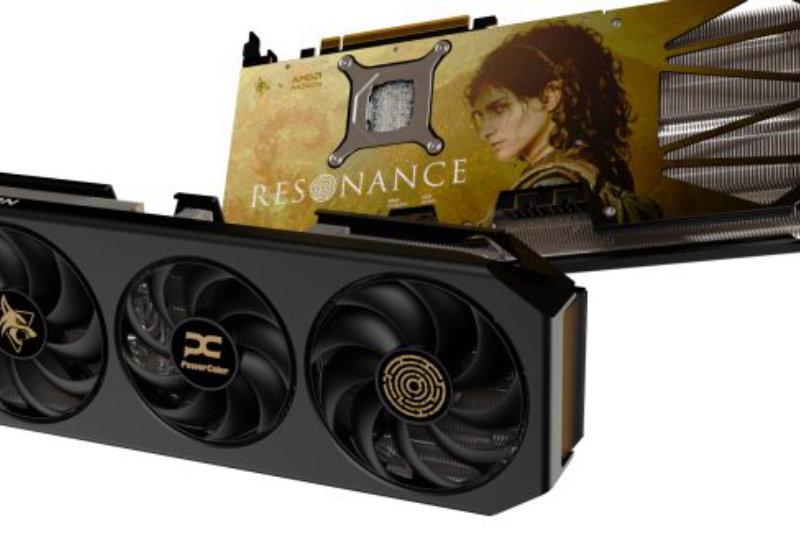
The new PowerColor Resonance RX 9070 XT graphics card brings striking artwork from Resonance: A Plague Tale Legacy to AMD’s RDNA 4 lineup, marking one of the more unusual tie-ins between a hardware brand and a game launch this year. Built in partnership with publisher Focus Entertainment, the card lands as a limited-edition twist on PowerColor’s existing Hellhound RX 9070 XT, keeping the same internals while dressing the card in artwork tied to the game’s protagonist, Sophia.
Resonance: A Plague Tale Legacy has been one of the standout releases of the month, and PowerColor’s decision to build a themed card around it reflects how closely PC hardware marketing now leans on major game launches. Rather than reinventing the wheel with new silicon or a different cooler, PowerColor has focused the Resonance Edition on cosmetics and a bundled software package, giving fans of the game and the franchise a reason to pick this variant over the standard model.
Table of Contents
What the PowerColor Resonance RX 9070 XT actually changes
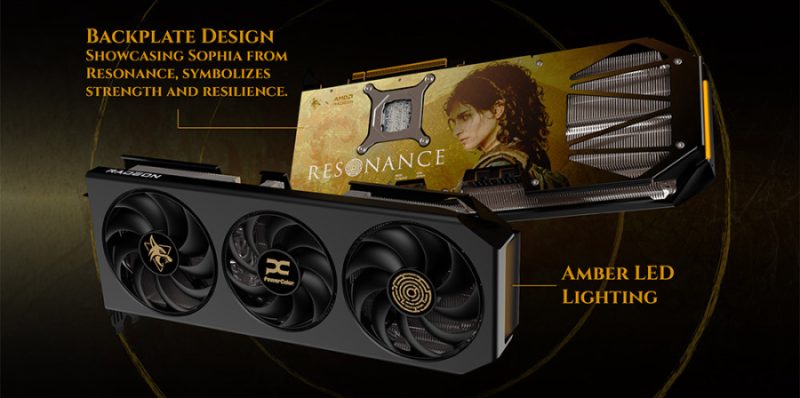
Visually, the headline change is a gold-toned backplate depicting Sophia, the game’s central character, replacing the usual Hellhound design. PowerColor has also swapped the card’s lighting to an amber hue, controlled through a dual-stage switch so owners can toggle the effect on or off without digging into software. It is a subtle but deliberate way of tying the card’s aesthetic to the game’s visual identity without overhauling the physical design.
Everything under the shroud stays consistent with the standard Hellhound RX 9070 XT. That means buyers get the same RDNA 4 performance and thermal behaviour, just wrapped in different artwork. For anyone who already likes the Hellhound cooler but wants something a bit more distinctive on the shelf or behind a glass side panel, that consistency is arguably the point.
Specifications and cooling hardware
The Resonance Edition runs AMD’s RDNA 4 architecture with 64 compute units and 16GB of GDDR6 memory clocked at 20Gbps across a 256-bit bus. Boost clocks climb to 3010MHz when the card is switched into its OC mode, and a Dual BIOS switch lets owners drop to a quieter profile when raw clock speed matters less than noise.
| Specification | Detail |
|---|---|
| Architecture | AMD RDNA 4 |
| Compute Units | 64 |
| Memory | 16GB GDDR6, 20Gbps, 256-bit bus |
| Boost Clock (OC mode) | Up to 3010MHz |
| VRM | 10+1 phase on a 12-layer PCB |
| Cooling | Triple-fan Hellhound cooler, reverse-rotation fans, dual-ball bearings |
Cooling comes from PowerColor’s familiar triple-fan Hellhound setup, using reverse-rotation fans and dual-ball bearings to manage airflow and longevity. Honeywell PTM7950 phase-change material sits between the GPU die and the cooler, a material PowerColor has favoured on recent cards for its ability to maintain thermal performance over time better than standard paste. A copper baseplate spans both the GPU core and the surrounding VRAM modules, and the fans remain completely still until the card crosses 50°C, keeping idle and light desktop use silent.
Power delivery is handled by a 10+1 phase VRM built on a 12-layer PCB, a fairly robust setup for a card in this tier and one that leaves headroom for the OC mode’s higher boost clocks. None of this differs from the standard Hellhound model, which underlines that the Resonance Edition is really a cosmetic and bundle-driven variant rather than a performance revision.
How it stacks up against other RX 9070 XT cards
AMD’s RDNA 4 generation has already produced a wide spread of RX 9070 XT designs from board partners, each chasing a different combination of cooling capacity, noise, and styling. Cards such as the AORUS Radeon RX 9070 XT ELITE take a more aggressive cooling approach aimed at overclockers, while PowerColor’s own Hellhound line has generally positioned itself as a balanced, mid-tier option with strong thermals for its price point.
The Resonance Edition does not attempt to compete on raw cooling capacity or clock headroom. Instead, it slots into the market as a collector-oriented variant, similar in spirit to previous-generation cards like the ASUS TUF RX 7900 XT OC, which also carved out its identity through design choices rather than a spec sheet advantage. Themed graphics cards are not a new idea either; board partners have dressed up cards for game tie-ins for years, echoing earlier efforts such as the ASRock Radeon RX 5600 XT Phantom Gaming, though this is one of the more elaborate examples in the RDNA 4 generation.
What it means for buyers
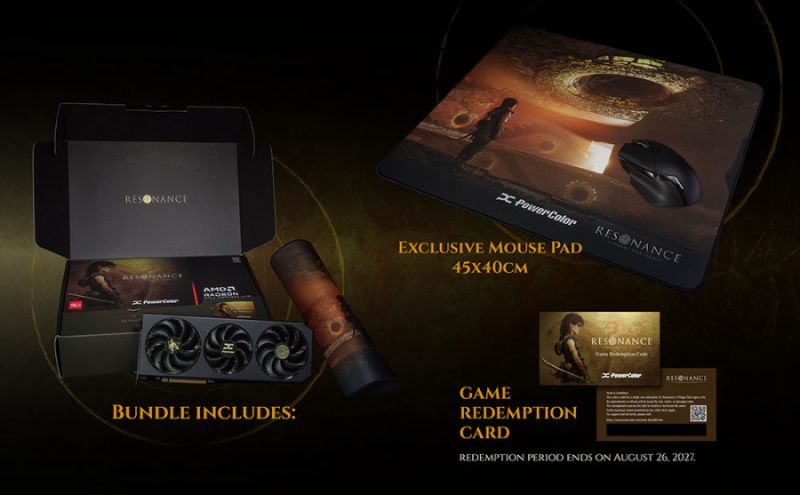
Each Resonance RX 9070 XT ships with a digital copy of Resonance: A Plague Tale Legacy and a matching PowerColor mousepad, effectively bundling in extra value for players who were already planning to buy the game. For someone shopping purely on performance per dollar, the standard Hellhound RX 9070 XT will likely remain the more sensible pick, since the underlying hardware is identical.
Where the Resonance Edition earns its place is with buyers who want their build to reflect a specific game or aesthetic, not just raw benchmark numbers. It is a niche appeal, but a genuine one, and it shows AMD’s board partners are still willing to experiment with cosmetics on flagship-tier RDNA 4 hardware rather than treating every card as interchangeable. Anyone drawn to the artwork should still weigh whether the bundled game and mousepad justify choosing this variant over the standard model, since the silicon inside performs exactly the same either way.