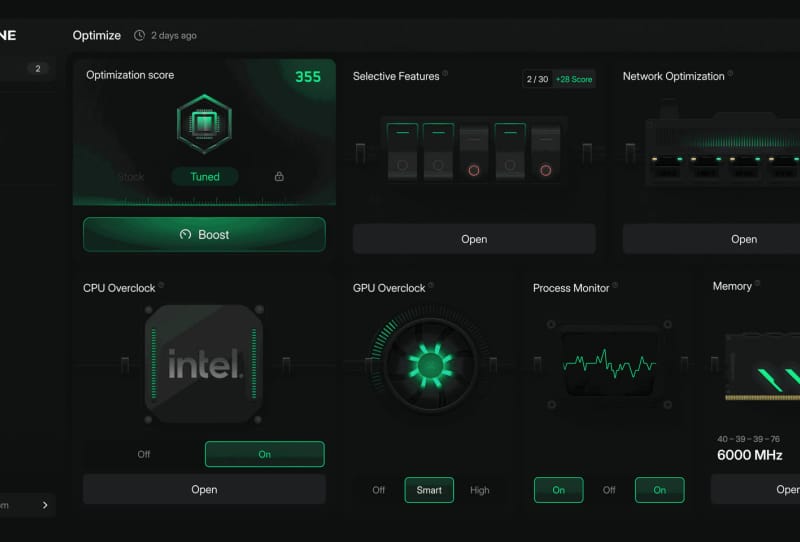
A new Hypertune overclocking tool has surfaced after months of quiet testing with roughly 60,000 PC enthusiasts, and it arrives with a headline claim that will raise eyebrows: automated frame rate gains of up to 60 percent. The software comes from a Miami-based gaming company operating under the banner Gaming Performance Engineering, and it was built in partnership with Intel, which contributed engineering resources and its Extreme Tuning Utility software development kit as the technical foundation.
The pitch is simple. Rather than manually adjusting voltages, clock speeds and memory timings, a task that intimidates plenty of PC owners, Hypertune scans a system and applies tuning automatically. That is a meaningful shift for a hobby that has traditionally rewarded patience, trial and error, and a willingness to risk instability for extra performance.
Table of Contents
What the Hypertune overclocking tool actually does
Once installed, Hypertune examines the host machine in detail. It checks the CPU, GPU, RAM configuration, installed drivers and relevant Windows settings before deciding how far it can safely push performance. The company calls this process a Smart Optimization Engine, and it functions as an observation phase before any changes are applied.
After that scan, the tool generates and applies an optimisation preset tailored to the detected hardware. It covers automated overclocking for both the processor and graphics card, along with adjustments to RAM timings aimed at improving latency and effective frequency. In theory, that combination touches every major performance bottleneck in a modern gaming rig without the user needing to open a BIOS menu.
For anyone who has already gone through the process of upgrading a CPU and motherboard, a tool like this promises to squeeze out the remaining performance headroom without repeating hours of manual benchmarking.
The numbers behind the 60 percent claim
That 60 percent figure is the standout marketing hook, but the company itself is careful to frame it as an outlier rather than a typical result. Most systems, according to the demonstrations offered so far, will see far more modest single-digit gains. Two example configurations illustrate that spread clearly.
| Test system | CPU | GPU | Reported FPS gain |
|---|---|---|---|
| System A | Intel Core Ultra 9 285K | NVIDIA GeForce RTX 5090 | 18.9% to 28.2% |
| System B | Intel Core i7-14700K | NVIDIA GeForce RTX 3080 | 4.3% to 9.8% |
The gap between those two results is telling. A high-end, current-generation pairing like the Core Ultra 9 285K and an NVIDIA GeForce RTX 5090 clearly has more untapped headroom than an older Core i7-14700K and RTX 3080 combination, which is likely already running closer to its practical limits out of the box. That pattern lines up with what enthusiasts already know from manual overclocking: newer silicon typically has more thermal and voltage margin to exploit.

Why Intel’s involvement matters
Intel’s backing gives Hypertune more credibility than a typical third-party tuning utility. Building on the Extreme Tuning Utility SDK means the software taps into the same low-level access Intel’s own overclocking tools use, rather than relying on reverse-engineered workarounds. That reduces the risk of the kind of instability or voltage mismanagement that has occasionally plagued aggressive auto-overclocking tools in the past.
It also signals a broader shift in strategy. Rather than competing purely on raw chip performance, Intel appears increasingly interested in software that makes existing hardware, including Intel’s upcoming Nova Lake CPU plans, feel faster without requiring an upgrade. For a company facing stiff competition on the silicon side, easy software-driven performance gains are a relatively low-cost way to keep existing customers satisfied.
What it means for PC gamers and builders
For newer builders, Hypertune’s appeal is obvious. Manual overclocking still carries a learning curve, and plenty of people who read guides on building a gaming PC from scratch never touch their BIOS settings afterwards out of caution. An automated tool that handles CPU, GPU and RAM tuning in one pass removes that barrier entirely, provided it proves reliable across a wide range of hardware combinations.
Sceptics will rightly point out that the 60 percent figure is a best-case scenario rather than an expectation. Anyone setting realistic performance goals for a gaming PC should treat single-digit to low-double-digit gains as the more likely outcome, particularly on systems that are already reasonably well configured or thermally constrained. Case cooling, power delivery and existing BIOS settings will all influence how much headroom Hypertune can actually find.
Independent benchmarking will ultimately decide whether Hypertune lives up to its early testing results once it reaches a wider audience beyond the initial 60,000-strong testing group. If the tool proves stable and delivers consistent, safe gains across a broad spread of Intel and NVIDIA hardware, it could become a genuinely useful addition to the PC gaming toolkit, one that turns overclocking from a niche hobby into something closer to a one-click feature.