The new California 3D printer law will require manufacturers to build firearm-detection technology into future machines sold in the state, though printers already sitting on workshop benches and in homes will be exempt from the rule. The requirement targets newly produced printers rather than the installed base, and its actual rollout is tied to a technical standard that an international standards body has not yet finished writing.
Key takeaways
- ✓California will require newly manufactured 3D printers to include firearm-detection technology
- ✓The mandate's rollout depends on a technical standard still being finalised by ASTM International
- ✓3D printers already owned or already on sale before the rule takes effect will be exempt
- ✓The law targets untraceable 'ghost guns' rather than penalising current printer owners
- ✓Enforcement details remain unclear until ASTM publishes its firearm-detection specification
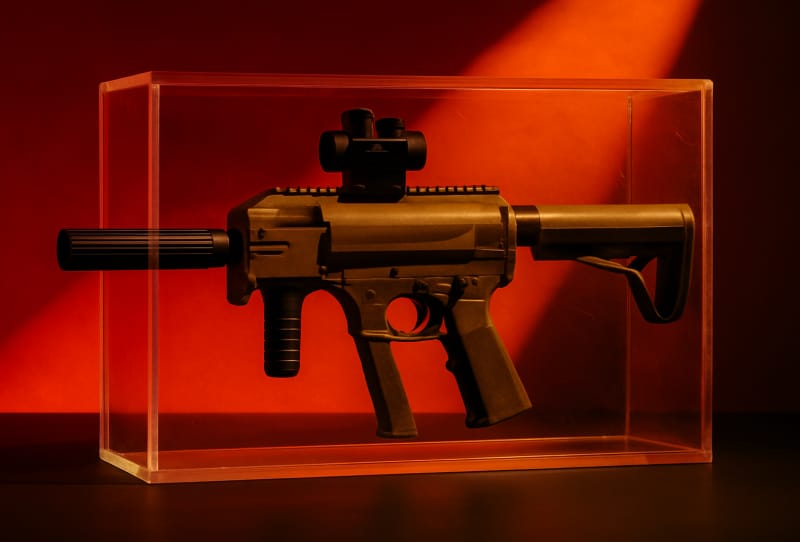
The legislation responds to years of growing concern about so-called ghost guns, firearms assembled from printed or home-machined parts that carry no serial number and are far harder for police to trace. Consumer-grade 3D printers have become capable enough, and cheap enough, that printing a functional lower receiver or frame no longer requires specialist equipment. California’s answer is to push the fix upstream, onto the printer itself, rather than relying solely on laws against the finished firearm.
Table of Contents
How California’s 3D printer law will work
Rather than spelling out its own detection method, the law leans on ASTM International, the body responsible for a huge range of manufacturing and materials standards, to define exactly how firearm-component detection should function inside a 3D printer. Until that standard is published, manufacturers have no fixed technical target to build toward, which effectively delays enforcement regardless of when the law is formally on the books.

Once the standard exists, newly manufactured printers sold in California would need software or firmware capable of recognising files, or geometric patterns within files, associated with firearm parts and refusing to print them. That is a similar concept to how some photocopiers and image-editing tools already refuse to reproduce banknotes, adapted to the far messier problem of three-dimensional printable objects.
Why existing 3D printers are exempt
Retrofitting detection technology onto millions of printers already sold, many running open-source firmware such as Klipper or Marlin, was never going to be realistic. Owners can modify firmware, flash custom builds, or simply use slicer software the manufacturer never touched, which makes after-the-fact enforcement on old hardware close to unworkable.
Lawmakers instead chose a forward-looking approach: the rule applies to the manufacturing pipeline from the point the standard takes effect, not to hardware already in circulation. That spares current owners of popular machines like machines like the Bambu X2D or entry-level machines such as the Creality SPARKX i7 any disruption, while still aiming to close the loophole for printers built from now on.

The ghost gun problem isn’t new to 3D printing regulation
California’s move follows a broader pattern of state and federal efforts to tighten rules around untraceable firearms, including requirements around serialisation and background checks for home-built guns. Applying that pressure to 3D printers specifically acknowledges how mainstream desktop printing has become, with machines from brands such as Bambu Lab, Creality, Anycubic and Prusa now common in home workshops, schools and maker spaces rather than specialist labs.
Detection software is not a new idea either. Some slicer platforms and online file libraries already attempt to flag firearm-shaped models, with mixed success. Notably, a workaround for 3D printed gun detection software has already surfaced, underlining how quickly determined users can sidestep filters built around recognising specific file shapes or metadata. Any standard ASTM eventually publishes will need to withstand exactly that kind of evasion to be worth enforcing.
What the rule means for manufacturers and buyers
For printer makers, the practical challenge is less about writing detection code and more about building something resilient enough that it cannot be trivially bypassed by renaming a file or tweaking a mesh. Because major manufacturers sell the same hardware platforms globally, a California-specific requirement could still influence firmware decisions well beyond the state, much as emissions or safety rules in one large market often end up shaping products sold everywhere.

For everyday buyers and hobbyists, nothing changes immediately. Current owners keep using their printers exactly as before, and nothing in the law criminalises ordinary modelling, prototyping or educational use. The practical effect, once ASTM’s standard lands and manufacturers comply, will be felt mainly by people shopping for a new printer in California, and possibly by companies deciding whether to build detection into every unit they ship or only those destined for that market.
Frequently asked questions
Does the California 3D printer law affect printers people already own?
No. The law is written to exempt existing machines, applying instead to newly manufactured printers sold after the rule takes effect and the relevant technical standard is finalised.
What is ASTM International’s role in this law?
ASTM International is developing the technical standard that defines how firearm-detection technology inside a 3D printer should actually work. The law’s enforcement is tied to that standard being published, so manufacturers know what to build toward.
Can 3D printer firearm-detection software be bypassed?
Workarounds for existing detection tools have already appeared, since most systems rely on recognising specific file shapes or data that can be altered. Any future ASTM-based standard will need to address that weakness to be effective.
Will this California 3D printer law apply outside the United States?
The law only applies to printers manufactured for sale in California. However, because major printer brands sell the same hardware globally, firmware changes built to satisfy the rule could end up shipping in other markets as well.