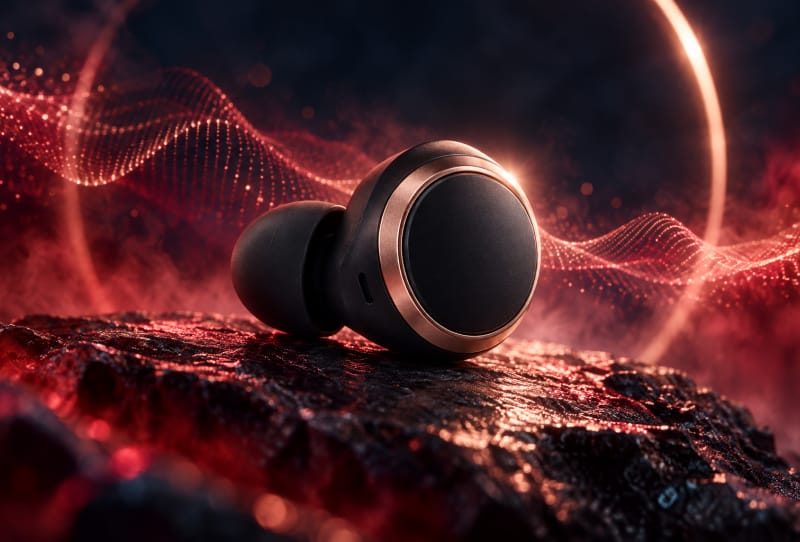
Bluetooth just gained nearly four times more bandwidth, and that extra headroom is what finally makes truly lossless Bluetooth audio possible across different brands of phones and earbuds. The Bluetooth Special Interest Group has formally introduced a feature called High Data Throughput, or HDT, which lifts the maximum data rate on Bluetooth Low Energy connections to as much as 7.5 Mbps. Standardised lossless audio built on top of that extra capacity is expected to land in 2027, not this year.
Key takeaways
- ✓Bluetooth's new HDT feature nearly quadruples bandwidth, up to 7.5 Mbps.
- ✓Standardised lossless Bluetooth audio is expected to arrive in 2027.
- ✓Existing earbuds and phones cannot gain HDT support through a software update.
- ✓HDT is an optional part of Bluetooth 7.0, so buyers must check for it by name.
- ✓Qualcomm's FastConnect 8800 chip already supports HDT ahead of 2027 products.
For anyone who has noticed that wireless earbuds never quite sound as detailed as a wired pair, this is the clearest sign yet that the gap has a real technical fix in motion. The catch is that nobody with current earbuds or a current phone will be able to update their way into it. New hardware, built around a new radio chip, is required on both ends of the connection.
Table of Contents
Why lossless Bluetooth audio has been so hard to achieve
Every pair of Bluetooth headphones relies on a codec to squeeze music down small enough to transmit wirelessly. That compression process throws away some audio information, which is why even the newer LE Audio standard and its LC3 codec still fall short of a true lossless copy of a track. CD-quality lossless audio simply demands more bandwidth than standard Bluetooth has ever reliably offered.
Until now, the only workaround has been Qualcomm’s aptX Lossless, which only functions when both the phone and the earbuds support Snapdragon Sound, or through an external Bluetooth dongle plugged into a source device. Both approaches lock buyers into specific hardware combinations, which is exactly the limitation HDT is designed to remove.
Because HDT folds extra bandwidth directly into the Bluetooth standard itself, lossless playback could eventually work the same way ordinary Bluetooth pairing does now, regardless of brand. That same bandwidth boost also opens the door to better spatial audio, wireless surround formats, and faster data syncing for devices like smartwatches.
What’s holding the rollout back
HDT solves the bandwidth problem, but several pieces still need to fall into place before anyone can buy a pair of truly lossless Bluetooth earbuds. The standard lossless audio format that will actually run over this extra capacity hasn’t been finalised by the Bluetooth SIG yet, so HDT alone doesn’t guarantee lossless sound on day one.

Shoppers will also need to look past marketing names. HDT is an optional component of the broader Bluetooth 7.0 standard, meaning a device can carry the Bluetooth 7.0 label without actually supporting HDT. Buyers will need to check for HDT support specifically on a spec sheet rather than assuming a version number covers it.
Phone support is another open question. Pairing HDT-capable earbuds with a phone that lacks the feature will simply fall back to today’s Bluetooth speeds. Samsung’s chip division has already backed HDT, but Samsung, Google and Apple have not confirmed whether their phones will support it. Apple in particular has a patchy track record with lossless audio, having made its own lossless tracks awkward to access through third-party apps.
How this compares to what’s already on the market
Chipmakers are not waiting around. Qualcomm’s FastConnect 8800 already supports HDT, putting the building blocks for 2027 earbuds and phones in place well ahead of any retail launch. That mirrors how Qualcomm pushed earlier Bluetooth audio gains through its Snapdragon Sound platform, and ties into Qualcomm’s newest Snapdragon Sound chip, which focuses on letting earbuds handle AI tasks without needing a connected phone.
HDT also follows a pattern set by Bluetooth LE Audio’s earlier fixes for wireless sound, which addressed issues like battery drain and multi-device audio sharing. Each generation of the standard has chipped away at a different weakness in wireless listening, and bandwidth has consistently been the hardest one to solve.
Buyers browsing current releases, including many of the latest earbuds and headphones shown at IFA 2026, won’t find HDT support anywhere yet. Anything sold before 2027 will rely on existing codecs and, at best, aptX Lossless on a narrow set of Android phones.
What it means for buyers right now
Nobody should expect lossless Bluetooth audio to arrive broadly before 2027, and even then it will likely show up first in premium products before trickling down to cheaper models. Early HDT hardware is also likely to carry a price premium while chipmakers and manufacturers work out production costs for the new radios involved.

For now, anyone chasing the closest thing to lossless wireless sound is still limited to aptX Lossless pairings on compatible Android devices. That’s a narrower audience than HDT eventually promises to serve, since the whole point of folding lossless support into the Bluetooth standard itself is to make it brand-agnostic rather than tied to one chipmaker’s ecosystem.
Frequently asked questions
What is Bluetooth High Data Throughput (HDT)?
HDT is a new feature from the Bluetooth SIG that raises the maximum data rate on Bluetooth Low Energy connections to around 7.5 Mbps, nearly four times the previous ceiling, creating enough room for lossless audio streaming.
Can existing earbuds get lossless Bluetooth audio through an update?
No. HDT needs a new radio chip in both the earbuds and the connected phone, so no firmware or software update can add the feature to hardware already on the market.
Does Bluetooth 7.0 automatically include lossless audio?
Not necessarily. HDT is an optional part of the Bluetooth 7.0 standard, so a device can be labelled Bluetooth 7.0 without supporting HDT. Buyers need to look for HDT specifically on the spec sheet.
When will lossless Bluetooth audio products be available?
Standardised lossless audio built on HDT is expected around 2027, with chips like Qualcomm’s FastConnect 8800 already supporting the feature ahead of the first consumer devices.