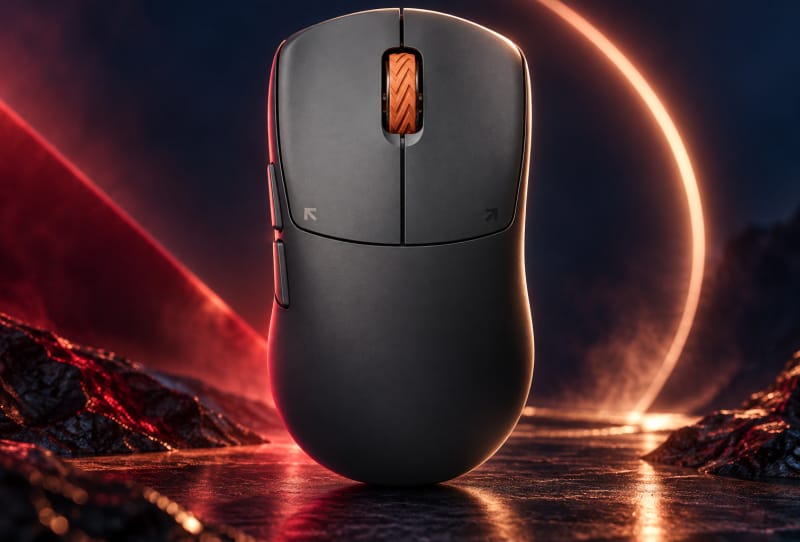
The Keychron G25 HE is a new wireless gaming mouse that squeezes the brand’s Hall effect switch technology into a shell barely bigger than a Razer Viper Mini. Keychron confirmed the mouse through a social media post rather than a formal launch, and at 46 grams it lands among the lighter wireless mice on the market without chasing the lowest possible weight.
Key takeaways
- ✓The Keychron G25 HE weighs 46 g and measures 120 x 63 x 39 mm, close to a Razer Viper Mini.
- ✓It uses new MagOpt switches combining optical and Hall effect magnetic sensing for adjustable actuation.
- ✓A PixArt PAW3955 sensor delivers 40,000 DPI, 8 kHz polling and 750 IPS tracking.
- ✓Keychron has not yet published an official spec sheet, with details surfacing via EloShapes instead.
- ✓The switches retain a physical click leaf, which may limit how cleanly rapid trigger behaves.
It arrives only months after the Keychron G6 HE, and the G25 HE effectively takes that mouse’s internals and shrinks them down. Keychron has spent the past year building out a family of Hall effect mice aimed at players who want adjustable actuation points and rapid trigger response, features long associated with premium keyboards and now increasingly common in mice too.
Table of Contents
What the Keychron G25 HE actually offers
Keychron has not released an official product page or spec sheet for the G25 HE, which is unusual for a mouse that has already been announced publicly. Instead, most of what is known comes from a third-party shape comparison database, where the mouse has been scanned and measured alongside its closest rivals.
Those measurements put the shell at 120 by 63 by 39 millimetres, a footprint that tracks closely with the Razer Viper Mini and the Razer Cobra. The shape is symmetrical with programmable thumb buttons placed on the right side only, which suggests Keychron is targeting claw and fingertip grip players rather than building a true ambidextrous design. A partially open bottom plate rounds out the physical layout, a detail usually included to shave weight without hollowing out the whole shell.
Sensor and performance specifications
Underneath the shell sits a PixArt PAW3955 optical sensor paired with a Nordic 54LM20A microcontroller, the same combination Keychron used in the G6 HE. That gives the G25 HE a peak tracking resolution of 40,000 DPI, a polling rate of up to 8 kHz, tracking speed of 750 inches per second and acceleration tolerance of 60 G. On paper, those numbers sit comfortably among the fastest wireless mice currently shipping.
| Specification | Keychron G25 HE |
|---|---|
| Dimensions | 120 x 63 x 39 mm |
| Weight | 46 g |
| Sensor | PixArt PAW3955 optical |
| Microcontroller | Nordic 54LM20A |
| Max DPI | 40,000 |
| Polling rate | Up to 8 kHz |
| Max tracking speed | 750 IPS |
| Max acceleration | 60 G |
MagOpt switches: the real story behind Keychron G25 HE
The feature giving the mouse its name is the new MagOpt switch, which blends optical sensing with Hall effect magnetic detection in a single button assembly. In theory, this dual approach should let the G25 HE offer the adjustable actuation points and rapid trigger behaviour that Hall effect mice are known for, where a player can set how far a click needs to travel before it registers.
However, the MagOpt switches still include a physical click leaf and a distinct tactile bump, carried over from traditional mechanical switch design. Early observers have pointed out that this leaf is largely what gives the click its feel, but it also works against the smooth, linear travel that adjustable actuation technology depends on. In other words, bolting Hall effect sensing onto a switch that still clicks like a conventional one may blunt some of the benefit the technology is supposed to deliver.
How it compares and what it means for buyers
Keychron’s decision to chase the Viper Mini shape is a clear signal about who the G25 HE is for. Razer’s small-bodied mice have become a favourite among players who prefer a compact grip, and Keychron entering that space with Hall effect switches gives those shoppers an option Razer itself does not currently offer in that exact form factor. Anyone comparing shapes for the best gaming mouse for a claw grip will find the G25 HE worth watching once pricing and availability firm up.
Keychron has already brought magnetic switch technology to its keyboards, and the G25 HE shows the same approach extending across its mouse lineup at a faster pace than most rivals. Whether the tactile click leaf undermines the adjustable actuation pitch in practice will only become clear once independent testing is possible, but the spec sheet alone puts the G25 HE in direct competition with some of the fastest wireless mice sold today. For now, interested buyers should watch Keychron’s own lineup for an official announcement with full pricing and release details.
Frequently asked questions
What makes the Keychron G25 HE different from the G6 HE?
The G25 HE uses the same sensor, microcontroller and MagOpt switch technology as the G6 HE, but packs them into a much smaller 46 gram shell shaped like the Razer Viper Mini, rather than the G6 HE’s larger body.
Does the Keychron G25 HE support adjustable actuation?
Its MagOpt switches combine optical and Hall effect sensing, which typically enables adjustable actuation and rapid trigger. The switches still include a tactile click leaf, which some observers believe may limit how precisely that adjustment behaves in practice.
When will the Keychron G25 HE be available to buy?
Keychron has only confirmed the mouse through a social media announcement so far. No official spec sheet, pricing or release date has been published yet.
Is the Keychron G25 HE wireless?
Yes, based on its measured weight and component layout the G25 HE is designed as a wireless mouse, consistent with the rest of Keychron’s HE lineup.