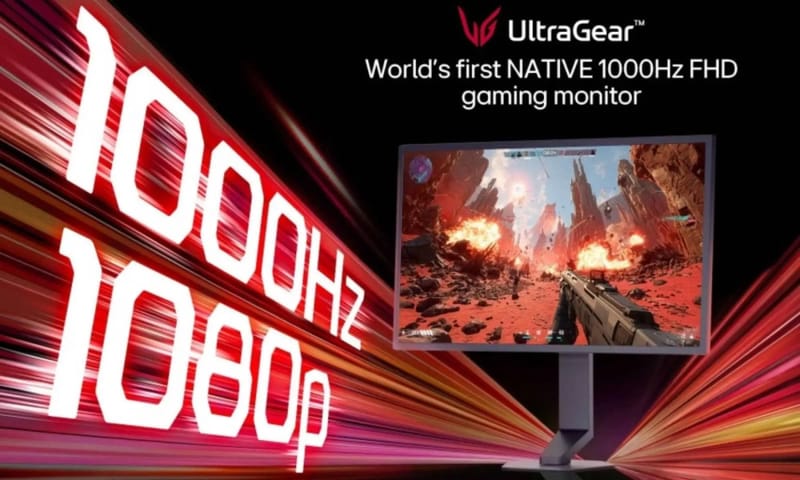
The LG UltraGear 1000Hz monitor, the first of its kind, is not actually built around an LG Display panel. TCL CSOT chief executive Jun Zhao confirmed at the DTC 2026 conference in Wuhan that his company supplies the 24.5-inch FHD IPS panel inside the UltraGear 25G590B, LG’s record-breaking gaming screen.
Key takeaways
- ✓TCL CSOT CEO Jun Zhao confirmed it supplies the IPS panel in LG's UltraGear 25G590B.
- ✓The 24.5-inch FHD panel marks CSOT's first mass-produced 1000Hz LCD.
- ✓Panels come from CSOT's Gen 8.5 T9 LCD fab in Guangzhou, China.
- ✓LG is reportedly weighing 5K and 6K inkjet-printed OLED monitor panels for 2028-2029.
- ✓CSOT's Gen 8.6 T8 inkjet OLED line is installing equipment, targeting Q4 2027 production.
That detail matters because LG has its own in-house display arm, LG Display, which alongside BOE has dominated the IPS LCD segment for years. Choosing an outside supplier for its flagship refresh-rate monitor is a notable shift, and it points to a closer working relationship between the two companies than many expected.
Table of Contents
Why TCL CSOT got the job on the LG UltraGear 1000Hz monitor
According to Zhao, this is the first time TCL CSOT has mass-produced a 1000Hz LCD panel. The panels reportedly roll off its Gen 8.5 T9 LCD fab in Guangzhou, a facility built specifically for high-density, high-speed production runs. Hitting 1000Hz natively on an LCD panel is a genuine manufacturing milestone, since pixel response and signal timing both need to scale well beyond the 240Hz to 360Hz range that still dominates most gaming monitors.
There is also a bit of shared history behind the deal. TCL CSOT operates a second facility, the T10 fab, which it purchased from LG Display. That prior transaction may have smoothed the path toward LG sourcing panels from CSOT for the 25G590B rather than leaning on its own display division or BOE, the other major IPS LCD producer.
For buyers, the origin of the panel inside a monitor rarely changes the day-to-day experience, but it does signal how competitive the supply chain has become. Display makers are increasingly willing to buy from rivals when the technology and capacity line up, rather than sticking strictly to in-house or traditional partners.
Inkjet-printed OLED could be next for LG monitors
The more interesting part of the story is what comes after the 1000Hz LCD. An LG Electronics official at the same event said the company is considering 5K and 6K inkjet-printed OLED panels for future monitors, with a target window of around 2028 to 2029.
Inkjet printing is a different way of building an OLED panel. Instead of evaporating organic material through a fine metal mask, as current OLED monitors do, the process deposits the material directly through nozzles. It is a manufacturing method that promises lower costs and larger panel sizes over time, which explains the interest from both LG and TCL CSOT.
This isn’t the first time inkjet OLED has come up. Earlier reporting detailed TCL CSOT’s plans for 700Hz inkjet-printed OLED panels, also pencilled in for 2028 or 2029. To support that ambition, CSOT’s larger Gen 8.6 T8 Inkjet OLED line in Guangzhou is already installing equipment. Zhao said the T8 line remains on schedule for mass production in the fourth quarter of 2027, giving LG a potential supply source to tap if it commits to the 5K and 6K plan.
LG has stressed that nothing is locked in yet. The company is described as evaluating the idea rather than confirming it, so the 2028-2029 timeline should be treated as a target rather than a release date.
How the numbers stack up
It helps to see the current panel and the proposed future ones side by side, since the jump in resolution and refresh technology is significant.
| Panel | Technology | Resolution | Refresh rate | Status |
|---|---|---|---|---|
| UltraGear 25G590B | IPS LCD | Full HD | 1000Hz | Shipping now |
| TCL CSOT inkjet OLED | Inkjet-printed OLED | Not specified | Up to 700Hz | Targeting 2028-2029 |
| LG 5K/6K inkjet OLED | Inkjet-printed OLED | 5K/6K | Not specified | Under evaluation, 2028-2029 |
The gap between a 1000Hz Full HD IPS panel and a 5K or 6K OLED screen is enormous, both in resolution and in the underlying manufacturing process. That gap is exactly why the shift to inkjet printing matters. Evaporation-based OLED production struggles to scale efficiently to very large, very high-resolution panels, which is part of why true large-format, high-resolution OLED monitors remain rare and typically sit at the premium end of the market, as seen with Alienware’s own 5K OLED gaming monitors.
What this means for gaming monitor buyers
None of this changes what is already on shelves. The LG UltraGear 1000Hz monitor is a real, shipping product built for competitive players who want the lowest possible input lag and smoothest motion handling an LCD can offer. Its TCL CSOT origins don’t affect its specifications or performance.
What it does signal is a broader realignment in how premium gaming panels get made. OLED monitor shipments have been climbing industry-wide, and manufacturers like OLED monitor shipments have been climbing industry-wide as brands race to push refresh rates and resolution simultaneously, something also visible in ASRock’s Taichi OLED monitors hitting up to 720Hz. If LG does commit to 5K and 6K inkjet OLED screens, it would put the company in direct competition with its own supplier for the next generation of high-end displays, a dynamic that could ultimately benefit buyers through faster innovation and more competitive pricing pressure across the panel supply chain.
For now, the takeaway is straightforward. LG’s fastest monitor to date runs on borrowed technology from a rival panel maker, and the next big leap in monitor resolution and speed may well depend on how quickly that same rival can get inkjet OLED production working at scale.
Frequently asked questions
Does TCL CSOT make the panel in LG’s 1000Hz UltraGear monitor?
Yes. TCL CSOT CEO Jun Zhao confirmed at DTC 2026 that the company supplies the 24.5-inch FHD IPS panel used in LG’s UltraGear 25G590B, marking CSOT’s first mass-produced 1000Hz LCD panel.
What is inkjet-printed OLED technology?
It is a manufacturing method that deposits OLED material through nozzles rather than evaporating it through a fine metal mask, a change that can lower production costs and make larger OLED panels more viable.
When will LG release 5K or 6K OLED monitors?
Nothing is confirmed. An LG Electronics official said the company is considering inkjet-printed 5K and 6K OLED monitor panels for around 2028 to 2029, but LG is still evaluating the idea.
Is the LG UltraGear 1000Hz monitor already available?
Yes, the UltraGear 25G590B is already shipping as LG’s native 1000Hz Full HD gaming monitor, independent of the future OLED plans discussed at DTC 2026.