The DLSS 5 launch date is now official: Nvidia has confirmed the AI rendering technology will go live on September 3, arriving first in NBA 2K27 at 9pm PT. It’s a curious pairing given the sports title isn’t typically celebrated for pushing graphical boundaries, but Nvidia says the launch marks the first real-world test of a technology that has divided opinion since its reveal earlier this year.
The announcement follows a leak just days earlier, when the DLSS 5 DLL file surfaced inside NBA 2K27’s game files before Nvidia had said anything official. That leak also gave modders an early chance to try porting the tech onto older hardware, with mixed results. Now that the rollout is confirmed, players will get their first proper look at what Nvidia is calling a major leap for real-time graphics.
Table of Contents
What Nvidia is actually launching
DLSS 5 will be available across all RTX 50 series desktop GPUs, RTX 50 series laptops, and through GeForce Now streaming, but it stops there. Older cards, including the RTX 40 series and everything before it, are not officially supported. That’s a notable line in the sand, especially for owners of relatively recent cards like the ASUS Dual GeForce RTX 4060, which will miss out despite still being a capable performer for most modern games.
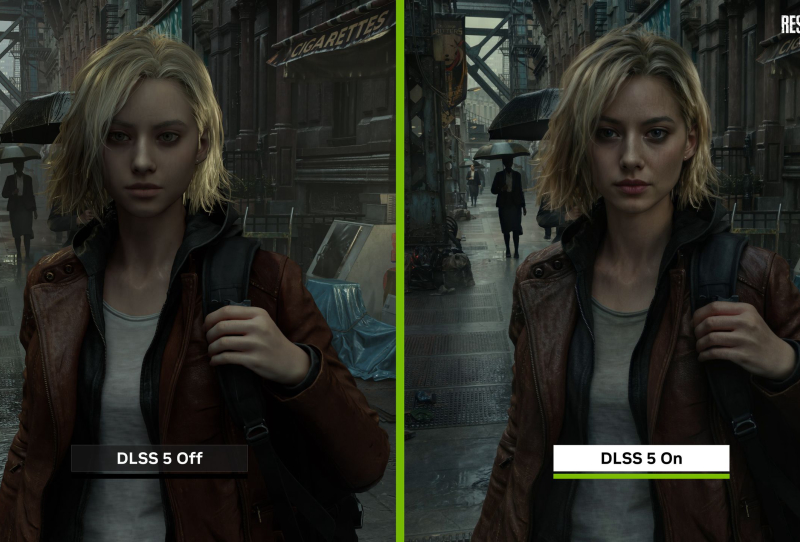
Nvidia has worked directly with NBA 2K27 developer Visual Concepts and publisher 2K to build the feature into the game, describing the goal as delivering “a new level of authentic sports experience for its players.” The company’s own technical name for the underlying tech is 3D-guided Neural Rendering, and it’s designed to render lighting on skin, hair, and facial detail more naturally, while keeping the facial geometry scanned from real athletes intact.
Why DLSS 5 has proven controversial
DLSS 5 differs from earlier versions of Nvidia’s upscaling suite because its AI model doesn’t just fill in frames, it infers how complex scene elements such as characters, hair, and lighting “should” look based on inputs from the game engine, including colour buffers and motion vectors. That’s a deeper integration with a game’s actual assets than typical generative AI image tools, which in theory should make results more consistent and predictable.
Not everyone is convinced. Critics have raised concerns about the premise since DLSS 5 was first revealed, questioning how much creative control developers retain when an AI model is shaping so much of the final image. Nvidia CEO Jensen Huang has leaned into the ambition rather than away from it, calling DLSS 5 “the GPT moment for graphics, blending hand-crafted rendering with generative AI to deliver a dramatic leap in visual realism while preserving the control artists need for creative expression.”
NBA 2K27 will be the first shipping game where players can judge those claims for themselves, rather than relying on Nvidia’s own demos and marketing.
The benchmarks Nvidia has shared so far
Alongside the launch date, Nvidia released its first in-house benchmark figures for DLSS 5 running on RTX desktop hardware. The results should be read cautiously, since they cover only one game and come directly from the company promoting the feature, but they do hint at how demanding the technology is.
| GPU | Resolution tested | Notes |
|---|---|---|
| RTX 5090 | 4K | Highlighted as flagship-tier result |
| RTX 5080 | 4K | Only 4K figures shared |
| Lower-tier RTX 50 cards | Below 4K | Tested at reduced resolutions only |
Nvidia’s decision to only publish 4K numbers for the 5090 and 5080 is telling. It suggests the company expects diminished results further down the stack, since less powerful cards were apparently tested at lower resolutions rather than 4K. That lines up with earlier reporting on DLSS 5’s performance on older Ampere GPUs, where modders running unofficial ports saw frame rates suffer noticeably compared with officially supported hardware.
What it means for RTX owners and the wider market
For anyone shopping for a new graphics card, the DLSS 5 launch date adds another factor to weigh alongside raw performance and price. Owners of cards like those in GIGABYTE’s RTX 40 Super series cards will be locked out of the feature entirely, at least officially, which could push some buyers toward RTX 50 series hardware sooner than planned.
It also sets up a genuinely interesting test case for the games industry more broadly. Sports titles rarely lead the way on cutting-edge graphics technology, so NBA 2K27 becoming the debut vehicle for Nvidia’s most ambitious rendering claims is unusual. Whether DLSS 5 lives up to Huang’s framing, or whether the performance cost proves too steep for mainstream adoption, should become clear quickly once players outside Nvidia’s own marketing team get their hands on it from September 3.
Until then, the benchmarks remain a preview rather than proof, and the real verdict will come from how the feature performs once it’s running on ordinary hardware in ordinary living rooms, not in a controlled demo built to make the technology look its best.