Maxsun has rolled out three new Maxsun B850 microATX motherboards aimed at AMD Ryzen desktop builders who want a compact AM5 platform without giving up expansion. The trio, named MS-B850M I-CAFE, B850M-P WIFI and B850M-B WIFI, all target the same chipset but land at noticeably different price and feature points once wireless networking and memory capacity are factored in. None of them have an official Australian price yet, but the specification sheets alone tell a useful story about where budget AM5 boards are heading in late 2025.
All three share the same microATX form factor and AM5 socket, so any current Ryzen desktop chip that supports the B850 chipset should drop straight in. Where they diverge is memory capacity, wireless support and rear I/O, which matters more than it might sound for anyone planning a small form factor build or a home server that still wants gaming-grade PCIe lanes.
Table of Contents
What each Maxsun B850 microATX motherboard actually offers
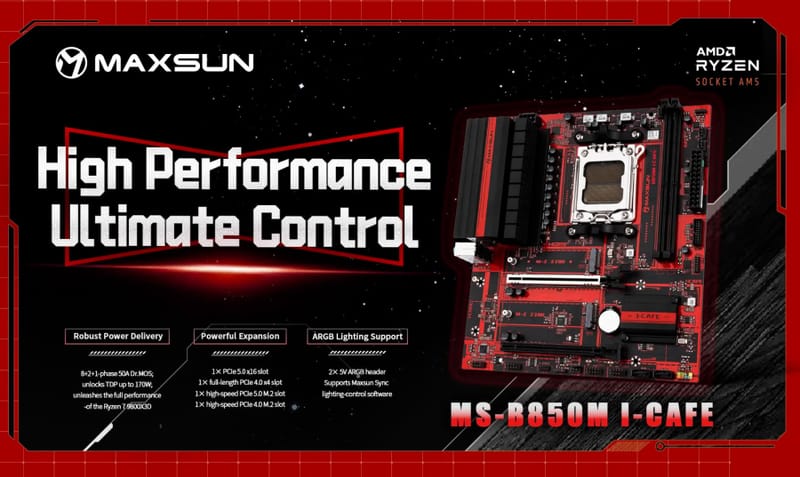
The entry point, the MS-B850M I-CAFE, measures 245 x 210 mm and sticks to two DDR5 DIMM slots, supporting up to 128 GB of memory at DDR5-8000 with overclocking. It gets one PCIe 5.0 x16 slot alongside a PCIe 4.0 x4 slot, two M.2 slots split between PCIe 5.0 and PCIe 4.0, and two SATA ports for anyone still running spinning drives or older SSDs. Networking is handled by 2.5 GbE only, with no Wi-Fi module fitted, and integrated graphics output is limited to a single HDMI 1.4 port. Rear USB is modest too, with four USB 5 Gbps ports and two USB 2.0 Type-A ports rounding things out.

The two Challenger-branded boards, B850M-P WIFI and B850M-B WIFI, share most of their internals. Both carry a PCIe 5.0 x16 slot plus a PCIe 4.0 x4 slot, two M.2 slots, two SATA ports, 2.5 GbE, and a MediaTek MT7902 module delivering Wi-Fi 6 and Bluetooth 5.2. Both also add a USB-C 20 Gbps front panel header alongside four USB 5 Gbps and four USB 2.0 ports on the rear, a noticeably richer I/O spread than the I-CAFE model. For display output from integrated graphics, both Challenger boards step up to HDMI 2.0 and dual DisplayPort connections capable of 4K at 60 Hz.
Where the two Challenger boards genuinely differ is size and memory ceiling. The B850M-P WIFI is the larger of the pair at 245 x 245 mm, with four DIMM slots supporting up to 256 GB of DDR5, making it the obvious pick for anyone running memory-heavy workloads or simply wanting headroom for future upgrades. The B850M-B WIFI trims things back to 245 x 215 mm and two DIMM slots capped at 128 GB, a sensible trade-off for a tighter case build where four-slot boards do not physically fit. All three motherboards use a Realtek ALC897 audio codec for onboard sound, a common and reliable choice at this price tier rather than anything premium.
Specifications at a glance
| Model | Size | Memory | Wi-Fi | Rear USB | Display (iGPU) |
|---|---|---|---|---|---|
| MS-B850M I-CAFE | 245 x 210 mm | 2x DDR5, up to 128 GB | None | 4x 5 Gbps, 2x USB 2.0 | HDMI 1.4 |
| B850M-P WIFI | 245 x 245 mm | 4x DDR5, up to 256 GB | Wi-Fi 6, BT 5.2 | 4x 5 Gbps, 4x USB 2.0 | HDMI 2.0, dual DP 4K60 |
| B850M-B WIFI | 245 x 215 mm | 2x DDR5, up to 128 GB | Wi-Fi 6, BT 5.2 | 4x 5 Gbps, 4x USB 2.0 | HDMI 2.0, dual DP 4K60 |
How the Maxsun B850 microATX motherboards compare to established rivals
Maxsun is a less familiar name in Australia than ASRock, ASUS or Gigabyte, but the specification sheet on these boards reads competitively against known quantities. Boards such as ASRock’s B850 Steel Legend WiFi and ASRock’s Phantom Gaming B850 Riptide WiFi offer similarly featured PCIe 5.0 and Wi-Fi 6 packages, though typically at a higher price point given their brand recognition and additional VRM refinement. The ASUS ROG Strix B850-A Gaming WiFi sits in a similar bracket again, aimed at buyers who want RGB styling and a fuller feature set alongside the core AM5 platform.
What sets the Maxsun boards apart is the sheer memory bandwidth on offer relative to their likely price. DDR5-8000 with overclocking is a genuinely high figure for a budget board, and pairing one with something like G.SKILL’s Flare X5X DDR5 kits would let a builder actually chase those rated speeds rather than settling for stock JEDEC timings. That said, hitting DDR5-8000 in practice depends heavily on the specific Ryzen chip’s memory controller and the quality of the DIMMs used, so it is worth treating that figure as a ceiling rather than a guarantee.

What this means for AM5 builders
The absence of confirmed pricing outside China makes it hard to say definitively how good value these boards are for Australian buyers. The B850M-P WIFI has reportedly appeared on the Chinese market at roughly CNY 799, which converts to around $119 USD at current exchange rates, though that figure has not been officially confirmed by Maxsun and local pricing, once it arrives, could differ substantially due to shipping, taxes and retailer margins.
Still, the broader signal here matters more than any single number. AMD’s Ryzen desktop platform continues to attract smaller motherboard manufacturers chasing the budget microATX segment, and that competition tends to push established brands toward sharper pricing too. For anyone planning a compact Ryzen build who doesn’t need premium VRM cooling or extensive RGB, keeping an eye on how Maxsun’s lineup performs once it reaches wider retail, and what independent reviewers find under sustained load, would be a sensible step before committing. Full details and regional availability can be tracked through Maxsun’s official site as the launch progresses.
For now, these three boards give AM5 shoppers a wider spread of options than before: a Wi-Fi-free bargain model, a compact Wi-Fi 6 board for tight cases, and a four-DIMM Wi-Fi 6 option for those who want maximum memory headroom without stepping up to a full ATX board.