
High Availability has become an essential consideration for businesses that rely on digital infrastructure to keep operations running smoothly. Unexpected downtime can disrupt services, compromise data, and cause setbacks that are difficult to recover from without a solid continuity plan in place. QNAP’s High Availability Manager offers an effective solution by creating an environment where services remain uninterrupted, even during hardware failures.
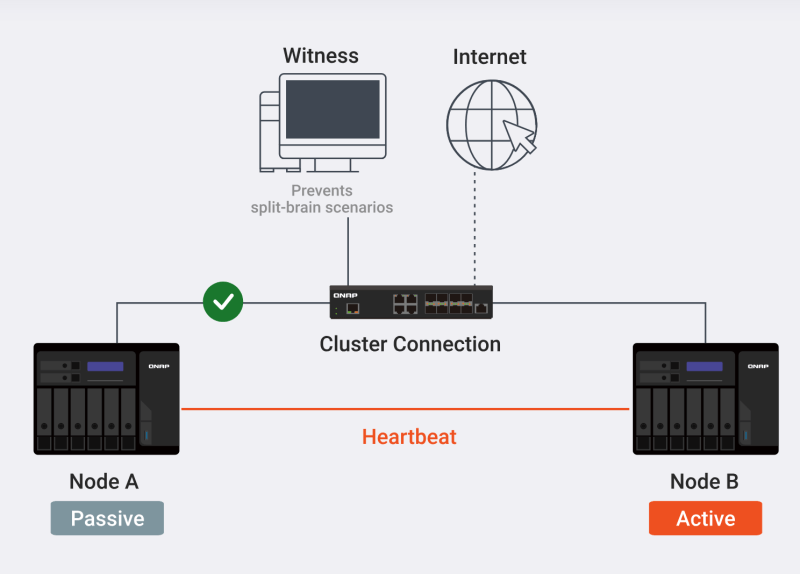
The concept behind High Availability is straightforward yet powerful. By pairing two QNAP NAS devices into a cluster, one acts as the active server handling all operations, while the other functions as a passive backup ready to take over. This arrangement ensures that if one system experiences issues, the other seamlessly steps in to keep everything operational.
This approach is not limited to large enterprises but is designed to be accessible for smaller organisations and professional users as well. With QNAP making the setup user-friendly and efficient, businesses can strengthen their disaster recovery strategies without unnecessary complexity. The result is a more resilient IT environment that reduces risks and provides greater confidence in day-to-day operations.

The Importance of High Availability
Modern organisations depend on uninterrupted access to their digital systems to maintain efficiency and meet customer expectations. Any period of downtime, whether caused by hardware failure, system crashes, or unexpected disruptions, can result in lost productivity and potentially harm business reputation. High Availability is designed to mitigate these risks by providing an environment where services remain consistently accessible.
Implementing an HA solution ensures that core business functions such as data storage, application services, and communication platforms remain operational, even when unexpected issues occur. This not only supports business continuity but also strengthens disaster recovery strategies by reducing the likelihood of data loss. Regardless of industry or company size, minimising downtime is a priority for organisations that rely heavily on their IT infrastructure.
With High Availability, businesses can maintain reliable access to critical resources while reducing financial losses associated with outages. Service interruptions that once might have caused extended downtime can now be resolved almost instantly through automated failover systems. The result is a more dependable digital environment that safeguards productivity and instils confidence in both staff and customers.
How QNAP’s High Availability Works
QNAP’s High Availability Manager is built around the concept of creating a cluster of two NAS systems. One NAS operates as the active server, carrying out all data processing and service delivery, while the other remains in a passive role, synchronising data in real time and preparing to take over when required. This architecture ensures that services remain available without manual intervention if the active system encounters issues.
In the event of a failure, the passive NAS automatically steps in through a process known as failover. This transition happens quickly, maintaining service continuity and ensuring users experience minimal disruption. The switch is designed to take less than a minute, offering both speed and reliability in critical moments.
This dual-server setup provides a powerful safeguard against data loss and downtime. By continuously replicating information and settings between the two systems, organisations gain assurance that operations will not grind to a halt during unforeseen outages. It is a practical approach to achieving resilience without adding unnecessary complexity to IT management.
Simplified Cluster Management
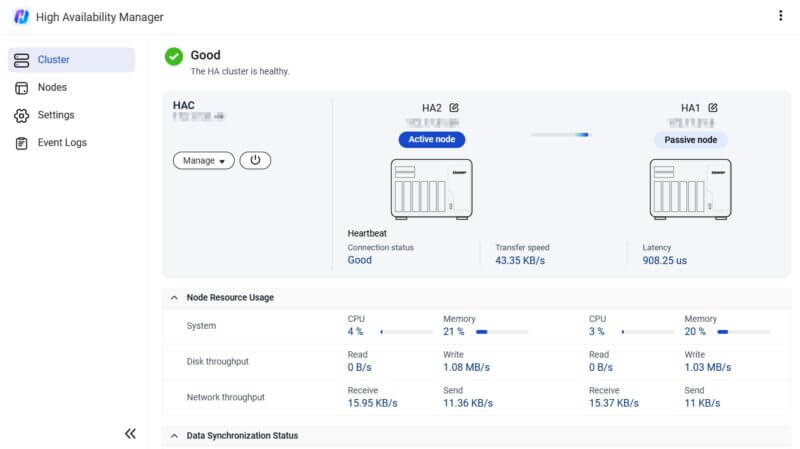
Managing a High Availability cluster may sound complex, but QNAP has streamlined the process with its dedicated High Availability Manager application. This tool provides administrators with an intuitive interface for setting up clusters, making adjustments, or rebuilding systems if required. The result is an approachable system that removes the steep learning curve often associated with enterprise-level redundancy solutions.
The application also includes monitoring features that give clear visibility into the health of both active and passive servers. Administrators can track hardware status, transmission speeds, and latency to ensure performance remains stable and reliable. This level of oversight allows for proactive management, helping identify potential issues before they cause service interruptions.
By combining simple configuration with effective monitoring, businesses can manage their HA clusters without the need for specialised expertise. It becomes possible for organisations of all sizes to maintain a highly resilient IT environment. QNAP’s design focus ensures that High Availability is not just powerful but also practical to implement and maintain.
Data Protection with SnapSync
An essential part of any High Availability setup is ensuring that data remains consistent and up to date across all systems. QNAP addresses this need through its SnapSync technology, which enables real-time replication between the active and passive NAS. This ensures that both servers maintain identical data sets, minimising the risk of loss if a failover occurs.
SnapSync operates continuously, monitoring changes and synchronising them as they happen. This approach supports a low Recovery Point Objective by reducing the amount of data that could potentially be lost during a failure. It is a valuable tool for organisations that prioritise data integrity and require up-to-date information to be available at all times.
The system’s foundation in ZFS storage adds another layer of reliability. Known for its robust data protection features, ZFS works with SnapSync to provide a dependable and efficient replication process. Together, these technologies help create a storage environment where data consistency is maintained without sacrificing performance or accessibility.
Ensuring Business Continuity
Service uptime is one of the most critical requirements for any organisation that relies on digital infrastructure. QNAP’s High Availability design provides the ability for the passive NAS to take over within seconds if the active server encounters a problem. This rapid switch helps achieve a low Recovery Time Objective, keeping downtime to a minimum and ensuring staff and clients can continue working without disruption.
The ability to maintain operations even during hardware failures gives organisations confidence in their disaster recovery planning. Instead of waiting for lengthy manual interventions, the automated failover process guarantees services remain available almost immediately. This level of protection is particularly important for businesses running around-the-clock operations or those delivering customer-facing services.
By maintaining data availability and keeping systems online, High Availability strengthens the resilience of core business functions. It prevents interruptions that could otherwise damage productivity or reputation, offering a foundation for seamless and reliable operations. For industries where continuous access to data and services is vital, the benefits of uninterrupted continuity are substantial.

Use Cases Across Industries
High Availability is valuable across a wide range of business environments where uninterrupted access to data and services is critical. For companies using NAS as a central file server, QNAP’s solution ensures employees can continue collaborating without delays, even if one system encounters an unexpected fault. This uninterrupted access keeps workflows smooth and helps maintain productivity in day-to-day operations.
In virtualised environments that rely on iSCSI IP-SAN storage, QNAP High Availability provides continuous access to essential data. By ensuring storage services remain online, businesses can protect applications and systems that depend on consistent performance. This is especially important for organisations running multiple virtual machines or managing sensitive workloads.
High Availability also plays a key role in supporting AI-driven applications that rely on fast and reliable storage. By managing automatic failover without requiring manual input, QNAP ensures that AI servers continue operating through hardware failures. This makes it easier for organisations to integrate advanced technologies with the confidence that their data infrastructure can keep up.
System Requirements and Supported Models
To set up QNAP’s High Availability Manager, two identical NAS systems are required to create a cluster. One device acts as the active server, while the second takes the role of the passive server, mirroring operations and data in real time. This arrangement provides a dependable foundation for maintaining service continuity during hardware issues.
Each NAS must run QuTS hero version h5.3 or later and be equipped with at least 8 GB of memory. These specifications ensure that both systems can manage synchronisation, replication, and failover tasks effectively without affecting performance. By meeting these requirements, organisations can deploy a stable and reliable HA environment.
QNAP offers broad model compatibility for High Availability setups, covering both desktop and rackmount solutions. Supported models include:
- TVS-h874T, TVS-h674T, TVS-h874, TVS-h674, TVS-h474, TBS-h574TX
- TS-h3077AFU, TS-h1677AXU-RP, TS-h1277AXU-RP, TS-h1277AFX
- TS-h3087XU-RP, TS-h2287XU-RP, TS-h1887XU-RP, TS-h987XU-RP
- TVS-h1688X, TVS-h1288X
- TDS-h2489FU, TDS-h2489FU R2
- TS-h2490FU, TS-h1090FU, TS-h1290FX
- TVS-675, TS-h1886XU-RP R2, TS-h886
This extensive range allows businesses to choose hardware that matches their requirements, while still taking advantage of the same advanced High Availability features. Whether for small offices or large-scale enterprise environments, QNAP provides flexibility in deployment without compromising reliability.

Building a Resilient IT Strategy with QNAP
Creating a resilient IT strategy involves more than simply storing data securely; it requires ensuring that services remain accessible no matter what challenges arise. QNAP’s High Availability Manager delivers this by combining hardware redundancy, real-time synchronisation, and automated failover into one comprehensive solution. Businesses are able to continue operating with confidence, knowing that disruptions are minimised.
By integrating High Availability into their infrastructure, organisations reduce the risks associated with downtime and data loss. The ability for the passive server to take over instantly allows staff to keep working, customers to stay connected, and operations to continue running smoothly. This reliability is a cornerstone for industries where constant access to digital resources is essential.
The flexibility of QNAP’s supported models means that High Availability is not limited to large enterprises. Small and medium-sized organisations can also implement this technology to protect critical services and data. In doing so, they strengthen their disaster recovery strategies while ensuring scalability for future growth.
QNAP’s approach to High Availability offers a balance of accessibility and robustness that suits a wide range of business needs. By adopting this technology, companies can establish a more dependable IT foundation, one that supports long-term success and provides peace of mind in an increasingly data-driven world.
