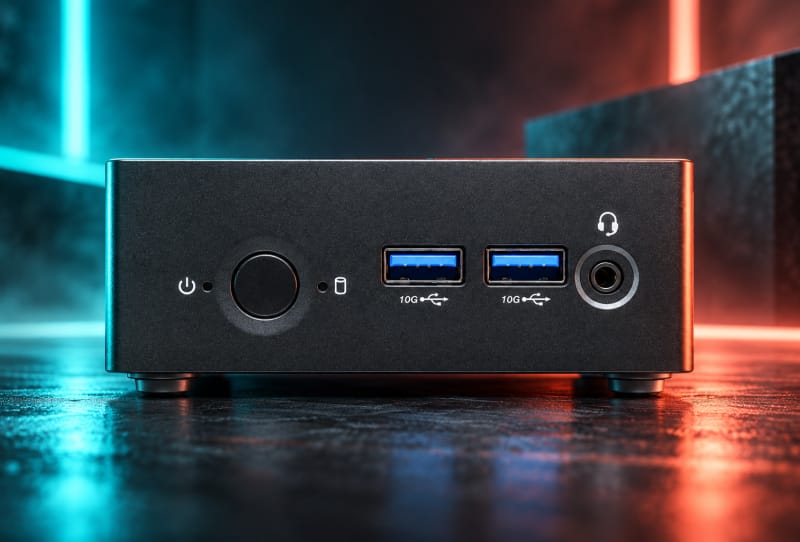
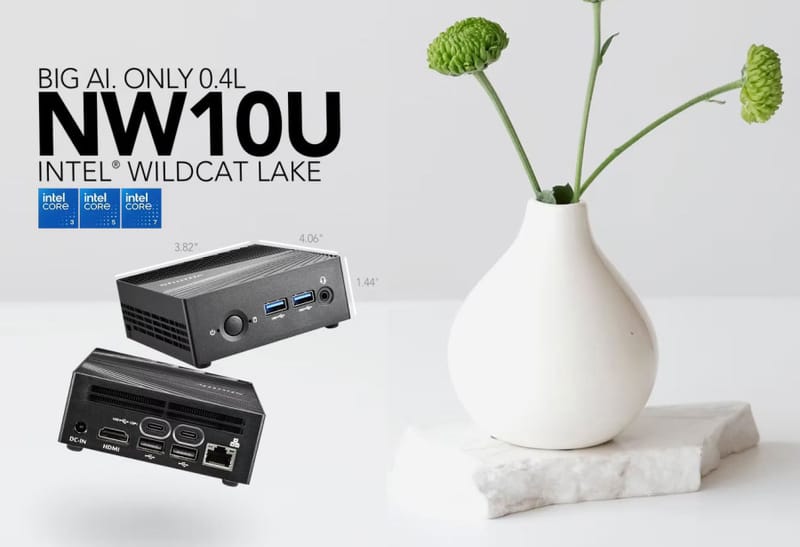
Shuttle has released the NW10U, a mini PC small enough to fit in the palm of a hand yet built around Intel’s latest low-power “Wildcat Lake” chips. The whole system measures just 103 x 97 x 36.5mm, works out to a volume of only 0.4 litres, and still manages to pack in up to 64GB of DDR5 memory, dual NVMe storage and a full suite of modern ports.
Key takeaways
- ✓The Shuttle NW10U mini PC measures just 103 x 97 x 36.5mm with a volume of 0.4 litres.
- ✓It runs Intel Wildcat Lake Core 3, Core 5 or Core 7 chips at a 15W TDP.
- ✓Memory tops out at 64GB of DDR5-6400, paired with two M.2 2280 PCIe 4.0 NVMe slots supporting RAID 0 or RAID 1.
- ✓Display output covers one HDMI 2.1 port and two USB-C ports with DisplayPort 2.1, plus six USB ports and Gigabit Ethernet.
- ✓The system is rated for continuous 24/7 operation between 0°C and 50°C and can be VESA-mounted behind a monitor.
That combination of size and specification is the real story here. Mini PCs have been shrinking for years, but the Shuttle NW10U Mini PC pushes further than most of its rivals while keeping support for business-grade reliability features like RAID storage and round-the-clock operation. It is aimed squarely at desks, kiosks, digital signage and home offices where a full-sized tower simply isn’t welcome.
Table of Contents
What’s powering the Shuttle NW10U Mini PC
Inside, Shuttle offers a choice of Intel Core 3, Core 5 or Core 7 processors from the Wildcat Lake family, all running at a 15W TDP. That low power envelope is a deliberate choice. It keeps heat and noise down in a chassis this small, while still giving buyers a tier of performance options depending on whether the machine needs to handle light office work or more demanding multitasking.
Memory tops out at 64GB of DDR5-6400, which is a generous ceiling for a system this compact and should be enough headroom for virtualisation, multiple browser-heavy workloads or running several lightweight servers at once. Cooling comes from an active heat-pipe design paired with what Shuttle calls Smart Fan technology, which adjusts fan speed dynamically rather than running at a fixed rate regardless of load.
Compact design with surprisingly broad connectivity
Despite its size, the NW10U doesn’t skimp on ports. Display output includes one HDMI 2.1 connection alongside two USB-C ports that carry DisplayPort 2.1, meaning buyers can realistically run up to three displays from the one unit. Six additional USB ports and Gigabit Ethernet cover the rest of the day-to-day connectivity needs.
A third M.2 2230 E-Key slot is reserved for an optional wireless module, so networking can be upgraded to Wi-Fi and Bluetooth without touching the main storage bays. Shuttle also includes VESA mounting hardware supporting both 75 x 75mm and 100 x 100mm patterns, letting the whole machine disappear behind a monitor rather than sitting on the desk at all.
Storage, expansion and always-on reliability
Storage expansion runs through two M.2 2280 slots, both supporting PCIe 4.0 NVMe SSDs, with RAID 0 and RAID 1 configurations available for buyers who want either extra speed or data redundancy. That’s a meaningful inclusion for a mini PC this size, since RAID support is often reserved for larger desktop builds.
Shuttle has also built in a set of features aimed at unattended or always-on deployments. Firmware TPM 2.0 covers security requirements, while RTC power-on scheduling, automatic startup after a power loss, Modern Standby and Wake-on-LAN support make the NW10U suitable for remote management. The system carries a rating for continuous 24/7 operation across an ambient temperature range of 0°C to 50°C, which points squarely at commercial and industrial use cases rather than casual home computing alone.
| Configuration | Processor | Memory | Storage |
|---|---|---|---|
| Good | Core 3 304 | 8GB DDR5 | 512GB NVMe SSD |
| Better | Core 5 320 | 16GB DDR5 | 1TB NVMe SSD |
| Best | Core 7 350 | 32GB DDR5 | 1TB NVMe SSD |
How it stacks up against other mini PCs
Wildcat Lake is Intel’s newer entry-level mobile platform, and its chips have already proven popular elsewhere. Demand for Intel’s budget Wildcat Lake laptop chips was strong enough that supply reportedly sold out shortly after launch, which suggests the platform is in genuine demand rather than a niche curiosity.
Against rivals, the NW10U sits in a crowded but growing field. Systems such as Tuxedo’s Nano Pro Gen15 mini PC and GIGABYTE’s BRIX mini PC chase similar goals of small footprint and capable performance, though neither matches the NW10U’s 0.4-litre volume. For buyers after more raw horsepower rather than efficiency, mini PCs built for heavier workloads, like the Bosgame M5 MAX, show just how differently this category can be configured depending on the target audience.
What sets the Shuttle NW10U Mini PC apart is the mix of industrial-style reliability features with genuinely tiny dimensions. Few competitors offer RAID-capable dual NVMe storage, a wide operating temperature range and VESA behind-monitor mounting in a chassis this small, which makes it a sensible fit for point-of-sale terminals, signage controllers and compact office desktops alike.
Frequently asked questions
What processors does the Shuttle NW10U Mini PC use?
It uses Intel’s Wildcat Lake platform, available with Core 3, Core 5 or Core 7 processors, all running at a 15W thermal design power.
How much storage can the NW10U hold?
It has two M.2 2280 slots supporting PCIe 4.0 NVMe SSDs, with RAID 0 and RAID 1 configurations available for either faster speeds or data redundancy.
Can the Shuttle NW10U be mounted behind a monitor?
Yes. Shuttle includes VESA mounting hardware compatible with both 75 x 75mm and 100 x 100mm patterns, letting the unit sit out of sight behind a display.
Is the NW10U suitable for always-on use?
It is rated for continuous 24/7 operation across an ambient temperature range of 0°C to 50°C, and includes features like RTC power-on scheduling and automatic restart after a power loss for unattended deployments.